


Signs of a Well-Made Wooden Table: The Connoisseur’s Checklist
Is the heavy, lustrous dining table you've been admiring a true masterwork of nature, or simply a clever illusion of luxury? It's a common anxiety to fear paying a premium for mass-produced composites, making it essential to recognize the signs of a well-made wooden table before you commit. You deserve a home that feels like a sanctuary, anchored by pieces that reflect your appreciation for genuine quality and enduring beauty.
Identifying these hallmark indicators of artisanal craftsmanship ensures your next purchase is a timeless investment rather than a temporary fixture. We'll show you how to look past the surface finish to find the integrity of traditional joinery and the tactile depth of solid timber. This guide simplifies technical terms, helping you distinguish between fleeting trends and heirloom quality. By the end, you'll have the confidence to select furniture that brings both internal balance and a sense of refined heritage to your private world.
Key Takeaways
- Distinguish between fleeting veneers and the structural soul of solid timber to ensure your furniture remains a legacy piece for decades.
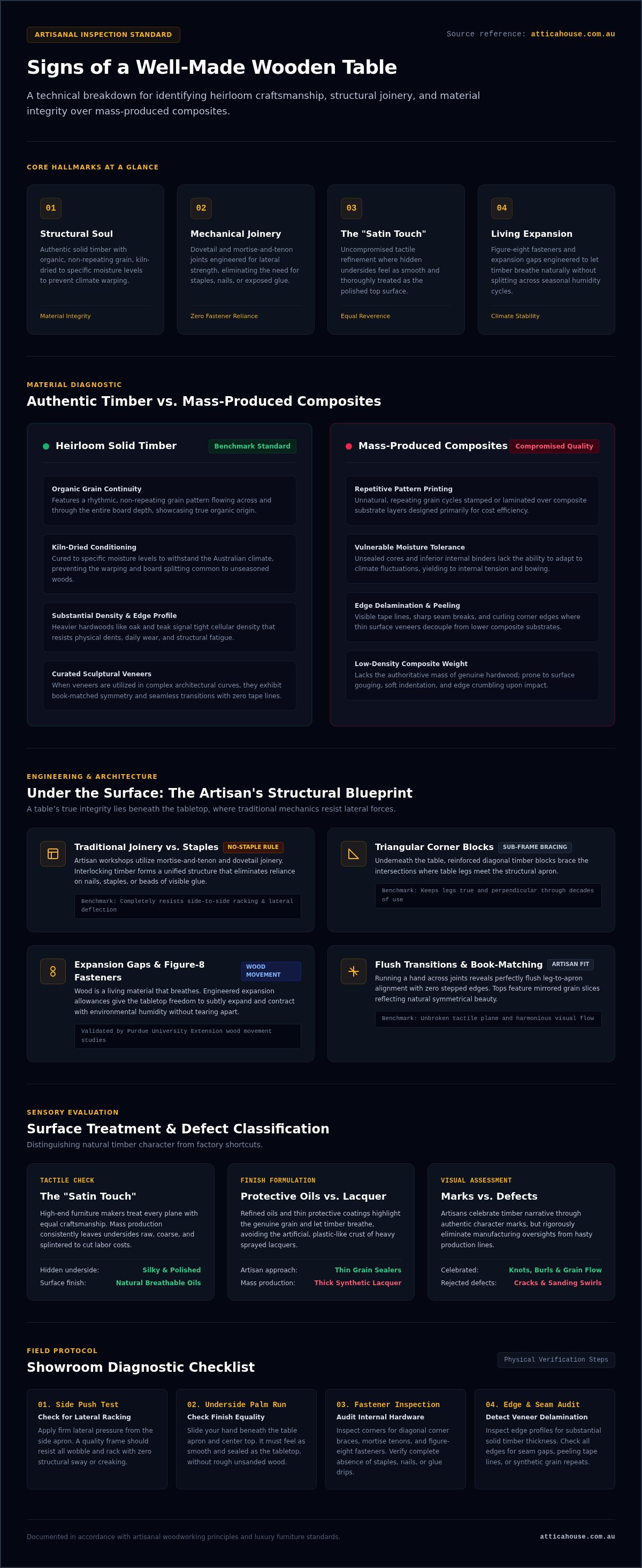
- Recognize the signs of a well-made wooden table by identifying traditional joinery like dovetail and mortise-and-tenon joints, which provide strength without the need for staples or visible glue.
- Experience the importance of tactile refinement; a high-quality table should feel as smooth on its hidden undersides as it does on its polished surface.
- Master the art of selection by choosing a piece with the correct scale and proportion to anchor your room and foster a sense of internal balance.
The Foundation of Quality: Material Integrity and Timber Selection
True luxury begins with the raw material. While solid wood offers unparalleled longevity, engineered wood is often a composite of layers designed for cost efficiency. When looking for the signs of a well-made wooden table, the visual depth of the grain is your first clue. Authentic hardwood displays a rhythmic, non-repeating pattern that flows through the entire board. High-end timber must be kiln-dried to specific moisture levels. This process ensures the wood remains stable despite changes in the Australian climate, preventing the warping or splitting that plagues lesser furniture.
Look closely at the table's edge. A substantial timber thickness suggests a piece built for the long term. This structural integrity is often reinforced by traditional mortise and tenon joinery, which provides a level of stability that mechanical fasteners simply can't match. It's the difference between a table that feels solid under your touch and one that doesn't yield to pressure.
Solid Timber vs. High-End Veneers
Solid wood is the gold standard for dining tables, yet some complex, sculptural designs utilize high-end veneers for added stability over large surfaces. You can spot the difference by checking the edges. Cheap veneers often show repeating grain patterns, peeling corners, or visible tape lines. A masterfully applied veneer features seamless transitions and grain matching that honors the wood's natural growth.
The Weight of Excellence
Density is a tactile promise of quality and one of the clearest signs of a well-made wooden table. Heavier hardwoods like oak or teak signal a tight grain structure that resists dents and wear. Heirloom quality refers to furniture designed with such structural excellence that it's intended to serve multiple generations.
The Artisan’s Mark: Joinery and Structural Precision
The soul of a table lies in its construction. One of the most telling signs of a well-made wooden table is the "No-Staple" rule. Artisans avoid nails, staples, or beads of visible glue, opting instead for mechanical strength. High-end furniture relies on dovetail and mortise-and-tenon joints. These techniques ensure that the piece remains a singular, unified structure for decades. To test this integrity, perform a stability check. Gently push the table from the side. A quality frame should resist "racking" or lateral movement entirely. For those seeking deeper insight into high-end curation, The Ultimate Guide to Luxury Furniture in Australia offers a broader perspective on creating a sanctuary.
Under the Surface: What to Look for Beneath the Tabletop
True quality is often hidden. Inspect the underside for corner blocks, which are triangular braces that reinforce where the legs meet the apron. These ensure the legs stay true despite years of use. You should also look for expansion gaps or figure-eight fasteners. These components are vital because wood is a living material. According to Purdue University Extension's analysis of wood movement in furniture, timber naturally expands and contracts with humidity. Without these features, a tabletop may eventually split or warp.
Seamless Transitions
Run your hand along the joints. A flush connection where the leg meets the apron is a sign of precision. You'll also notice the art of "book-matching" in the grain. This involves aligning timber slices so the patterns mirror each other across the surface. It creates a rhythmic, symmetrical beauty that feels intentional. When you explore our curated dining tables, you'll find these marks of excellence have already been vetted for your peace of mind.
The Tactile Experience: Finish and Surface Refinement
A table's finish is its final conversation with the room. One of the most sensory signs of a well-made wooden table is what artisans call the "Satin Touch." This refers to a surface that feels as smooth on the hidden underside as it does on the top. Mass-produced pieces often neglect these unseen areas, leaving them rough or unfinished. In contrast, a connoisseur's piece treats every inch with equal reverence. High-end finishes avoid the "plastic-looking" thick lacquers that mask the wood's soul. Instead, refined oils and thin, protective coatings are used to highlight the natural grain. This ensures the color remains consistent across the legs, apron, and tabletop, creating a harmonious visual flow. Identifying these signs of a well-made wooden table allows you to invest in a piece that ages gracefully.
Natural Imperfections vs. Manufacturing Defects
High-end makers celebrate the timber's story. You should distinguish between "character marks," like knots or burls, and manufacturing defects. Cracks that compromise the structure or visible sanding swirls are signs of rushed production. According to research from the USDA Forest Products Laboratory, the choice of finishing materials significantly impacts the long-term durability and moisture resistance of hardwoods. A superior finish doesn't just protect; it enhances the timber’s natural luminescence, making the wood appear to glow from within.
Protective Coatings for Modern Living
Modern living requires a balance between beauty and resilience. A well-refined surface must withstand the occasional heat of a coffee cup or the moisture of a chilled glass. These standards of tactile excellence extend beyond the dining room. If you're applying these quality checks to smaller pieces, explore our Luxury Bedroom Ideas for insight into selecting the perfect bedside table. To find a piece that meets these rigorous standards, shop our curated collection of luxury wooden tables today.
Curating Your Sanctuary: Selecting a Table That Endures
Choosing a table is an act of intention. It is the anchor of your room's emotional resonance, especially when selecting statement dining tables that serve as the heart of your home. Scale and proportion are vital; a piece must breathe within its environment to create a sense of calm and refuge. The Attica House philosophy is rooted in this delicate balance, ensuring that beauty and comfort coexist without compromise. When you understand the signs of a well-made wooden table, you move beyond mere consumption and into the art of meaningful curation.
Finding Your Design Language
Whether your aesthetic leans toward sculptural buffets or minimalist coffee tables, the fundamental quality markers remain unchanged. Integrating global design sensibilities with timeless craftsmanship allows you to create a space that feels both modern and rooted. Look for pieces that honor the timber’s natural narrative while maintaining a polished, intentional silhouette. This synergy of form and function is what transforms a house into a refined sanctuary that reflects your personal story.
The Art of Selection
Purchasing from a refined curator provides a pre-vetted standard of excellence, removing the anxiety of hidden defects or mass-produced substitutes. Before you make your final decision, revisit this connoisseur’s checklist:
- Material: Is it kiln-dried solid timber or high-quality, stable veneer?
- Joinery: Are there traditional joints like mortise-and-tenon instead of staples?
- Finish: Does the surface feel smooth and look luminous rather than plastic?
- Feel: Is the piece heavy, stable, and free from lateral movement?
By checking for these signs of a well-made wooden table, you ensure your investment is one that lasts for decades. To find your next heirloom piece, explore our curated collection of luxury dining tables and discover the difference of true artisanal quality.
Investing in a Legacy of Design
A wooden table is more than a surface for daily life; it's a silent witness to your most cherished moments. By mastering the signs of a well-made wooden table, you move beyond surface aesthetics to find the structural soul of your home. You now know to look for the strength of traditional joinery, the stability of kiln-dried timber, and the tactile refinement of a hand-applied finish. These specific details distinguish a temporary fixture from a true heirloom.
At Attica House, we believe that luxury resides in these quiet details. Our expertly curated collection features statement pieces that blend timeless beauty with the comfort of modern living. We provide Australia-wide delivery for our statement pieces, ensuring your sanctuary anchor arrives with the quality assurance you expect. Curate your dining sanctuary with Attica House and embrace a world where craftsmanship meets comfort. Your home is a reflection of your story, and you're now equipped to choose pieces that tell it beautifully for generations to come.
Frequently Asked Questions
Is solid wood always better than veneer for a dining table?
Solid wood is the gold standard for longevity, but high-quality veneers are often a deliberate choice for structural stability in complex, sculptural designs. While solid timber allows you to sand and refinish a piece over decades, a premium veneer on a stable core prevents warping in expansive surfaces. You should avoid thin, mass-produced veneers that peel at the edges, as these lack the integrity of artisanal craftsmanship.
How can I tell if a table uses mortise and tenon joinery?
Look for a rectangular tenon end that fits into a corresponding hole, or mortise, in the connecting piece. This technique is one of the most reliable signs of a well-made wooden table. You'll often find these joints where the legs meet the table's apron. If the connection is flush and resists any lateral movement without the use of visible screws or staples, you've found a piece built with structural precision.
What are the best types of wood for a high-quality table in Australia?
Dense hardwoods like Oak, Teak, and Walnut are ideal for the varied Australian climate. These species offer superior resistance to dents and provide the weight necessary for a stable, high-end feel. When selecting timber, ensure it's been properly kiln-dried. This process stabilizes the wood's moisture content, preventing the splitting or warping that can occur when natural materials are exposed to local environmental shifts over the seasons.
Why do some expensive wooden tables have small gaps in the construction?
These subtle spaces are usually expansion gaps, which are essential for the health of solid timber. Wood naturally breathes, expanding and contracting as humidity levels fluctuate throughout the year. Artisans include these gaps to prevent the tabletop from cracking under its own internal pressure. It's a hallmark of thoughtful engineering that ensures your investment remains beautiful and structurally sound as it settles into your private sanctuary.
How do I maintain the finish of a well-made wooden table?
Maintenance begins with protection from heat and moisture through the use of coasters and soft linens. Dust your table regularly with a dry, lint-free cloth to prevent abrasive buildup. It's best to avoid aggressive household cleaners that might degrade the wood's protective coating. A light application of high-quality furniture wax every few months will nourish the timber, maintaining the satin touch and natural luminescence of your piece.