


Chests & Cabinets for Workshop Storage
A well-organised workshop starts with storage suited to the way you work. Choose chests & cabinets that fit the tools and materials you need to store, and look for units supplied with safety information and wall-anchoring equipment. The Australian Competition and Consumer Commission says securing furniture to a wall or floor with an anchoring device is the best way to prevent it from tipping over.
It’s understandable to want storage that feels considered as well as practical: the right layout can make tools easier to find and keep a workspace feeling composed. This guide explains what assembly may involve and how to choose colours, drawer and cabinet configurations, and lockability for your needs. You’ll also learn which details to weigh, from the items you plan to store to how often you need them close at hand, so you can make a thoughtful, well-suited choice.
Key Takeaways
- Plan assembly around the unit’s instructions and safety information, with a considered approach to securing it in place.
- Choose a colour that complements the workshop and helps the storage feel intentional within the space.
- Match drawer and cabinet layouts to what you store and how you need to access it.
- Decide whether lockability suits the items you’ll keep inside and the way the workspace is used.
Assembly requirements
Assembly may involve joining panels, fitting drawers and doors, and attaching handles. The exact steps depend on the unit, so keep its instructions nearby. Before starting, clear a level area in the garage and leave enough room to lay out the components. This makes it easier to identify each part and follow the instructions without forcing pieces into place.
Match the components to the parts list and check which tools the instructions require. Sort the fixings by type, then assemble the main frame as directed. Fit shelves, drawers, or doors only at the stages shown in the guide. For example, a cabinet with several shelves may need its frame assembled before the shelves go in.
For safety, look for units supplied with wall-anchoring equipment and instructions. The Australian Competition and Consumer Commission (ACCC) says securing furniture to a wall or floor with an anchoring device is the best way to prevent tipping. Anti-tip restraints are anchoring devices designed to help keep furniture in place.
- Lay out panels and fixings, then match each component with the instructions.
- Build the frame in the specified order, keeping the unit supported as directed.
- Fit drawers, doors, and shelves according to the assembly guide.
- Use the supplied anchoring equipment as directed for the intended installation surface.
Plan the final position before assembly if the unit will be anchored. Access to the fixing point can become limited once a heavy cabinet is full or pushed close to a wall. Consider nearby benches, doors, and walkways in the garage so the finished placement remains practical.
Finish by checking the instructions for any final steps, including whether fitted parts sit correctly and the anchoring is complete. Don’t load the unit until assembly is finished. Taking care as you work helps keep components aligned and leaves the storage ready for tools, supplies, or workshop equipment.
Colour options
Colour affects how a storage unit looks in its surroundings. In a bright garage, a pale finish can sit quietly beside light walls, while a charcoal tool chest creates stronger contrast against a white wall. Neither is automatically better. Choose a tone that suits the room, its existing surfaces, and the atmosphere you want.
Start with the largest nearby surfaces, such as the floor, walls, and workbench. If a concrete floor and timber bench already create varied textures, a restrained cabinet colour can bring the space together. In a compact workshop, repeating a wall tone may make storage feel less dominant. For a focal point, choose a contrasting shade that gives one unit presence.
Consider how the finish looks under your usual lighting. A colour near a window may appear different under workshop lights, so where possible, view a sample or product image against the intended background. Glossy surfaces can reflect nearby light, while matte finishes tend to look softer. Both the finish and surrounding materials shape the overall effect.
- Light neutrals: Consider white or pale grey beside light walls for a calm, blended look.
- Dark tones: Try charcoal against pale walls when you want the unit to stand out.
- Colour accents: Repeat a shade from a nearby tool, stool, or workbench detail.
For a workshop connected visually to a home, choose storage that feels at ease in both settings. A warm neutral beside timber furniture can soften a utilitarian corner, while a darker tone can echo metal fixtures. If you’re shaping a more considered interior, explore cabinet styles and finishes for ideas that bring storage into harmony with the room.
Drawer and cabinet configurations
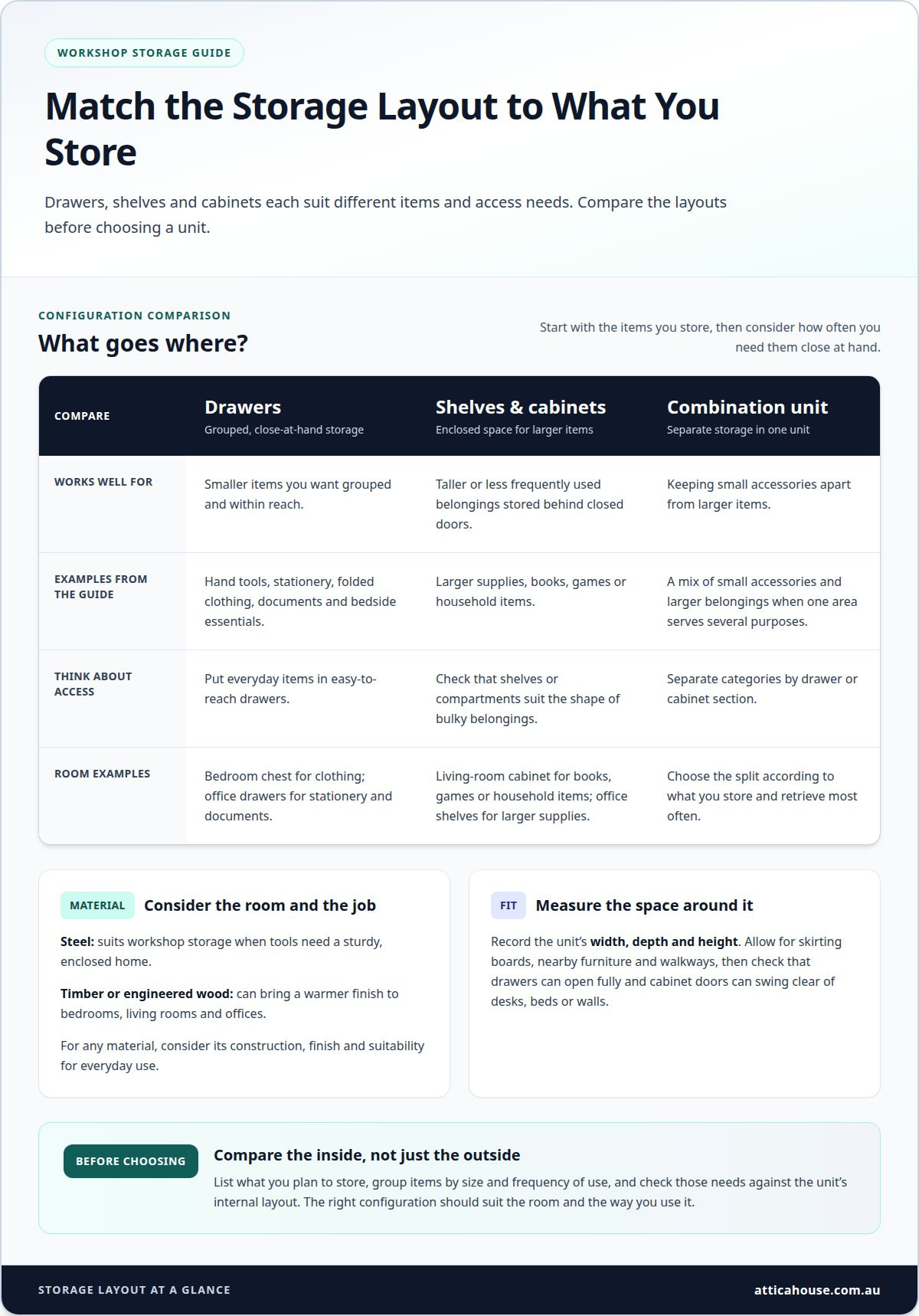
Choose materials according to the room and what the unit needs to hold. Steel suits workshop storage when tools need a sturdy, enclosed home. Timber and engineered wood can bring a warmer finish to bedrooms, living rooms, and offices. Whatever the material, consider its construction, finish, and suitability for everyday use.
Drawers keep smaller items grouped and within reach, such as hand tools, stationery, or folded clothing. A cabinet with shelves stores taller or less frequently used belongings behind closed doors. A combination unit can separate small accessories from larger items, making it useful when one area serves several purposes.
In a bedroom, consider a chest of drawers for clothing and bedside essentials. In a living room, a cabinet can conceal books, games, or household items while keeping the space composed; for specialist entertainment setups, dedicated audio furniture from hifi-rack.com can provide sturdy shelving for sensitive components. Office drawers can organise stationery and documents, while shelves hold larger supplies. Choose a layout based on what you store and retrieve most often.
Measure the available space before choosing a unit. Record its width, depth, and height, allowing for skirting boards, nearby furniture, and walkways. Leave enough clearance for drawers to open fully and cabinet doors to swing without hitting a desk, bed, or wall. In a narrow office, door clearance can matter as much as overall width.
- Frequent access: Place everyday items in easy-to-reach drawers.
- Bulky belongings: Choose shelves or compartments that suit their shape.
- Shared storage: Separate categories by drawer or cabinet section.
List the items you plan to store in each room, grouping them by size and frequency of use. A bedroom chest may need to fit folded clothes, while an office unit may need room for files and stationery. Compare these needs with the internal layout, not just the exterior—an approach exemplified by bespoke fitted specialists like Finest Furniture Studio, where compartments and shelving are configured around specific belongings. This helps the configuration suit the room rather than dictate how you use it.
Lockability
A lock can help control access to stored items. First consider what you want to keep inside. In a shared garage, for example, locking away specialist tools can help separate them from communal supplies. In a home office, a lockable drawer may suit documents that need privacy. Match the feature to the items and the people using the space.
Check how the locking mechanism works and which parts it secures. A key lock may suit a unit with one regular user, while shared access can make key management less straightforward. A combination lock avoids the need to keep a key nearby, but users must remember the code. Check whether it secures one drawer, several drawers, or the entire cabinet.
For a mobile tool chest, consider how often it moves and who needs access. A lock may restrict access to its contents, but it does not secure the chest in place. Think about where it will be parked and whether you need to reach its contents during a job. For fixed storage, consider whether the lock suits your daily routine and the way you use the room.
- Single user: Decide whether carrying and storing a key feels practical.
- Shared workspace: Establish who needs access and how access will be managed.
- Mixed storage: Consider whether only selected drawers need a lock.
Before choosing, list the contents that need restricted access, then compare that need with the lock’s coverage. Check the opening method, key or code management, and how the lock affects everyday access. If a cabinet will hold frequently used items, a cumbersome locking routine may disrupt the workday. If it stores occasional-use equipment, access may matter less. Explore cabinet options for considered storage as you refine the right configuration.
Attica House: Buffets & Cabinets
Attica House offers Buffets & Cabinets for considered storage in the home. They’re suited to spaces where you want a piece that contributes to the character of a living or dining area, rather than workshop organisation. Choose with the room, the belongings you want close at hand, and the atmosphere you want to create in mind.
A buffet can provide practical storage and a focal point in a dining area, while a cabinet may suit other living spaces. Attica House also offers Coffee Tables, Console Tables, and Dining Tables, so you can explore complementary furniture for a cohesive setting. These pieces serve a different purpose from workshop storage, and suit home spaces where appearance and everyday function go together.
Explore Attica House Buffets & Cabinets to find considered storage for your home.
Shape a more considered space
Choose storage according to how you want each space to feel, as well as what it needs to hold. A workshop calls for purposeful, practical organisation; rooms in the home may benefit from furniture that feels integrated with the interior. Keep these needs distinct: workshop equipment prioritises utility, while living spaces may call for pieces that balance function and visual character.
For the home, Attica House offers Buffets & Cabinets, Coffee Tables, and Console Tables. These pieces can bring continuity to a room while serving different everyday purposes. Consider the role each one should play and how it will sit alongside the furniture and finishes already in place. A considered choice can make the room feel more complete.
Explore Buffets & Cabinets from Attica House as you consider a fitting home storage piece. The right chests & cabinets can support a space that feels both useful and composed. Take the next step at your own pace, with a clear sense of what belongs in each room.
Frequently Asked Questions
How do I assemble and care for chests and cabinets?
Assemble each unit according to its supplied instructions, using the recommended tools and fixings. Keep small components together as you work, and avoid forcing joints or overtightening screws. For care, follow the guidance for the specific material and finish. Dust with a soft cloth, avoid abrasive cleaners unless the care instructions allow them, and periodically check handles, hinges, and accessible fasteners for looseness.
What types of chests and cabinets are available in Australia?
Options include drawer chests, cabinets with shelves, and combination units. Steel suits workshop storage, while timber and engineered wood offer warmer finishes for other rooms.