


Ottoman vs Coffee Table: Choosing the Perfect Centrepiece for Your Living Room
What if the most defining element of your home isn't the sofa you sink into, but the surface that anchors your entire world? The choice between an ottoman vs coffee table in living room design is rarely just about utility; it's a quiet dialogue between structural stability and tactile sanctuary. You likely want a space that feels curated yet deeply personal, avoiding the coldness of a showroom while steering clear of domestic clutter. It’s natural to worry if a soft surface can truly hold its own or if a stone table might feel too fragile for real life.
You deserve a home that acts as a refuge, where every piece tells a story of careful selection and quiet luxury. In this guide, you'll discover how to balance sophisticated form with lived-in comfort to select the ideal anchor for your refined living space. We'll explore the enduring appeal of organic, curved forms and the functional versatility of artisanal materials like honed marble and smoked oak. From the safety of padded edges to the grounding presence of structured wood, we will help you navigate these aesthetic choices to create a room that reflects your internal balance and personal style.
Key Takeaways
- Discover how to select a centrepiece that acts as the gravitational pull for your room, grounding your design with intentionality and poise.
- Explore the sculptural elegance of hard surfaces versus the evocative comfort of upholstered pieces to find your ideal aesthetic balance.
- Master the "tray trick" to harmonise functionality and softness when deciding between an ottoman vs coffee table in living room settings.
- Evaluate your daily rituals to choose a piece that serves either as a curated stage for hosting or a multi-functional refuge for family connection.
- Gain insight into the philosophy of selecting pieces that mirror your personal story and foster a deep sense of internal balance.
The Living Room Anchor: Deciding Between Ottoman and Coffee Table
Every thoughtfully composed living room has a silent conductor. This central piece acts as the gravitational pull, drawing together disparate elements like sofas, armchairs, and designer rugs into a singular, cohesive narrative. When you stand at the threshold of your lounge, the anchor is what grounds your gaze. It’s the stage for your morning espresso and the resting place for your favorite art volumes. The debate between an ottoman vs coffee table in living room styling isn't merely a question of furniture; it's a decision about the emotional temperature you wish to set for your home.
Traditionally, the coffee table has served as the architectural foundation of the home. It offers hard surfaces, clear lines, and a sense of unwavering stability. Whether crafted from honed marble, smoked oak, or glass, it provides a structured platform for entertaining and a curated stage for decor. Conversely, the ottoman introduces a layer of tactile sanctuary. Its upholstered surface invites a more relaxed posture, encouraging guests to linger and repose. While the coffee table often demands a certain level of decorum, the ottoman offers a soft invitation to exhale. This choice fundamentally dictates how you move through the space and how the room feels during quiet moments of solitude.
The Evolving Role of the Modern Centrepiece
Our homes have transitioned from formal reception areas into multi-functional sanctuaries where beauty must coexist with comfort. This shift toward "lived-in luxury" has elevated the upholstered alternative from a peripheral footrest to a central masterpiece. Exploring the history of the ottoman reveals its origins as a communal seating solution in the Ottoman Empire, a legacy that modern design honors by prioritizing connection over rigid formality. Choosing a piece that reflects your personal story ensures your home feels like a refuge rather than a clinical showroom.
Spatial Awareness and Design Symmetry
Precision is the hallmark of a refined interior. Before selecting your anchor, assess the footprint of your seating arrangement to maintain a sense of internal balance and symmetry. A piece that is too small will feel lost, while one that is too large can stifle the room's energy.
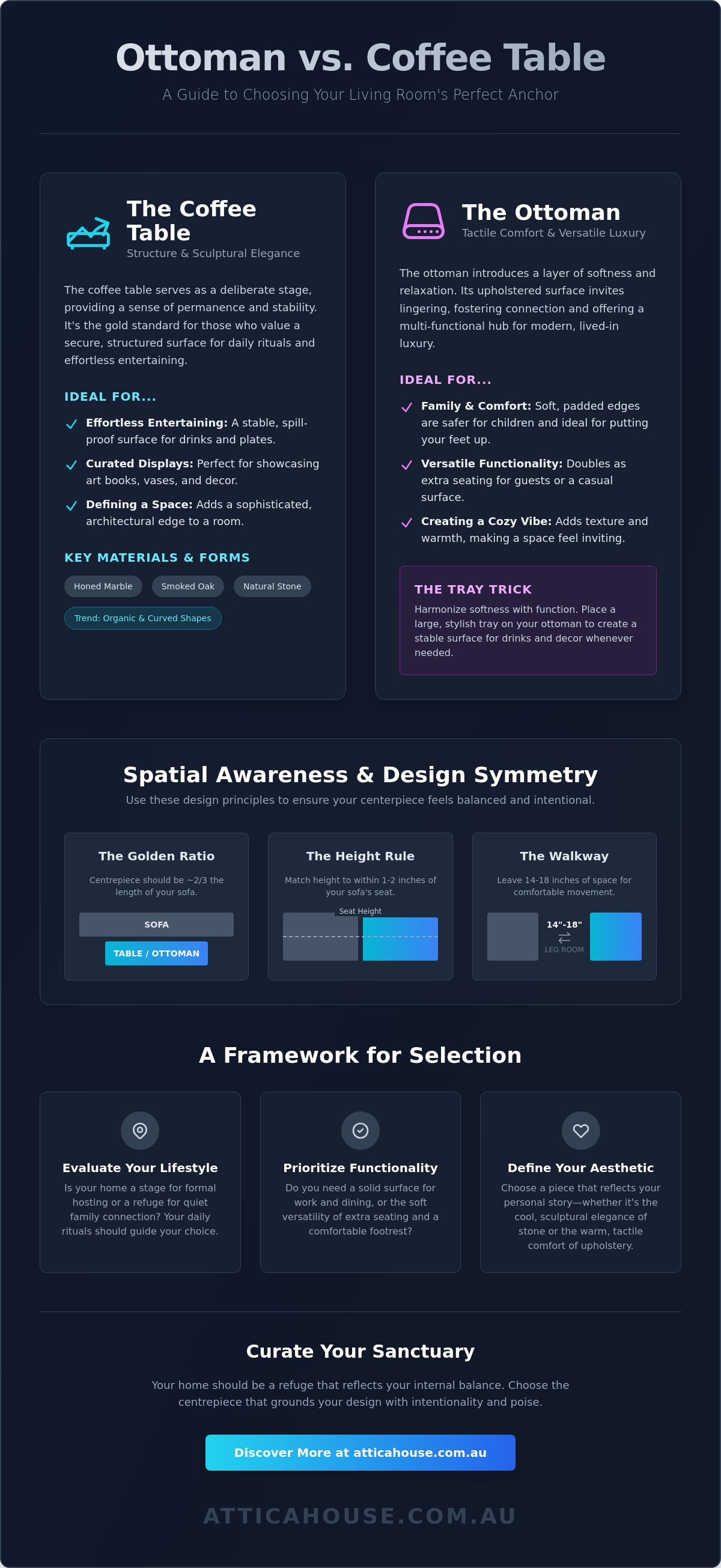
- The Golden Ratio: Aim for a centrepiece that is approximately two-thirds the length of your sofa to ensure visual harmony.
- The Height Rule: Your table or ottoman should sit within one to two inches of your sofa’s seat height to maintain a seamless physical flow.
- The Walkway: Leave roughly 14 to 18 inches between the edge of the seating and the centrepiece to allow for effortless movement and legroom.
These measurements prevent the room from feeling cluttered, allowing the spatial rhythm to remain steady and graceful. By respecting these proportions, you ensure your furniture serves as a functional component of a meaningful life.
The Coffee Table: A Study in Structure and Sculptural Elegance
The coffee table is more than a surface; it's a structural anchor that provides a sense of permanence within your sanctuary. While an ottoman offers soft repose, the coffee table serves as a deliberate stage for the rituals of daily life. It’s the place where a heavy art book rests or where a crystal vase catches the morning light. When considering an ottoman vs coffee table in living room arrangements, the coffee table remains the gold standard for those who value stability. A hard surface ensures that entertaining feels effortless, providing a secure foundation for delicate glassware without the need for a tray.
Materiality plays a vital role in the emotional resonance of your home. High-end design currently favors "quiet luxury" materials such as honed marble, smoked oak, and handwoven textures. In 2026, we see a distinct shift toward organic shapes. Sharp, rigid lines are giving way to curved silhouettes and scalloped edges, which help a structured piece feel more approachable and calm. This blend of structural integrity and soft form allows a room to feel grounded yet fluid. It creates a space that feels curated but never clinical.
The Allure of Natural Stone and Designer Marble
Marble stands as a testament to longevity and natural artistry. Each vein tells a story of geological time, making every piece a singular work of art. A stone surface provides a cool, tactile contrast to the plushness of sofas and armchairs. It introduces a sophisticated edge that fabric simply cannot replicate. For those seeking a centrepiece that bridges the gap between heritage and modern luxury, Designer marble coffee tables offer a timeless anchor for any room. The weight of stone provides a sense of psychological security, making the environment feel established and intentional.
Functionality Meets Refined Craftsmanship
Beyond aesthetics, a coffee table offers unparalleled ease of maintenance in high-traffic social zones. Spills are easily managed on timber or stone, making these pieces ideal for homes where life is lived fully. Styling a hard surface is an art form in itself. You can display a curated collection of objects without the space feeling cluttered by following the principles of "midimalism," a balance between minimalism and maximalism. This approach allows for personal expression without sacrificing the serenity of the room.
The sculptural impact of geometric and organic silhouettes can transform the room's energy. In recent contemporary coffee table designs, we see a preference for pieces that use glass or slender metal frames to create a sense of airiness. This prevents the room from feeling heavy, especially when choosing between an ottoman vs coffee table in living room layouts with substantial seating. If you're looking to refine your sanctuary, you might explore a selection of sculptural coffee tables that celebrate the beauty of raw materials and expert craftsmanship.
The Ottoman: Embracing Tactile Comfort and Versatile Luxury
While the coffee table provides a structural anchor, the ottoman offers a gentle softening of the spatial narrative. Large rooms often suffer from "leggy" furniture arrangements, where every piece stands on slender timber or metal supports. An upholstered centrepiece breaks this visual pattern, providing a solid, grounded block of texture that anchors the seating group. When debating the ottoman vs coffee table in living room design, consider the acoustic benefits. Fabric surfaces absorb sound, contributing to a quieter, more intimate atmosphere that feels like a true refuge from the outside world.
The ottoman is a multi-functional marvel, transitioning effortlessly from a footrest to an extra seat during larger gatherings. This versatility makes it indispensable for those who value a fluid, adaptable environment. In terms of safety, soft edges are a thoughtful choice for households with young children or for those who simply wish to move through their space without the sharp corners of a traditional table. When exploring the pros and cons of each, the psychological comfort of a padded surface cannot be overstated. It invites you to put your feet up, physically signaling that the day's work is done.
A Refuge of Comfort and Flexibility
Textures like velvet, linen, and leather do more than just look beautiful; they create a home sanctuary that appeals to the senses. The portability of these pieces allows you to reconfigure your lounge at a moment's notice, making luxury feel personal and attainable. You can discover how to use ottomans for style and function to enhance your lounge, ensuring every element serves your daily rituals while maintaining a sophisticated aesthetic.
Textural Depth and Layering
True elegance lies in layering. Placing a rich, upholstered ottoman over a handcrafted rug creates a sense of warmth and depth that a hard surface rarely achieves. Whether you prefer the timeless charm of tufted traditionalism or the clean lines of modern upholstered cubes, the role of colour is paramount. An ottoman can act as a sophisticated pop of pigment, drawing the eye and adding a layer of curated personality to a neutral palette. This careful selection of materials ensures your environment reflects your internal balance and a deep respect for your private space.
A Framework for Selection: Balancing Lifestyle with Design
Choosing between an ottoman vs coffee table in living room environments often comes down to the rituals you value most. Your home is a reflection of your personal story, and the centrepiece should facilitate the life you lead within its walls. If your lounge is primarily a sanctuary for quiet evenings and family connection, the softness of an ottoman is unmatched. For those who frequently host formal gatherings, the structured elegance of a table might be the wiser path. It’s a delicate balance between the desire for a curated gallery and the need for a lived-in refuge.
You don't have to sacrifice stability for comfort. The "Tray Trick" is a sophisticated solution that bridges the gap between these two choices. By placing a large, low-profile tray in a contrasting material like brushed brass or dark timber atop an upholstered surface, you create a temporary hard plane. This provides a secure foundation for candles or a teapot while preserving the room's tactile warmth. This adaptability ensures your space remains functional for entertaining without losing its sense of calm and repose.
A hybrid approach is increasingly popular in modern Australian homes, where open-plan living demands versatility. Pairing a smaller, sculptural coffee table with a nested stool or ottoman provides the best of both worlds. This arrangement allows for a stable surface for a glass of wine while offering a pull-out seat or footrest when the mood shifts. It creates a rhythmic, layered look that feels both modern and timeless, catering to the fluid nature of contemporary life.
Households with Children and Pets
Safety is a silent priority in a well-designed home. The rounded, padded edges of an upholstered piece naturally prevent the small accidents common in high-energy households. When selecting fabrics, look for performance weaves that offer longevity and resistance to the Australian sun without sacrificing sensory appeal. Conversely, solid timber or stone coffee tables provide an "unbreakable" quality that endures the rigours of daily life, standing as a testament to high-end craftsmanship that lasts for generations.
Entertaining and Social Dynamics
Consider your social dynamics and surface area requirements. If you typically host larger groups, a stable surface for decanters and glassware is non-negotiable for seamless hosting. However, an ottoman serves a dual purpose as overflow seating, ensuring every guest feels welcomed into your thoughtfully composed world. To find a piece that resonates with your aesthetic vision, explore our curated collection of designer stools and ottomans that celebrate the art of living well.
Curating Your Sanctuary with Attica House
At Attica House, we believe that a home should be a quiet reflection of your internal balance. The choice of a centrepiece isn't merely a functional requirement; it's a profound act of aesthetic selection that defines the soul of your sanctuary. Whether you lean toward the structural poise of a table or the tactile sanctuary of an upholstered piece, your decision between an ottoman vs coffee table in living room design should feel like an invitation to exhale. Our philosophy blends global design sensibilities with a sophisticated Australian perspective, ensuring every piece you choose offers both longevity and emotional resonance.
Creating a truly cohesive environment requires looking beyond the individual object to how it harmonises with your broader collection of luxury furniture. For those who find it difficult to choose, a hybrid arrangement often provides the most nuanced result. By pairing a smaller, sculptural stone table with a nested upholstered stool, you introduce a rhythmic variety of heights and textures. This approach allows you to enjoy the cool, architectural lines of marble alongside the warm, welcoming presence of fabric. It’s a sophisticated way to ensure your living space remains adaptable to both formal hosting and private repose.
The Final Flourish: Styling Your Selection
The art of living well is often found in the smaller details that bring a room to life. Once you've selected your anchor, use statement wall art to balance the visual weight of the furniture below. A large, evocative print can draw the eye upward, preventing the centre of the room from feeling too heavy. On the surface itself, curate a selection of coffee table books that reflect your passions, interspersed with organic elements like a simple branch in a glass vase or a scented candle. These layers enhance the sensory experience, turning a house into a deeply personal refuge.
An Invitation to Refinement
We invite you to explore the tactile quality of our curated collection and experience the weight of craftsmanship firsthand. You can view our range via our Sydney partner showroom, where the nuances of our materials are on full display. Our selection process is designed to simplify your journey, offering a recognizable aesthetic vision that prioritises your comfort and story. Trust your intuition as you compose your space. When you choose pieces that evoke a sense of calm and beauty, you aren't just decorating a room; you're crafting a meaningful life. Let your home be a place where beauty and comfort coexist in perfect symmetry.
Composing a Living Space That Reflects Your Story
The journey of selecting the perfect anchor for your home is a deeply personal one. Whether you've been drawn to the architectural clarity of stone or the tactile indulgence of velvet, the decision between an ottoman vs coffee table in living room styling ultimately hinges on your unique daily rituals. You've seen how a structured surface provides a stage for elegant hosting, while a soft ottoman offers a versatile refuge for family connection. By balancing these elements, you create a room that reflects both your aesthetic vision and your need for internal balance.
We invite you to Explore our curated collection of Designer Coffee Tables and Ottomans to find the piece that resonates with your personal story. Every item in our range is curated by experts in aesthetic selection to ensure longevity and grace. You can experience the quality firsthand at our Sydney partner showroom or enjoy the convenience of Australia-wide delivery for all luxury pieces. Trust your intuition as you compose your sanctuary. Your home is a reflection of your soul, and the right centrepiece is the final note in your story of living well.
Frequently Asked Questions
Is an ottoman or a coffee table better for a small living room?
An ottoman is generally the superior choice for a small living room due to its multi-functional nature and soft profile. In a compact environment, pieces that serve dual purposes, acting as both a footrest and additional seating, maximise the utility of the floor plan. Its rounded edges also prevent the space from feeling physically or visually restricted, allowing for a more graceful flow through the room without the risk of sharp corners.
Can I use an ottoman as a coffee table for holding drinks?
You can certainly use an ottoman as a coffee table for drinks provided you incorporate a sturdy tray to create a level surface. This simple addition transforms a soft, upholstered piece into a functional platform for glassware and decanters. It's a practical way to enjoy the tactile comfort of an ottoman while maintaining the stability required for entertaining guests in your sanctuary without worrying about spills on the fabric.
How do I choose the right size ottoman for my sectional sofa?
When selecting an ottoman for a sectional, aim for a piece that occupies approximately two-thirds of the interior length of the sofa's "L" or "U" shape. This proportion ensures the centrepiece feels intentional and grounded rather than lost within the scale of the seating. You should also ensure there is at least 14 to 18 inches of clearance on all sides to allow for effortless movement and comfortable legroom for everyone seated.
What is the best material for a coffee table if I have young children?
For households with young children, solid timber or honed stone coffee tables with rounded edges offer the best balance of longevity and safety. These materials endure the rigours of daily life without the fragility of glass or the maintenance of delicate finishes. However, if your primary concern is preventing bumps and bruises, an upholstered ottoman remains the gold standard for creating a secure, child-friendly environment that doesn't sacrifice sophisticated style.
Should the ottoman be the same height as the sofa cushions?
An ottoman should ideally sit at the same height as your sofa cushions or one to two inches lower to maintain a seamless physical flow. This alignment ensures that when you use the piece as a footrest, your posture remains natural and relaxed. Maintaining this symmetry between the seating and the centrepiece is essential for achieving a sense of internal balance and visual harmony in your thoughtfully composed living space.
Can you have both an ottoman and a coffee table in the same room?
It's entirely possible to include both an ottoman vs coffee table in living room layout by adopting a nested or tiered approach. You might pair a smaller, sculptural coffee table with a lower ottoman that can be tucked away when not in use. This hybrid strategy offers the structural elegance of a hard surface alongside the tactile sanctuary of upholstery, catering beautifully to the fluid needs of modern, lived-in luxury.
How do you style a tray on an ottoman to make it look professional?
Styling a tray on an ottoman requires a balance of height, texture, and personal storytelling. Start with a substantial tray in a material like brushed brass or dark timber, then apply the "rule of three" by grouping a tall vase, a stack of art books, and a smaller sensory object like a candle. This curated arrangement provides a professional, polished look while grounding the soft surface with a point of architectural interest.
Are leather ottomans more durable than fabric ones for daily use?
High-quality leather ottomans are typically more durable than fabric options for daily use, especially in high-traffic areas. Leather develops a beautiful patina over time and is naturally more resistant to spills and dust, making it a wise investment for longevity. While modern performance fabrics offer impressive stain resistance, leather remains a timeless choice for those seeking a material that ages with grace and reflects a commitment to high-end craftsmanship.