


How to Get Your Home Ready for Furniture Delivery, Room by Room
Delivery day runs more smoothly when you’ve measured and prepared the furniture, access route and destination room in advance. Preparing your home for furniture delivery means checking every doorway, hallway, stairway and lift against the item’s dimensions, then clearing a safe path to its final position. Keep the route open on the day and be ready to guide the delivery team.
It’s easy to focus on the room where a new piece will sit and overlook tight turns and narrow spaces along the way. A little preparation helps you spot access problems early and make delivery calmer, from the entrance to the final placement.
This guide explains how to measure furniture and its delivery route, clear the way through your home, and prepare the destination room and household for delivery day. With a clear plan, there are fewer last-minute obstacles between your chosen piece and the space it’s meant to complete.
Key Takeaways
- Map every doorway, corner, stairway and lift on the route, noting the tightest clearances and any obstacles.
- Compare the item’s dimensions with its destination, including space needed for extensions or other moving parts.
- Prepare a clear path by moving nearby furniture and fragile objects before the delivery team arrives.
- On delivery day, keep pets safely away, stay available to guide the team and inspect the furniture before signing for it.
Measuring the delivery route
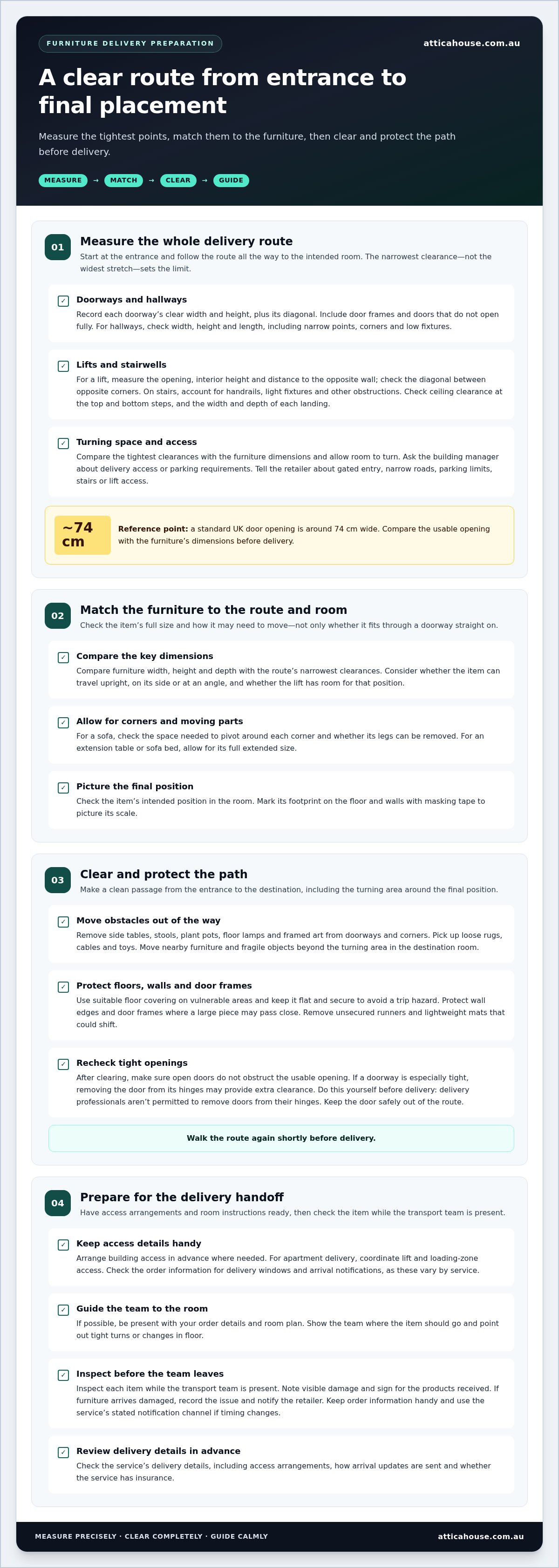
When preparing your home for furniture delivery, measure the full route from the entrance to the intended room. Compare the tightest clearances with the furniture’s dimensions, allowing for the space needed to turn.
-
Measure Doorways and Hallways
Measure each doorway’s clear width and height, then check its diagonal to assess whether the item can pass through straight or at an angle. Account for door frames and doors that do not open fully. In hallways, measure the width, height and length, including narrow points, corners and low fixtures. Compare these measurements with the furniture’s width, height and depth. The narrowest point, not the widest stretch, determines the available clearance.
-
Measure Lifts and Stairwells
For a lift, measure the opening, interior height and distance to the opposite wall. Check the diagonal between opposite corners, as a large item may need to be tilted. On stairways, account for handrails, light fixtures and other obstructions. Check ceiling clearance from the top and bottom steps, as well as the width and depth of each landing. These measurements help establish whether the item can turn safely between floors.
-
Check Access and Parking Permits
Ask your building manager about any delivery access or parking requirements and arrange access in advance. Requirements vary by building and parking arrangements. Tell the retailer about gated entry, narrow roads, parking limits, stairs or lift access. Delivery windows and arrival notifications vary by service, so check the information provided for your order. Planning these details is a practical part of preparing your home for furniture delivery.
Checking furniture dimensions
For an apartment delivery, arrange lift and loading-zone access in advance, and share any building access or parking restrictions with the delivery service. If furniture arrives damaged, inspect it before the team leaves, record the issue and notify the retailer. If delivery is delayed, use the notification channel provided for your order to request an update.
-
Check Sofa Legs and Corner Clearance
Compare the sofa’s full dimensions with the planned route, including the space needed to turn each corner. Check whether its legs can be removed, and have detachable legs ready for delivery. A sofa that fits through a doorway straight on may still be difficult to pivot if the hallway narrows or the turn is tight.
-
Check Hallway Clearance
Compare furniture height and width with the hallway’s narrowest clearance, and account for low ceiling fixtures or architectural details. Check the item’s intended position, too: mark its footprint on the floor and walls with masking tape to picture its scale. For an extension table or sofa bed, allow for its full extended size.
-
Check Lift Dimensions
Measure the lift opening and its interior width, depth and height, then compare them with the furniture’s dimensions. Consider whether the item can travel upright or on its side, and whether the lift has enough room for that position. In an apartment, coordinate lift and loading-zone access so the route from the vehicle to the destination is clear.
-
Review Delivery Cover and Details
Before delivery, check whether the service has insurance and review the delivery details, including access arrangements and how arrival updates are sent. Keep the order information handy. Inspect each item while the transport team is present, note visible damage and sign for the products received. If timing changes, use the service’s stated notification channel to follow up.
Careful measuring also helps you choose furniture for your home with its room and access route in mind.
Clearing the delivery route
Before delivery, move nearby furniture and fragile objects out of the route, from the entrance to the destination. Clear doorways, hallways and corners so the team can move the piece without navigating household clutter.
-
Clear Items from the Delivery Path
Walk the route from the entrance to the destination and remove anything that could obstruct the furniture. Move side tables, stools, plant pots, floor lamps and framed art away from doorways and corners. Pick up loose rugs, cables and toys that could catch underfoot or against the item. In the destination room, move nearby furniture and fragile objects beyond the turning area. Walk the route again shortly before delivery.
-
Protect the Delivery Path
Protect vulnerable floor areas along the route, such as timber flooring near the entrance or a polished hallway. Use suitable floor covering and keep it flat and secure to avoid creating a trip hazard. Protect nearby wall edges and door frames where a large piece may pass close. Remove anything that could shift during delivery, including unsecured runners and lightweight mats. Keep the path clear from the entrance to the destination room.
-
Check Doorway and Hallway Clearances
Recheck narrow doorways and hallway turns after clearing the route. Make sure the opening remains unobstructed when doors are open, and move nearby items that reduce usable space. If a doorway is especially tight, removing the door from its hinges may provide extra clearance. Make this adjustment yourself before the team arrives, as delivery professionals aren’t permitted to remove doors from their hinges. Keep the door safely out of the route.
A standard UK door opening is around 74 cm wide, so compare the usable opening with the furniture’s dimensions before delivery. Removing a tight-fitting doorway's doors from their hinges may create extra clearance for furniture delivery.
Preparing the home on delivery day
On delivery day, guide the furniture safely into place and check its condition. Keep the route open, stay available if possible, and prepare the destination room before the team arrives.
- If possible, be present for delivery with your order details and room plan handy. Show the team where the item should go and point out any tight turns or changes in floor level. Keep pets in another room or outdoors while furniture is being moved, away from the route. If you can’t be there, arrange for someone familiar with your home to receive the delivery.
- Prepare the room before the item arrives. Move existing furniture yourself, as delivery professionals don’t move household furniture or move or set up electrical equipment. Keep outlets, light switches and vents accessible after placement. If a chandelier or ceiling pendant is part of your room plan, arrange installation by a licensed electrical contractor rather than asking the delivery team to connect it.
- Confirm the delivery arrangement before unloading begins. With delivery-only service, boxes are placed in your chosen room. Delivery with installation includes unboxing and assembling relevant items, with packaging and rubbish removed from the premises. Check that the service matches your preparations, and keep children and pets away from tools, packaging and the furniture’s placement area.
- Inspect each item before the transport team leaves, then sign for the products received. Check visible surfaces, edges and legs against your order. If you notice damage, record it promptly and raise it with the retailer. After placement, make sure the piece sits securely and doesn’t obstruct a switch, outlet or vent.
As you settle the room, explore furniture for your home with its intended space and daily use in mind.
Attica House: Buffets & Cabinets
Attica House offers Buffets & Cabinets for homes where considered storage can bring function and visual balance. Once you’ve measured the room and planned the delivery route, use those details to assess whether a cabinet’s intended position suits the space. Consider how its scale relates to nearby pieces, and leave room for doors and drawers to open without blocking a walkway.
For a cohesive living or dining area, explore the collection alongside Coffee Tables, Console Tables and Dining Tables. These pieces can help shape the room’s flow, from the first impression at the entrance to the arrangement around a dining space. Choose with your room dimensions and daily routines in mind.
Explore Attica House online or contact the team to discuss the collection.
Make Space for the Way You Want to Live
A considered arrival is the beginning of a room finding its rhythm. As you continue preparing your home for furniture delivery, think beyond where a piece will stand. Consider how you want the space to feel during a quiet morning, a shared meal or an evening with friends. That intention can guide the final placement and help your new furniture feel at home in daily life.
Attica House offers Buffets & Cabinets, Coffee Tables and Console Tables to bring function and visual character to living spaces. Explore the pieces with your room’s atmosphere and how you use it in mind, choosing what feels harmonious with the home you’re creating.
Explore Attica House’s furniture and take the next step towards a home that feels distinctly yours.
Frequently Asked Questions
How do I measure doorways, hallways and staircases before furniture delivery in Australia?
Measure the usable opening at each access point, then compare those measurements with the furniture’s dimensions and possible carrying positions. Include the tightest turn, not just the straight approach. Photograph narrow corners, stair landings or unusual entryways and keep the images with your measurements. This gives the delivery team clearer context about the route through your home.
How do I measure rooms and plan furniture placement before delivery?
Measure the intended position and consider how the piece will work with the room’s everyday use. Allow space for doors, drawers or extensions to open, and make sure people can move comfortably between the furniture and nearby features. For example, plan for dining chairs to be pulled out rather than judging the table alone. A simple room sketch can help you compare arrangements before delivery.
How do I prepare floors, walls and door frames for furniture delivery?
Move delicate décor, loose rugs and small items away from the route, then protect vulnerable surfaces with secure, non-slip coverings. Make sure floor protection lies flat and won’t shift underfoot. Clear objects from shelves near the path, and keep children and pets away from the work area. If you use temporary protection on a door frame, ensure it won’t obstruct the opening or catch on the furniture.
What happens if furniture cannot fit through the doorway on delivery?
If the item cannot pass through safely, don’t force it or risk damaging the furniture, doorway or walls. Delivery may be unsuccessful, and access-related issues can lead to additional charges. Contact the retailer promptly to discuss the situation and possible next steps for your order. Your route measurements and photos can help explain where clearance is a problem and what access constraints the delivery team encountered.