


Designer Rugs: A Curated Buying Guide for Refined Interiors (2026)
What if the most influential piece of art in your home isn't hanging on the wall, but resting quietly beneath your feet? It's easy to feel overwhelmed by the 198 plus possibilities in a collection, especially when you're searching for designer rugs that must anchor a large living space without feeling misplaced. You want a home that feels like a sanctuary, yet the technical choice between the resilience of wool and the delicate shimmer of viscose often creates more hesitation than inspiration.
We believe that selecting the right foundation should be an act of curation rather than a chore of commerce. This guide promises to transform your uncertainty into confidence, helping you identify a piece that blends 2026's earthy mineral tones with timeless, high-end craftsmanship. You'll discover how to anchor your furniture with precision and select materials that suit your unique lifestyle. We'll walk through the essential principles of rug placement and quality markers, ensuring your final choice reflects your personal story and brings a sense of lasting harmony to your interior.
Key Takeaways
- Understand how to treat your floor as the fifth wall, using a single piece to dictate the emotional resonance and colour palette of a sanctuary.
- Master the tactile nuances of wool, silk, and viscose to find the perfect balance between enduring quality and sensory appeal.
- Discover the artistic diversity within a curated collection of over 198 designer rugs, featuring the distinct creative visions of Orla Kiely and Wedgwood.
- Avoid common sizing errors by applying professional placement frameworks that ensure your furniture feels grounded and the room feels finished.
- Learn the simple care rituals that protect the heritage and longevity of your investment, turning a beautiful object into a lasting legacy.
The Artistic Anchor: Why Designer Rugs Define a Luxury Interior
A luxury interior is a symphony of deliberate choices. While we often obsess over the curation of art for our walls, we frequently overlook the expansive canvas beneath our feet. Design professionals often refer to the floor as the "fifth wall," a foundational surface that carries as much aesthetic weight as any vertical plane. Choosing from a collection of designer rugs is the first step in establishing the emotional resonance of a room. It's the artistic anchor that binds disparate elements like sofas, coffee tables, and wall art into a singular, cohesive narrative.
A designer rug does more than fill a void. It establishes the color palette and mood for the entire space, acting as a visual compass. If you begin with a rug featuring deep mineral tones or intricate tribal motifs, the rest of your furniture, from armchairs to console tables, naturally finds its place within that established spectrum. It's an investment in the art of living well, prioritizing the longevity of high-end craftsmanship over the disposable nature of mass-produced alternatives. These pieces are intended to be lived with, aged with, and cherished as part of your home's unique history.
The Psychology of a Grounded Space
The feeling of home is fundamentally tied to the sense of being grounded. Texture and pattern play a quiet but profound role in this psychological shift. A high-pile wool rug offers a tactile softness that signals the transition from the frantic outside world to a private refuge. Beyond the visual, designer rugs provide essential acoustic dampening. They absorb the sharp edges of sound, creating a hushed, sophisticated environment where conversation feels intimate and thoughts can settle. This marriage of sensory comfort and intentional design fosters a deep connection to our personal well-being. When your environment is balanced, your internal state often follows, turning a simple living space into a true sanctuary.
Designer vs. Standard: The Quality Distinction
There's a vast gulf between a mass-produced floor covering and a piece born from a creative legacy. Designer selections are defined by their unique patterns, premium raw materials, and limited production runs that ensure exclusivity. Consider the bold, rhythmic geometries of Florence Broadhurst or the playful, mid-century charm of Orla Kiely. These aren't merely decorative objects; they're expressions of a specific design heritage that mass-market items simply cannot replicate. The materials used, such as New Zealand wool or high-luster viscose, are selected for their durability and their ability to hold rich, complex pigments over decades. A designer rug is a masterful blend of heritage and modern innovation.
Selecting Your Masterpiece: A Framework for Evaluation
Choosing designer rugs is a process of discernment that goes beyond simple color matching. To find a piece that truly resonates, we recommend evaluating three specific pillars: Material, Weave, and Artistic Identity. These components dictate the rug's tactile presence, its visual depth, and its ability to withstand the rhythms of daily life. By viewing the selection through this curator’s framework, you ensure that your investment is as practical as it is beautiful.
There is a common misconception that "designer" equates to "fragile." In reality, the opposite is often true. High-end craftsmanship utilizes superior fibers that are naturally stain-resistant and durable. A well-chosen piece isn't just a decorative layer; it's a functional foundation built for the art of living well. As you consider the intended use of your room, look for materials that match your lifestyle. A formal dining room might call for the elegance of a silk blend, while a high-traffic living area thrives with the robust nature of premium wool.
Materiality and the Sensory Experience
The soul of a rug lies in its fibers. Wool remains the gold standard for refined interiors because of its natural elasticity and matte finish. It's incredibly resilient. In contrast, viscose or silk blends offer a lustrous sheen that catches the light, creating a sense of movement across the floor. For rooms that prioritize a sense of calm and refuge, natural fibers like New Zealand wool or jute are excellent choices. They don't just feel better. They contribute to improved indoor air quality and align with a commitment to sustainable living. The choice of material also dictates the vibrancy of the pigments. A wool rug will hold deep, saturated tones with a grounded quality, while silk-like materials allow for a more ethereal, shimmering palette.
Understanding Weave and Texture
The way a rug is constructed defines its character. Hand-knotted rugs represent the pinnacle of heritage. Every individual knot is tied by hand, resulting in a piece of unmatched longevity and detail. Hand-tufted options offer a different kind of luxury, often allowing for more sculptural textures and varied pile heights. Whether you prefer a plush, high-pile finish that invites you to linger or a crisp flatweave for a more minimalist look, the technique matters. You can explore the technical nuances in our hand-knotted vs hand-tufted rugs comparison to see which construction fits the specific needs of your space.
Take a moment to explore our curated collection to see how these materials and weaves interact in various lighting and spatial settings. Each piece is an invitation to bring a new layer of tactile beauty into your home.
Iconic Designer Collections: From Orla Kiely to Wedgwood
Stepping into our collection of over 198 unique designs is like entering a gallery where every piece tells a different story. These designer rugs are the result of visionary collaborations that bridge the gap between high-fashion and the quiet sanctuary of the home. From the bold, rhythmic patterns of Florence Broadhurst, which bring a distinctly Australian artistic flair, to the heritage-rich motifs of global icons, the selection is a celebration of creative diversity. Each collection offers a specific aesthetic signature. This variety allows you to choose a piece that doesn't just fill a space, but resonates with your personal narrative and the architectural character of your home.
The Playful Sophistication of Orla Kiely
Orla Kiely’s work is instantly recognizable for its rhythmic, mid-century modern aesthetic. Her signature "Stem" patterns and retro-inspired color palettes, featuring moss greens, ochres, and muted terracottas, bring a sense of nostalgic warmth to modern lounges. These designs act as a vibrant counterpoint to minimalist luxury furniture Australia, where clean lines benefit from a touch of geometric playfulness. It's about finding a rhythmic balance. A bold pattern on the floor allows for more understated elegance in your choice of sofas and coffee tables, creating a room that feels thoughtfully curated rather than cluttered.
The High-Fashion Flair of Ted Baker and Wedgwood
If your taste leans toward a more traditional sense of elegance, the collections from Ted Baker and Wedgwood offer a shift toward high-fashion sophistication. Ted Baker rugs often feature intricate floral motifs and deep, saturated tones that feel like an immersive walk through a lush garden. They bring a sense of drama and romance that is perfectly suited for a master bedroom or a private sitting room. Wedgwood, by contrast, leans into classic, refined motifs inspired by centuries of ceramic artistry. These pieces are the ideal choice for formal dining rooms. They establish a sense of occasion and heritage. Choosing between these designer rugs is ultimately about deciding what kind of atmosphere you wish to inhabit, whether it's the energetic charm of a modern print or the steady, quiet luxury of a classic motif.
The Curator’s Guide to Size, Placement, and Coordination
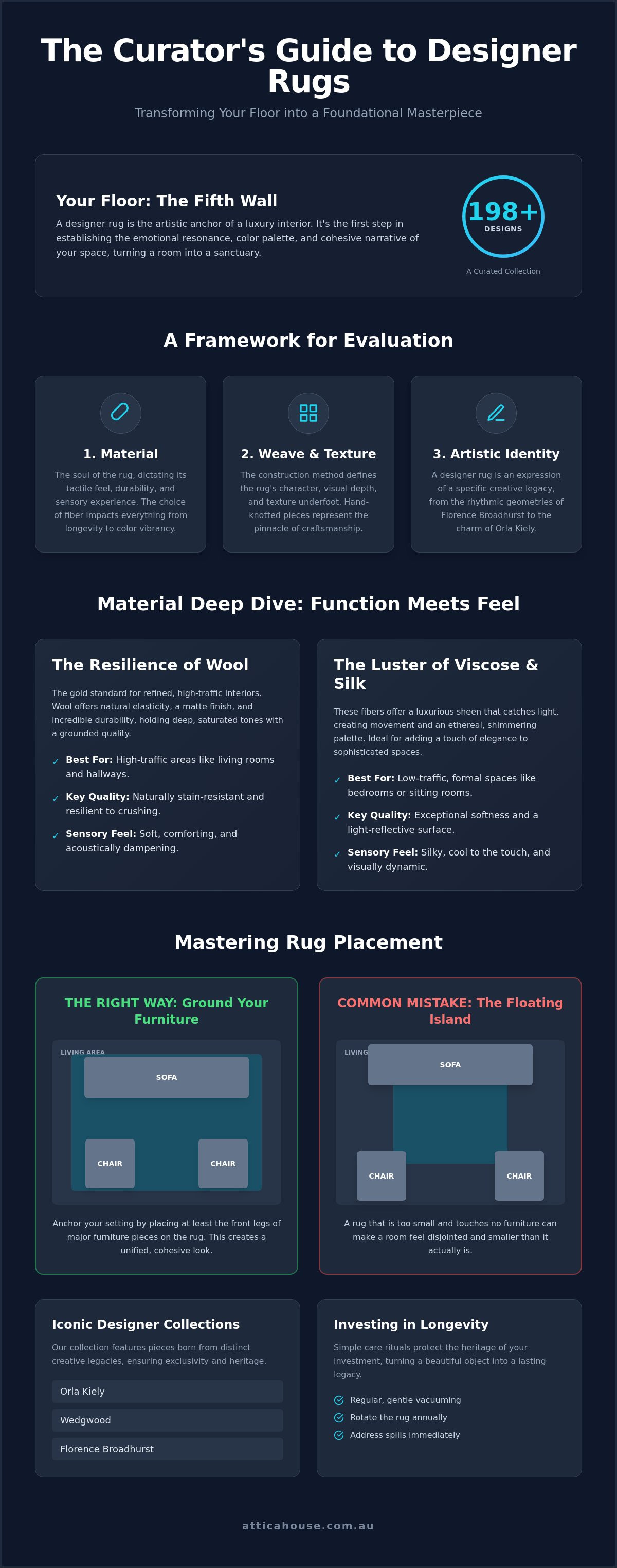
The most frequent error in luxury interior design isn't a clash of colors, but a failure of scale. A rug that is too small for its environment creates a sense of fragmentation, making even the most expansive room feel pinched and unfinished. When selecting designer rugs, the goal is to create a unified island for your furniture to inhabit. In a living space, this usually follows one of two professional frameworks: the "all legs on" approach, which creates a grand, expansive zone, or the "front legs only" rule, which anchors the seating while allowing the floor to breathe. This choice defines whether your room feels like a formal salon or a cozy, lived-in retreat.
Layering is another technique used to add depth and visual intrigue. Placing a smaller, character-rich patterned piece over a larger, neutral foundation creates a sophisticated, multi-dimensional look that feels personal and evolved. It's an invitation to linger and explore the tactile textures of your home. When you get the proportions right, the entire room settles into a state of balance that feels both intentional and effortless.
Sizing for a Harmonious Layout
Proportion is the silent language of a well-designed room. For standard Australian living spaces, a 2.4m x 3m or 3m x 4m rug is often the minimum required to comfortably anchor a sofa and armchair arrangement. A critical rule of thumb is to leave a border of approximately 30 to 45 centimeters of visible floor around the perimeter of the rug. This prevents the space from feeling "carpeted" and maintains the architectural integrity of your floorboards or tiles. You can find a detailed room-by-room breakdown in our guide on how to choose a rug size to ensure every piece fits your sanctuary perfectly.
Coordinating with Furniture and Decor
A designer rug acts as the connective tissue between your statement pieces. If you have chosen an intricate, patterned rug, balance it with a solid-colored sofa to avoid visual fatigue. Conversely, a neutral rug with a subtle, varied pile can provide the perfect stage for more ornate buffets & cabinets. Use the secondary, more delicate colors within the rug's weave to inform your selection of wall art, creating a rhythmic flow of color from the floor to the eye level. A well-placed rug acts as a visual bridge, harmonizing a modern velvet sofa with a classic timber console in an open-plan home. To find the piece that brings your vision together, explore our curated collection of designer rugs today.
Investing in Longevity: Care and Selection at Attica House
Choosing designer rugs is a commitment to a lifestyle that values substance over the ephemeral. Unlike mass-produced alternatives that often lose their structure and luster within a few seasons, a high-quality piece is crafted to endure. It's a foundational element that matures with your home, carrying the stories of your daily life within its weave. At Attica House, we see ourselves as curators of these legacies. We offer a collection that prioritizes both a specific aesthetic vision and the physical longevity required for a lived-in sanctuary.
The beauty of a premium rug shouldn't be a source of stress. Simple, rhythmic care rituals are all that's required to maintain the emotional resonance of your space. Rotating your rug every six months ensures even wear, especially in sun-drenched Australian interiors where light patterns shift throughout the year. Regular vacuuming on a low-suction setting prevents dust from settling into the deep fibers, preserving the tactile quality you first fell in love with. These small acts of stewardship ensure your investment remains a source of comfort and pride for decades.
Protecting Your Investment
A high-quality underlay is a silent but essential partner for your rug. It provides a necessary layer of safety by preventing slipping, but it also acts as a shock absorber. This cushioning protects the delicate fibers from being crushed against the hard floor, significantly extending the life of the weave. For those inevitable moments when life happens, keep a calm hand. Blot spills immediately with a clean, dry cloth, moving from the edge toward the center. Don't rub the fibers, as this can distort the pile and push the liquid deeper. We recommend a professional deep clean every one to two years to lift away microscopic particles and restore the natural luster and vibrancy of the materials. For those seeking comprehensive care for high-end home textiles and garments, Bancrofts Dry Cleaning offers the specialized expertise needed to maintain your luxury investments.
Final Selection: Finding Your Perfect Match
With a curated collection of over 198 unique designs, the perfect artistic foundation for your home is waiting to be discovered. We've made the process of selection as seamless as possible. You can filter our offerings by color, brand, or material to find the piece that speaks to your personal story and architectural style. Whether you are furnishing a coastal retreat or a refined metropolitan apartment, our Australia-wide delivery service ensures that these luxury pieces are accessible to every discerning home. We invite you to Explore the Designer Rug Collection and find the masterpiece that will serve as the soul of your interior.
Bringing Your Vision to Life
A home should be a reflection of your internal balance and personal history. By understanding how to select a piece that balances tactile warmth with architectural scale, you move from simply filling a room to curating a sensory experience. Whether you're drawn to the mid-century rhythms of Orla Kiely or the intricate floral narratives of Ted Baker, your choice of designer rugs serves as the definitive artistic anchor of your space. It is the foundation that transforms a house into a sanctuary, bridging the gap between high-end aesthetics and lived-in comfort.
With a curated collection of 198 plus unique designs and the convenience of nationwide delivery across Australia, the journey to a more refined interior is within reach. We invite you to explore our offerings and find the foundation that resonates with your vision of the art of living well. Elevate your space with our curated Designer Rug Collection and discover how a single, thoughtful selection can redefine the emotional resonance of your home. Your masterpiece is waiting to be discovered.
Frequently Asked Questions
How do I choose the right size designer rug for my living room?
Choosing the correct size starts with ensuring the rug anchors your furniture rather than floating in the center of the room. For a cohesive look, either place all furniture legs on the rug or ensure the front legs of your sofas and armchairs rest comfortably on the surface. You should aim for a border of 30 to 45 centimeters of floor around the perimeter. This maintains the room's proportions and prevents the space from feeling overwhelmed.
Are designer rugs suitable for high-traffic areas like hallways?
High-traffic areas like hallways and entryways thrive when paired with resilient materials like premium wool. Wool fibers have a natural elasticity and protective oils that repel dirt, making them an ideal choice for the busiest parts of your home. These designer rugs are built to withstand daily movement while maintaining their structural integrity. For hallways, ensure you select a piece with a dense weave to prevent premature wear in the walking path.
What is the difference between hand-knotted and hand-tufted designer rugs?
The primary distinction lies in the method of construction and the resulting longevity of the piece. Hand-knotted rugs are created by tying individual knots onto a vertical loom, a process that can take months and results in a rug that can last for generations. Hand-tufted rugs are made by punching yarn into a canvas backing. While they offer beautiful sculptural textures and varied pile heights, they generally have a shorter lifespan than their hand-knotted counterparts.
How do I clean a designer rug made of wool or viscose?
Maintenance begins with immediate action; you should always blot spills with a clean, dry cloth rather than rubbing the fibers. Wool is naturally forgiving due to its lanolin content, but viscose is highly absorbent and sensitive to moisture. It's best to avoid using water on viscose entirely. For both materials, we recommend a professional deep clean every one to two years to remove microscopic dust and preserve the natural luster of the fibers.
Can I use a designer rug on top of carpet?
You can certainly layer a rug over existing carpet to introduce a new layer of texture and visual interest. This technique is particularly effective in large bedrooms or living spaces where you want to define a specific seating area. To prevent the rug from shifting or rippling on the carpeted surface, always use a specialized rug-to-carpet underlay. This ensures the layout remains crisp and prevents any potential safety hazards from a moving foundation.
What designer brands are featured in the Attica House collection?
The Attica House collection is a curated gallery featuring world-renowned creative visions like Orla Kiely, Wedgwood, and Ted Baker. We also showcase the bold, rhythmic geometries of Florence Broadhurst, which bring a distinctly Australian artistic flair to our offerings. These designer rugs represent a blend of global design heritage and modern innovation. With over 198 unique designs available, you can find a piece that resonates with your specific aesthetic story and the architectural character of your home.
How long do handcrafted designer rugs typically last?
A handcrafted rug is an investment designed to endure for decades when properly maintained. Hand-knotted pieces are particularly exceptional, often becoming family heirlooms that last for 50 years or more. The longevity depends heavily on the material and the density of the weave. Wool is incredibly robust and ages gracefully, while silk or viscose blends are best suited for lower-traffic sanctuaries like master bedrooms where their delicate beauty can be preserved.
Do I need a rug underlay for my designer rug?
An underlay is an essential component for both the safety of your household and the preservation of the rug itself. It prevents the piece from slipping on hard floors, which reduces the risk of accidents and keeps the layout symmetrical. Beyond safety, an underlay acts as a shock absorber. This cushioning layer protects the fibers from being crushed between heavy furniture and the hard floor, significantly extending the life and comfort of your investment.