


Common Mistakes When Arranging Furniture: The Art of a Curated Sanctuary
A truly beautiful home isn't defined by the price of its pieces, but by the space that breathes between them. You've likely spent hours selecting the perfect marble coffee table or a velvet armchair, only to find the room feels stifled or disconnected once they're in place. It's a common frustration to own exquisite items that somehow fail to sing in unison. Identifying the common mistakes when arranging furniture is the first step toward reclaiming the harmony your home deserves.
We understand that luxury is as much about feeling as it is about form. You deserve a space that acts as a restorative refuge, not a cluttered showroom. This guide will reveal the professional design errors that disrupt domestic peace and teach you how to balance statement pieces with intentional negative space. We'll explore essential rules for furniture spacing, such as the 14 to 18 inch "arms-reach" rule for coffee tables and the nuances of rug sizing. You'll gain the confidence to rearrange your existing pieces for better flow, ensuring every corner of your home feels like a curated sanctuary.
Key Takeaways
- Discover how "floating" your pieces creates an intimate, layered atmosphere while avoiding the common mistakes when arranging furniture that lead to a sterile "waiting room" aesthetic.
- Master the art of scale and visual weight to ensure your statement sofas and delicate tables exist in perfect, sophisticated proportion.
- Understand the transformative power of designer rugs and how correct sizing acts as a foundation for a cohesive, expansive floor plan.
- Apply the "arms-reach" rule to ensure your coffee tables and consoles are positioned for both effortless elegance and practical comfort.
- Learn to identify or curate a central focal point that grounds your room and guides the eye toward a sense of intentional calm.
The "Wall-Hugging" Trap: Why Floating Your Furniture Creates Depth
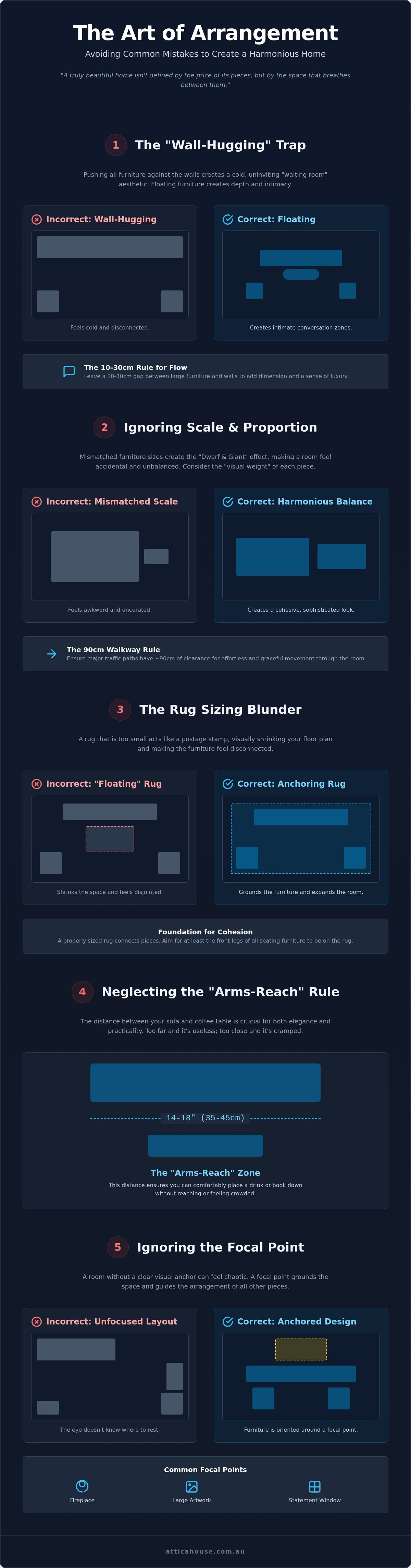
One of the most frequent common mistakes when arranging furniture is the instinct to push every large piece against the perimeter of the room. While it might feel like a way to maximize floor space, this approach often results in a "waiting room" aesthetic that feels cold and uninviting. By "floating" your furniture, which simply means pulling pieces away from the walls, you create an immediate sense of depth and intentionality. This shift transforms a room from a mere passageway into a restorative sanctuary where beauty and comfort coexist in harmony.
Understanding fundamental Interior design principles helps us see that space is just as important as the objects within it. We call this "curated breath." It's a design philosophy that allows the eye to appreciate the architecture of your home, from the sweep of the floorboards to the delicate craftsmanship of the skirting, rather than hiding these details behind the bulk of a sofa or cabinet. When furniture is pulled toward the center, the room feels more expansive and thoughtfully composed.
The 30cm Rule for Sophisticated Flow
Even in intimate spaces, a gap of just 10 to 30cm between a sofa and the wall creates a shadow line that adds immediate luxury and dimension. This breathing room signals that the furniture isn't fighting for space; it's occupying it with grace. For more generous rooms, placing a refined console table behind a floating sofa provides a functional surface for ambient lighting or artisanal objects, adding sophisticated layers to the visual narrative. Floating furniture is a technique to reclaim the center of a room for human connection.
Creating Intimate Conversation Zones
True luxury is found in the ease of connection. Instead of lining pieces up to face a television or a distant wall, group your sofas and armchairs into a "conversation circle" that encourages lingering and shared stories. This arrangement fosters a sense of warmth and social intimacy that perimeter-lining simply cannot achieve.
- Central Anchors: Use pieces like designer marble coffee tables to ground these zones. They provide a tactile, sculptural focal point that defines the boundaries of the seating area.
- Visual Balance: Pair substantial items, like deep-seated sofas, with more airy, sculptural armchairs. This prevents the room from feeling bottom-heavy or cluttered.
- Intentional Grouping: Ensure your seating is close enough to feel connected but spaced enough to allow for effortless movement.
When you focus on the relationship between pieces rather than their proximity to the walls, you avoid the common mistakes when arranging furniture that lead to a fragmented or awkward environment. This rhythmic balance is the hallmark of a home that feels both professionally designed and deeply personal.
Scale and Proportion: Balancing Statement Pieces with Room Volume
Balance is the silent language of a well-designed room. Achieving a harmonious interior requires more than just choosing beautiful objects; it demands an understanding of how those objects consume space. One of the most subtle yet impactful common mistakes when arranging furniture is failing to account for "visual weight." A deep, charcoal velvet sofa occupies far more psychological space than a glass coffee table of the same physical dimensions. When the visual weight is skewed, even a large room can feel claustrophobic or, conversely, strangely empty.
We often see the "Dwarf and Giant" effect in homes where scale has been overlooked. This happens when a sprawling, plush sectional is paired with a diminutive, spindly side table. Such a lack of cohesion makes a room feel accidental rather than curated. To avoid this, ensure your pieces share a similar sense of presence. If you're working with furniture for small spaces, focus on pieces with raised legs to allow light to flow underneath, creating an illusion of airiness without sacrificing comfort.
Functionality is the foundation of luxury. Movement through a room should feel effortless and rhythmic, never like an obstacle course. As a professional guideline, aim for approximately 90cm of clearance in major walking paths. This ensures that even when the room is full of guests, the flow remains graceful and undisturbed. If you have high ceilings, use that vertical volume to your advantage. Bespoke cabinetry from Bazzotti Living Spaces, tall buffets & cabinets, or grand wall art can bridge the gap between the floor and the ceiling, preventing your furniture from looking like it's huddling at the bottom of a well.
The Golden Ratio in Furniture Selection
The 2/3 rule is a timeless guide for achieving proportion. Your sofa should ideally span about two-thirds the length of the wall it sits against or the rug beneath it. When selecting a substantial marble coffee table, balance its density by pairing it with armchairs that have slender, elegant legs. This interplay prevents the center of the room from feeling over-encumbered. Similarly, when placing buffets & cabinets in a dining area, choose a length that commands attention without crowding the path to the dining table.
Managing Visual Clutter in Open-Plan Living
In open-plan living, we must define boundaries without building physical walls. Designer rugs and strategic lighting can "zone" a space, creating an intimate room-within-a-room. Varying the height of your pieces is essential for visual interest. Pair a low-slung sofa with a tall floor lamp or a piece of vertical art to keep the eye moving. Every sanctuary needs one clear "hero" piece, such as a statement chandelier, while other elements play a supporting role to maintain internal balance. Explore our collection of refined furniture and decor to find the perfect hero piece for your home.
By respecting the volume of your room and the visual weight of your selections, you avoid the common mistakes when arranging furniture that lead to a fragmented environment. Instead, you create a space that feels intentional, balanced, and deeply restorative.
The Rug Sizing Blunder: Why Small Textiles Shrink Your Space
A rug is far more than a mere floor covering. It's the emotional anchor of a room, a tactile foundation that defines the boundaries of your sanctuary. One of the most pervasive common mistakes when arranging furniture is selecting a rug that is too small for the space. When a rug is undersized, it acts as a "postage stamp," floating aimlessly in the center of the floor. This creates a fragmented, disjointed atmosphere that makes even the most expansive lounge feel cramped and unfinished.
True luxury requires a sense of abundance and continuity. In a sophisticated interior, your rug should act as a cohesive stage for your furniture. To achieve this, the textile should ideally extend at least 20cm beyond the edges of your primary pieces, such as your sofa or armchairs. This generous margin creates a visual bridge between the furniture and the architecture, ensuring the arrangement feels intentional. For those seeking a truly unique finish, exploring handcrafted rugs online Australia offers an opportunity to introduce artistry that grounds the room's narrative in heritage and quality.
Rug Placement Comparison
The difference between a failed layout and a successful one often comes down to how your furniture "sits" on the rug. Avoiding common mistakes when arranging furniture means understanding the relationship between the legs of your pieces and the edge of the textile. Avoid the "Floating Rug" fail, where no furniture legs touch the rug. Instead, aim for an "Anchored Layout."
- All Legs On: This is the gold standard for large rooms. The rug encompasses the entire seating group, creating an intimate room-within-a-room.
- Front Legs On: A graceful choice for medium spaces. Placing the front legs of sofas and armchairs on the rug connects the pieces without overwhelming the floor.
- Dining Room Precision: In the dining room, the rug must be large enough for chairs to remain on the surface even when pulled out. Aim for at least 60cm of rug extending beyond the table edge on all sides.
For added sophistication, consider layering a smaller, vintage-inspired rug over a larger, neutral base. This technique introduces a rhythmic quality and textural depth that feels both modern and timeless.
Materiality and Spatial Definition
The pile height and material of a rug significantly influence the perceived "softness" of a furniture cluster. A high-pile, plush texture invites a sense of restorative calm in a lounge, while a lower-profile weave provides the stability needed for dining chairs. Patterns can also be used strategically to direct the eye toward a focal point, such as a fireplace or an expansive window. Ultimately, a rug is the foundation upon which the room’s narrative is built, providing the tactile comfort necessary for a life well-lived.
Neglecting the "Arms-Reach" Rule for Surfaces
Luxury is often whispered through the ease of a gesture. Imagine a guest holding a crystal glass with nowhere to place it, or a quiet evening interrupted because a book is just out of reach. This oversight is among the most frequent common mistakes when arranging furniture. We call it the "Cocktail Rule": every seated guest should be within an effortless reach of a stable surface. While a central coffee table is essential, it rarely serves the entire room. In larger lounges, relying solely on a center piece forces guests to stand or lean awkwardly, breaking the rhythm of conversation and the sense of calm you've worked to create.
To create a truly hospitable environment, one must consider the strategic layering of side tables and ottomans. These smaller pieces offer versatility, allowing you to adapt the room for intimate gatherings or grander events without disrupting the flow. By selecting luxury furniture Australia, you ensure that even these functional additions are crafted from high-end materials like honed stone or aged brass, elevating the room's tactile appeal and emotional resonance.
The Art of the Side Table
Precision in placement is what separates a professional layout from an accidental one. Your side tables should sit within 5cm of the sofa arm height. This ensures a seamless transition when reaching for a drink or a lamp switch. Don't feel restricted to matching sets. Pairing a heavy marble coffee table with a slender metal or warm timber side table creates a sophisticated contrast that adds character. For smaller Australian homes, nested tables are an excellent solution, providing flexible surface area that can be tucked away when the quietude of the home is preferred.
The Functional Beauty of Buffets and Consoles
Storage should never be a purely utilitarian afterthought. Refined buffets & cabinets serve as both essential storage and elegant staging areas for entertaining. When positioning these pieces in a dining space, maintain a 15cm clearance between the dining table and the buffet. This allows for comfortable movement while serving. Beyond their storage capacity, these surfaces are the perfect canvas for "vignettes." Use a mix of tall lamps and curated art to create pockets of light and shadow that draw the eye and ground the room's design.
A home that anticipates your needs is a true sanctuary. Browse our collection of designer coffee and side tables to complete your living space with effortless elegance.
Ignoring the Focal Point: Designing Around a Visual Anchor
Every room requires a narrative heart, a singular point of interest that draws the eye and settles the soul. Among the most frequent common mistakes when arranging furniture is the failure to define this visual anchor, leading to a space that feels aimless or fragmented. Whether it's a grand fireplace, an expansive window with a verdant view, or a piece of evocative wall art, this focal point should dictate the orientation of every other piece in the room. Without it, furniture often feels like it's huddling in wait rather than engaging in a dialogue.
A common conflict arises when competing focal points, such as a television and a fireplace, fight for dominance. This creates a visual tug-of-war that disrupts the room’s internal balance. To maintain a sense of calm, prioritize the architectural feature or the view, and integrate technology subtly. Use lighting as your guide; a grand chandelier or strategically placed floor lamps can act as spotlights, gently directing attention toward your most cherished hero pieces and away from utilitarian distractions. This creates a rhythmic flow that rewards the eye as it moves through the space.
Centering the Room with Designer Marble Coffee Tables
In the absence of an architectural focal point, a central stone piece provides a necessary sense of gravity. A designer marble coffee table acts as a grounding element for the entire seating group, pulling disparate armchairs and sofas into a cohesive conversation zone. To prevent the space from feeling clinical, balance the cool, smooth tones of the marble with the tactile warmth of designer rugs. A sculptural coffee table serves as a functional piece of art, offering both a landing place for everyday objects and a sophisticated visual anchor.
Curating the Vertical Space
The arrangement of your home shouldn't stop at the floorboards. Vertical space is essential for creating a sense of volume and height. When hanging wall art prints, follow the professional "Eye-Level" rule by centering the piece approximately 145 to 150cm from the floor. This ensures the artwork feels connected to the furniture below rather than floating in isolation. Mirrors can also be used to amplify natural light and reflect your most beautiful furniture arrangements, doubling the visual depth of the room. These principles apply even to functional zones; for instance, luxury home office layouts thrive when visual balance is used to inspire productivity and clarity. By avoiding these common mistakes when arranging furniture, you transform your home into a refined, curated sanctuary that reflects your personal story with grace.
Cultivating Your Refined Sanctuary
Transforming a house into a soulful refuge is a journey of intentional selection and rhythmic placement. By stepping away from the wall-hugging trap and embracing the subtle art of floating your pieces, you invite a sense of depth and luxury into your daily life. This pursuit of a perfectly balanced environment is also what defines the world's most exclusive stays, such as the luxury villa rentals Ibiza curated by TOM BENZON, where every room is a study in effortless flow. Balancing the visual weight of your statement items with appropriately scaled designer rugs ensures that your home feels grounded and expansive. These shifts in perspective allow you to move past the common mistakes when arranging furniture, replacing awkward gaps with a flow that feels both professional and deeply personal.
Every corner of your home should reflect your commitment to living well. Whether you're seeking the timeless elegance of expertly crafted marble or the tactile richness of handcrafted textiles, our collection is designed to help you curate a space of internal balance. Explore our curated collection of luxury furniture and designer rugs to transform your home today. With our commitment to curated Australian luxury and reliable Australia-wide delivery, your vision for a sophisticated sanctuary is within reach. Trust your instincts, embrace the space, and begin the rewarding process of refining your world.
Frequently Asked Questions
What is the most common living room layout mistake?
The most frequent error is "wall-hugging," where every piece of furniture is pushed against the room's perimeter. This creates a cold, formal atmosphere reminiscent of a waiting room rather than a restorative lounge. Pulling your sofa and armchairs even a few centimeters toward the center creates a "conversation circle" that fosters intimacy and allows the architecture of your home to breathe.
How far should a coffee table be from a sofa?
The ideal distance between the edge of your sofa and your coffee table is between 35 and 45 centimeters. This specific measurement follows the "arms-reach" rule, ensuring that guests can effortlessly set down a drink or reach for a book without standing up. It provides enough space for comfortable legroom while maintaining the rhythmic connection between your seating and the central surface.
Can I put all my furniture against the walls in a small room?
While it's tempting to maximize floor space in tight quarters, pushing everything against the walls is one of the common mistakes when arranging furniture that actually makes a room feel smaller. Creating a small gap of just 10 centimeters behind a sofa adds a subtle shadow line that provides depth. This technique tricks the eye into perceiving more volume, making the sanctuary feel more expansive and layered.
How do I choose the right rug size for my furniture arrangement?
Your rug should act as a cohesive stage for your furniture rather than a floating island. As a professional guideline, ensure that at least the front legs of all major seating pieces rest on the rug. In a dining room, the rug must be large enough to accommodate the chairs even when they are pulled out, which typically requires a margin of 60 centimeters beyond the table edge.
What is the "Rule of Three" in furniture styling?
The "Rule of Three" is a design principle suggesting that objects grouped in odd numbers are more visually appealing and memorable. This arrangement creates a natural, asymmetric balance that feels more organic than even pairings. You might style a console table with a tall lamp, a medium-sized piece of art, and a small tactile object to create a vignette that feels both curated and lived-in.
How do I arrange furniture in an open-plan living and dining area?
In open-plan spaces, you must create "islands" of intimacy using designer rugs and strategic lighting to define each zone. A console table placed behind a floating sofa acts as a sophisticated, low-profile boundary between the lounge and dining areas. This allows the eye to travel across the room without interruption while clearly signaling the transition from one functional space to another.
Should my sofa face the door or the window?
Your sofa should ideally face the room's primary focal point, such as a fireplace or a window with a view, while still providing a clear line of sight to the entrance. This "command position" offers a psychological sense of safety and refuge. If facing the window isn't possible, prioritize the focal point and use mirrors to reflect the natural light and outside greenery into the seating area.
How do I create a focal point in a room with no fireplace?
If your room lacks a natural architectural anchor, you can curate your own using large-scale wall art prints or a sculptural buffet. A statement piece of furniture or a bold gallery wall provides a visual destination that grounds the entire arrangement. By directing your seating toward this intentional anchor, you avoid the common mistakes when arranging furniture that lead to a space feeling aimless or disjointed.