


What Size Rug for My Living Room? The Elegant Curator’s Guide to Scale and Symmetry
A rug that is too small doesn't just look off; it actively diminishes the architectural integrity of your entire home. When you find yourself wondering what size rug for my living room will finally create that sense of harmony, you're searching for more than a simple measurement. You're looking for the soul of the space. We've all experienced the "floating rug" effect, where a beautiful textile feels like a lonely island adrift in a sea of floorboards. It's a common struggle that can make even the most expensive Australian home feel unsettled and fragmented.
You deserve a living sanctuary that feels grounded, balanced, and intentionally composed. This guide simplifies the transition between metric and imperial sizing while mastering the nuances of open-plan living. You will gain the clarity needed to achieve the perfect furniture-to-rug ratio so you can invest in a high-end handcrafted piece with absolute confidence. We're exploring the specific dimensions and placement techniques that transform a house into a curated, soulful home.
Key Takeaways
- Understand how to banish the "floating rug" error to create a sense of grounding and enclosure that elevates the perceived value of your luxury furniture.
- Navigate standard Australian dimensions to determine exactly what size rug for my living room will create the most harmonious and curated foundation for your space.
- Explore professional layout strategies, including the "All Legs On" approach, to achieve a balanced, expansive, and soulful lounge environment.
- Learn the "Painter’s Tape" secret for visualizing scale and symmetry, ensuring your chosen piece fits your sanctuary with absolute precision before you buy.
- Discover how the interplay of pile height, bespoke materials, and local light can transform a simple floor covering into a timeless design statement.
The Art of Scale: Why Rug Size is the Foundation of Your Sanctuary
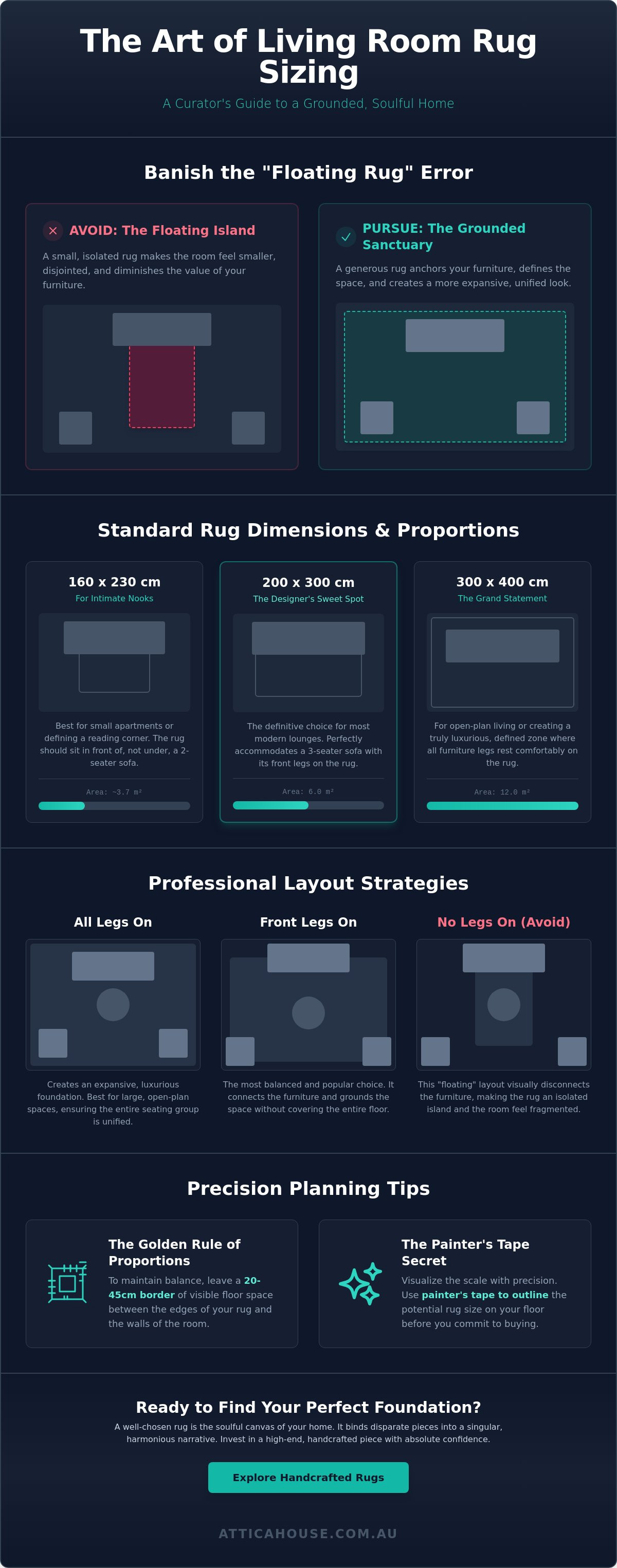
Selecting the right foundation for your home begins with a single, pivotal question: what size rug for my living room? Many homeowners fall into the trap of the 'floating rug' error, where a diminutive piece sits isolated in the centre of the room. This mistake shrinks the space and diminishes the perceived value of your investment. A small rug makes a high-end sofa look like an afterthought. In contrast, a generous rug acts as a psychological anchor. It creates a defined sanctuary, offering a sense of enclosure and calm that grounds the entire interior. When your furniture rests comfortably on a rug, it signals a sense of permanence and intentionality.
Large rugs possess a counterintuitive magic. While you might fear a 3x4 metre rug will overwhelm a compact Australian apartment, the opposite is true. Covering more floor area reduces visual clutter and draws the eye to the perimeter, making the room feel significantly more expansive. At Attica House, we view the rug as the soulful canvas of the home. It isn't just decor; it's the stage upon which your life and your curated furniture interact. It’s the element that binds disparate pieces into a singular, harmonious narrative.
The Golden Rule of Proportions
To maintain room breathability, aim for a 20-45cm border of visible floor space between the rug and the walls. This gap ensures the room doesn't feel wall-to-wall carpeted while providing enough coverage to unify the seating group. You must also consider the verticality of your space, balancing the rug’s footprint with the height of sculptural buffets or cabinets to ensure the room doesn't feel bottom-heavy. In interior design, scale is the relationship between objects and the void.
Designing for Harmony, Not Just Coverage
A well-chosen rug does more than fill a gap; it softens the architectural lines of luxury furniture australia. Symmetry plays a vital role here. In formal settings, a perfectly centred rug creates a sense of order and prestige. In relaxed living areas, an off-centre placement or a layered approach can feel more organic and lived-in. Beyond dimensions, understanding rug materials and construction allows you to pair texture with scale for a truly sensory experience. A large, low-pile wool rug offers a crisp, modern finish, while a plush, hand-knotted texture adds warmth and depth to a minimalist Australian home. The goal is to create a space where every element feels like it belongs exactly where it's placed.
Standard Rug Dimensions: A Blueprint for Australian Living Rooms
Choosing the right foundation for a space requires a shift from guesswork to architectural precision. In the Australian market, we rely on metric standards that define the rhythm and flow of a home. When you begin to contemplate what size rug for my living room, the answer usually reveals itself through the dimensions of your primary seating. A rug shouldn't merely exist in a room; it should ground it, acting as the silent tether that holds your design elements in harmony.
Standard dimensions provide a reliable framework for achieving this balance. Most high-end Australian interiors revolve around three specific scales: 160x230cm, 200x300cm, and 300x400cm. Each serves a distinct purpose in the curator's toolkit. While a 160x230cm rug covers roughly 3.6 square metres, moving up to a 300x400cm "Grand" size increases that footprint to 12 square metres. This jump in scale is often what separates a standard room from a professionally styled sanctuary.
The Versatile 160x230cm: For Intimate Nooks
This size serves as a sophisticated touchpoint for smaller footprints. It's particularly effective in inner-city apartments or secondary seating zones where space is a premium. You might pair this dimension with a single statement armchair or a compact coffee table to define a reading corner. For many homeowners, this scale is the perfect introduction to handcrafted rugs online australia, offering a concentrated dose of texture and artistry without overwhelming a modest floorplan. It works best when the rug sits just in front of a 2-seater sofa, rather than underneath it.
The Designer Standard: 200x300cm and 300x400cm
The 200x300cm rug is the definitive "sweet spot" for the modern Australian lounge. It provides enough surface area to accommodate a standard 3-seater sofa, ensuring the front legs rest comfortably on the pile. If you're styling a room with expansive sofas or large modular units, the 300x400cm size is essential for a seamless floor-to-furniture transition. This larger scale allows all furniture legs to be grounded on the rug, which creates a cohesive "island" effect in open-plan homes. Adhering to professional living room rug layout rules ensures you maintain a 30cm to 45cm border of bare floor around the rug, which prevents the space from feeling cramped.
In grand-scale architectural homes, standard sizes may fall short. When a room features 3-metre ceilings or vast glass expanses, a custom or oversized rug becomes the only way to maintain correct proportions. These bespoke pieces act as the soul of the room, providing a sense of permanence and luxury that smaller alternatives cannot replicate. If you're ready to define your space with intention, you can explore our curated collections to find the perfect anchor for your home.
Three Essential Layout Strategies for a Cohesive Lounge
Deciding what size rug for my living room requires a shift in perspective. You aren't just buying a textile; you're defining a boundary. The geometry of your furniture placement dictates the emotional energy of the room. While most homeowners default to the "Floating Furniture" layout, where the rug sits independently in the centre without touching any legs, this is often a missed opportunity. It’s a minimalist choice that works in very compact spaces, but for a truly curated feel, we look toward more integrated strategies. A rug should feel like an anchor, not an island.
The "All Legs On" Luxe Layout
The "All Legs On" approach is the pinnacle of expansive design. It’s most effective in large, open-plan Australian homes where the living area needs to feel like a distinct, self-contained sanctuary. By placing every piece of furniture entirely on the rug, you create a "room within a room" that feels grounded and bespoke. For this to work, the rug must be generous. We recommend ensuring the rug extends at least 20cm beyond the back of the sofa. This creates a luxurious margin that prevents the arrangement from feeling cramped. This same sense of unified scale is a cornerstone of luxury bedroom ideas, where a large rug under the bed establishes a foundation of quietude and refined comfort.
The "Front Legs" Anchor
For standard Australian living rooms, the "Front Legs Only" layout is the most versatile solution. It strikes a sophisticated balance between soft texture and the raw beauty of your floorboards or tiles. To master this look, ensure the rug extends at least 1/3 of the way under the sofa. This physical connection tethers the seating group together, preventing the furniture from looking like it’s drifting away. Consistency is the secret here; aim for a similar overlap for your armchairs and side tables to maintain a sense of rhythmic symmetry. It’s a practical way to achieve a high-end look without needing a custom-oversized piece.
Zoning in Open-Plan Spaces
In contemporary architecture, rugs act as the invisible walls of the home. When you're determining what size rug for my living room in a shared space, consider how it interacts with adjacent zones. You can use distinct rugs to separate the lounge from a formal dining area or a luxury home office. This creates a soulful flow throughout the house while giving each area its own identity.
- The Art of Layering: Place a smaller, decorative rug with a bold pattern over a larger, neutral base like jute or sisal for added depth.
- Complementary Palettes: Choose rugs that share a common tonal thread, such as warm ochres or cool eucalypt greens, to ensure the transition between zones feels intentional.
- Scale Variance: Use a large, plush pile for the lounge to signal relaxation, contrasted with a low-profile weave for the dining zone to facilitate movement.
By treating your rugs as architectural tools rather than mere accessories, you transform a simple floor covering into a foundational element of a meaningful, well-lived life.
Precision Planning: How to Measure Your Room Like a Professional
Designing a sanctuary begins with the architecture of your furniture, not the boundaries of your walls. When you're determining what size rug for my living room, the most common error is measuring the empty floor space. Instead, focus on your seating cluster. This anchor defines the room's energy and flow. Start by arranging your pieces exactly where they belong; then, measure the footprint they create together. This ensures the rug serves as a foundation for your life, rather than just a floor covering.
The Painter’s Tape Technique
Visualising a three-dimensional space from two-dimensional numbers is often difficult. Use low-tack painter's tape to outline potential rug dimensions directly on your floorboards or carpet. It's a foolproof method to see how a 300 x 400 cm rug interacts with your space compared to a 240 x 330 cm option. Live with these blue lines for 24 hours. This period lets you feel the room's rhythm during your morning coffee and evening wind-down. Ensure you adjust the tape to account for the swing of a buffet cabinet door or the clearance of a deep drawer. If the tape sits where a door needs to glide, the rug size requires a slight adjustment to maintain effortless movement.
Measuring Furniture for the Perfect Fit
Measure the total width and depth of your seating group. To create a sense of grounded luxury, add 20 to 30 cm to each side of this measurement. This extra breathing room ensures your furniture doesn't look cramped or unstable. To measure for an L-shaped modular sofa, calculate the distance from the furthest back corner to the front edge of the chaise, then add your 30 cm margin to ensure the entire silhouette is supported by the rug. This approach creates a cohesive island of comfort that feels intentional and bespoke.
Functional details dictate the success of your layout. Floor vents shouldn't be obstructed by heavy textiles, and fireplace hearths require a 15 to 20 cm clearance for both safety and aesthetic balance. Consider the walkway effect as you move through the home. If a rug ends in the middle of a high-traffic path, it creates a tripping hazard and feels visually jarring. Your foot should land entirely on the rug or entirely on the floor, never half-and-half. This precision ensures your home feels like a curated gallery where every element is placed with purpose. When you're ready to ground your space, explore our curated collection of designer rugs to find the perfect match for your home's unique scale.
Curating the Final Look: Texture, Material, and Placement
Choosing the right dimensions is only the first chapter in the story of your space. While you've calculated what size rug for my living room based on floor area, the physical texture and pile height dictate how that size is perceived. A rug with a low pile height of 5mm to 8mm creates a seamless transition that makes a room feel expansive and airy. Conversely, a plush, high-pile rug creates a defined "island" of comfort. This physical depth adds visual weight, which can make a large room feel more intimate and grounded.
The unique quality of Australian light also plays a pivotal role in your selection. In homes with large, north-facing windows, the intense afternoon sun interacts differently with various fibres. Natural light can make a high-shine silk or viscose blend appear to change colour throughout the day, often making the rug feel larger as it reflects brightness into the corners of the room. Matte wools behave differently; they absorb light, creating a sense of depth and stability that works beautifully in open-plan living areas.
- Coffee Table Placement: Aim for 40cm to 45cm of space between your sofa and the coffee table. This ensures the rug's pattern is visible while maintaining functional flow.
- Ottoman Balance: If using a large ottoman instead of a table, ensure at least 20 percent of the rug's central design is still visible to avoid a cluttered appearance.
- Symmetry: Align the centre of the rug with the centre of your main seating piece to create an immediate sense of architectural harmony.
Materiality and its Visual Weight
The materials you choose define the room's emotional resonance. High-shine silk blends offer a luminous quality that feels expansive, perfect for sophisticated entertaining areas. In contrast, heavy, handcrafted wools provide a matte finish that feels permanent and protective. To create a truly cohesive narrative, consider matching these textures to your wall art. A textured, impasto canvas pairs exquisitely with a chunky loop pile rug, while a sleek, glass-framed photograph finds its match in a fine-spun weave. This interplay ensures the room feels curated rather than merely furnished.
The Attica House Signature
At Attica House, we believe a home should be a soulful sanctuary that reflects your personal journey. Our commitment to blending global design trends with timeless craftsmanship ensures that every piece we offer serves as a foundation for a meaningful life. We don't just provide floor coverings; we offer the essential components of a well-lived environment. When you are deciding what size rug for my living room, you're choosing the canvas upon which your family's memories will be painted. Our curated pieces are designed to bring harmony, balance, and a touch of modern luxury to the contemporary Australian home.
Your perfect space is waiting to be realised. Explore our designer rugs to find your perfect fit and transform your living room into a masterclass of scale and symmetry. Discover our Collection here: https://www.atticahouse.com.au/collections/contemporary-rugs
Designing a Space That Breathes
A well-proportioned room feels effortless because it respects the quiet laws of symmetry and scale. When you master the art of measurement, such as maintaining the recommended 45cm border of exposed flooring around your furniture, you ground your space in professional precision. Selecting what size rug for my living room is the most significant design decision you'll make to define your lounge's boundaries. It's the difference between a fragmented space and a cohesive sanctuary; it's the foundation of your home's aesthetic rhythm. Our pieces reflect a heritage of handcrafted artistry, designed to withstand the nuances of modern Australian living while remaining deeply personal.
Every rug in our collection is curated by the design experts at Café Lighting & Living, ensuring a standard of quality that transcends fleeting trends. We provide Australia-wide delivery on all luxury pieces, making it simpler to bring bespoke elegance into your home. Your floor is a canvas, and the right rug is the anchor that holds your story together. We can't wait to see how you transform your sanctuary into a place of true harmony.
Discover Your Perfect Anchor: Shop Attica House Designer Rugs
Frequently Asked Questions
What is the most common rug size for a living room in Australia?
The 200cm x 300cm rug is the standard choice for Australian homes, effectively anchoring a typical three-seater sofa and two armchairs. For larger, open-plan residences, the 240cm x 330cm size has seen a 15% increase in preference among designers seeking to fill expansive floor plans. These dimensions offer a generous foundation that balances the room's proportions. It ensures your furniture feels grounded rather than floating in a sea of floorboards.
Can a rug be too large for a living room?
A rug is considered too large if it covers the entire floor area and sits flush against the skirting boards, which mimics wall-to-wall carpet. To maintain a sense of airiness, leave a minimum of 20cm to 45cm of visible flooring around the perimeter. This border acts as a frame for your rug. It highlights the architectural beauty of your timber or polished concrete floors while defining the seating zone with intentionality.
Should all furniture legs sit on the rug?
Placing all furniture legs on the rug creates the most cohesive and luxurious look, particularly in spacious rooms. If your space is more intimate, ensure at least the front two legs of every seating piece rest on the rug by about 15cm to 20cm. This connection unifies the furniture group into a single, inviting sanctuary. It prevents the pieces from feeling disconnected or drifting apart visually.
How much floor space should be visible around the rug?
You should aim for 30cm to 45cm of visible floor space between the rug's edge and the walls of your living room. In smaller Australian apartments, this margin can be reduced to 20cm to maintain a sense of scale. This negative space allows the room to breathe. It ensures the rug looks like a curated design choice rather than an oversized afterthought that crowds the room's natural flow.
What size rug do I need for a 3-seater sofa?
A 200cm x 300cm rug is the ideal answer when wondering what size rug for my living room featuring a standard 2.4-meter 3-seater sofa. This size extends approximately 30cm beyond each end of the sofa, providing a balanced and symmetrical aesthetic. It offers enough surface area to accommodate a coffee table and the front legs of flanking armchairs. This configuration creates a grounded, professional finish that feels both spacious and intimate.
Can you layer a small rug over a larger one in the living room?
Layering a smaller, decorative rug over a larger, neutral base rug is a sophisticated way to add texture and visual interest. Use a flatweave sisal or jute rug as the foundation and place a plush wool or patterned piece on top, ensuring the top rug is at least 60cm smaller on all sides. This technique allows you to define a specific area, like a reading nook, while maintaining the overall harmony of the room's palette.
How do I choose a rug size for an open-plan living and dining area?
Choose two separate rugs to define the living and dining zones within an open-plan layout, ensuring a clear walkway of at least 60cm between them. The dining rug must be large enough for chairs to remain on the surface when pulled out, typically requiring a 240cm x 330cm size for an 8-seater table. This visual separation organises the vast space into functional, soulful areas without the need for physical walls or partitions.
Does the rug need to be centered in the room or under the furniture?
The rug should always be centered under the furniture arrangement rather than the room itself to create a sense of purpose and symmetry. When determining what size rug for my living room, prioritise the layout of your seating group to ensure the rug anchors the core interaction zone. Aligning the rug with the furniture creates a balanced sanctuary that feels intentional. It avoids the awkwardness of a rug that looks lost in the centre of a large floor.