


How to Choose Art That Reflects Your Personality: The Art of Curating a Soulful Home
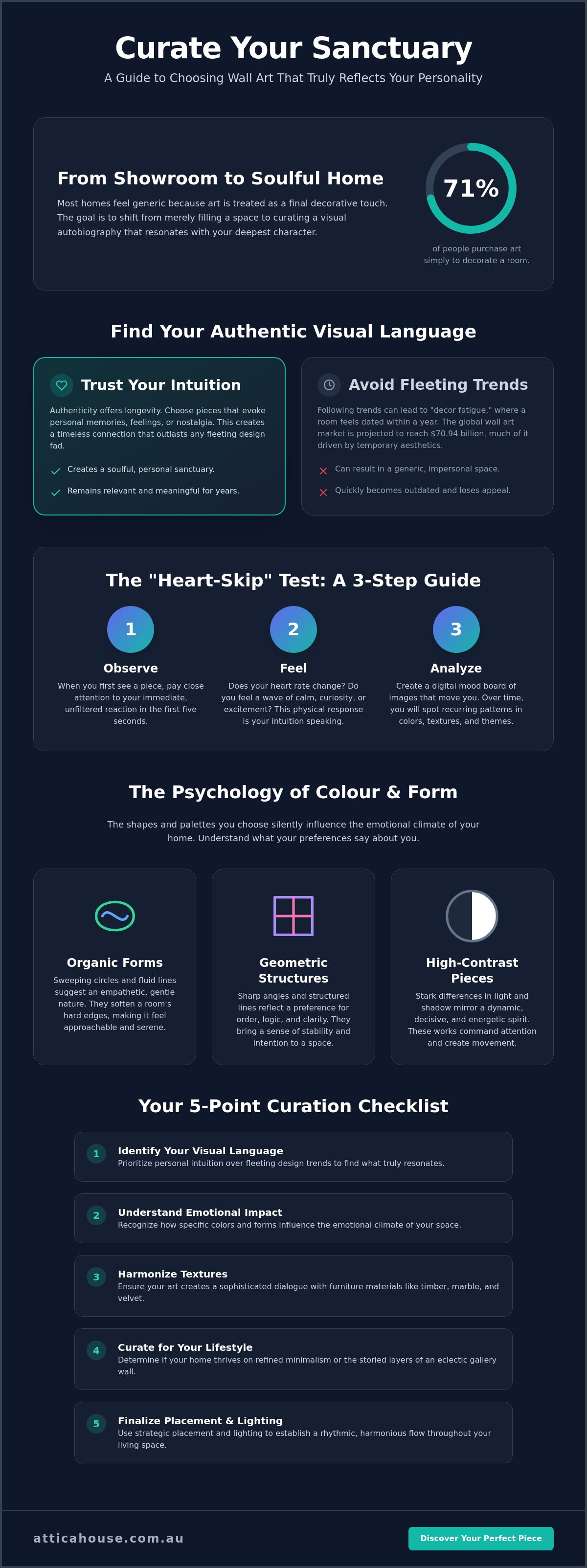
What if the paintings and prints on your walls were more than just fillers for empty space? While 71% of people purchase art simply to decorate their rooms, many find themselves living in homes that feel like a generic showroom rather than a personal sanctuary. You might feel overwhelmed by the endless digital galleries, or fear that your favorite pieces will clash with your existing furniture. Learning how to choose art that reflects your personality is the essential shift from merely furnishing a house to curating a soulful home that tells your unique story.
It's natural to worry about making the wrong investment or failing to find a cohesive look; however, your environment should be a deep reflection of your internal balance. In this guide, you'll discover how to move beyond simple decoration and select wall art that resonates with your deepest character. We will explore the nuances of high-end selection, from understanding the emotional weight of different mediums to ensuring your chosen pieces create a rhythmic harmony with your existing sofas, tables, and designer rugs. Together, we can transform your walls into a visual autobiography of those who dwell within.
Key Takeaways
- Learn to identify your instinctive visual language by prioritizing personal intuition over fleeting design trends.
- Discover how to choose art that reflects your personality by understanding how specific colour palettes and geometric forms influence the emotional climate of your sanctuary.
- Master the art of harmonising textures, ensuring your wall art prints create a sophisticated dialogue with furniture materials like timber, marble, and velvet.
- Identify your unique lifestyle archetype to determine whether your home thrives on refined minimalism or the storied layers of an eclectic gallery wall.
- Gain confidence in final placement and lighting techniques that establish a rhythmic flow throughout your living space.
Understanding Your Visual Language: The First Step in Art Selection
Your home is more than a collection of objects. It's a mirror of your inner landscape, a sanctuary where every texture and tone should resonate with your deepest character. Before you browse for wall art prints, you must first decipher your own visual language. This isn't about being an art critic; it's about recognizing your instinctive attraction to specific lines, tones, and moods that make you feel at peace. Visual language is the subconscious bridge between external aesthetics and internal values. By understanding this connection, you'll learn how to choose art that reflects your personality rather than just following a temporary fashion.
Every room needs an emotional anchor. This is the primary piece that dictates the space's energy, acting as a north star for subsequent choices. When you find this piece, it creates a sense of refuge. It's often the first thing you see when you enter a room, grounding the environment and offering a clear narrative for your life. It informs the choice of your sofas and the placement of your designer rugs, ensuring the room feels composed rather than cluttered.
Intuition vs. Trend: Why Authenticity Matters
The global wall art market is projected to reach $70.94 billion by 2026, yet much of what fills this space is driven by fleeting aesthetics. Trends often lead to decor fatigue, where a room feels dated within a year. Authenticity offers longevity, a principle that applies to all personal treasures, including the ethically sourced and handcrafted jewelry found at dryft.com.au. There's a subtle but vital difference between liking a piece in a gallery and wanting to live with it every day. True selection often involves memory and nostalgia. Perhaps a specific shade of ochre reminds you of a childhood summer, or a certain abstract form evokes the calmness of the sea. These personal echoes are what make a home feel soulful. When your choices are rooted in your own story, they remain timeless, regardless of shifting global design sensibilities.
The "Heart-Skip" Test: How to Listen to Your Gut
The most powerful indicator of a piece's suitability is your physical response. When you first view a work, pay attention to the first five seconds. Does your heart rate change? Do you feel a sense of curiosity or a sudden wave of calm? This is the heart-skip test. To refine this skill, build a digital mood board of images that move you. Over time, you'll see recurring patterns in your taste, perhaps a preference for thick impasto textures or the ethereal quality of fashion wall art. This data-driven approach to your own soul helps you understand how to choose art that reflects your personality while navigating the psychology of interior design with confidence. Your gut knows what your home needs before your mind can name it.
The Psychology of Colour and Form: What Your Choices Say About You
The colours and shapes you invite into your home act as a silent dialogue with your psyche. Understanding the psychological impact of interior design allows you to move beyond simple aesthetics toward emotional resonance. When considering how to choose art that reflects your personality, look closely at the "climate" you wish to create. A room’s atmosphere is built from the ground up, starting with the foundation of your designer rugs and rising to the visual climax on your walls.
Organic forms, such as sweeping circles and fluid flows, suggest a gentle, empathetic nature. They soften the hard edges of a room, making it feel more approachable and lived-in. Conversely, geometric structures and sharp angles reflect a preference for order, logic, and clarity. If you're naturally energetic and decisive, you might find yourself drawn to high-contrast pieces. These works use stark differences in light and shadow to mirror a dynamic spirit. They demand attention and provide a sense of movement that matches an active lifestyle.
Sometimes, the best choice isn't a direct reflection of your current state but a necessary balance. A high-energy individual might choose serene, minimalist art to create a much-needed sense of refuge. This intentional selection ensures your home remains a place of internal balance. By choosing art that provides what you lack in your daily life, you create a more holistic environment.
The Palette of the Soul: From Monochromatic to Vibrant
An introvert's refuge often features monochromatic tones. Soft blues, muted greys, and warm neutrals provide a backdrop for deep contemplation and rest. For the bold visionary, primary colours and energetic brushstrokes signal an outward-facing, vibrant life. Meanwhile, the grounded naturalist finds comfort in sage greens and rich ochres. These earthy pigments offer a sense of stability and connection to the environment. Whether you are selecting a new piece for your hallway or coordinating with your hand-selected armchairs, the palette is your primary emotional tool.
Abstract vs. Figurative: Imagination vs. Reality
Abstract art often appeals to the creative, open-ended thinker. While 36% of consumers select abstract art according to 2026 market trends, it remains a powerful tool for those who want their home to feel like an evolving narrative. It offers no fixed answers, allowing your imagination to wander and find new meanings over time. In contrast, figurative art provides the comfort of a clear narrative. It speaks to those who value heritage, tradition, and the tangible beauty of the world. You can use wall art to bridge the gap between these two worlds. A stylised landscape, for instance, offers both the familiarity of nature and the intrigue of artistic interpretation. This balance allows you to ground your space while still inviting a sense of wonder. Understanding these psychological layers is the final key to knowing how to choose art that reflects your personality with absolute confidence.
Materiality and Texture: Harmonising Art with Your Furniture
Art isn't an isolated entity; it exists in a tactile dialogue with every surface in your home. When you explore how to choose art that reflects your personality, you must look beyond the image to the materiality of the work itself. There is a profound relationship between wall art prints and the physical textures that surround them. A canvas with a heavy impasto finish, a major trend for 2026, offers a dimensional quality that mirrors the raw honesty of a timber table or the soft inviting nature of a velvet armchair. These connections create a sense of cohesion that makes a room feel intentionally curated rather than merely assembled.
Visual weight is a critical component of this harmony. It's the perceived "heaviness" of a piece based on its size, colour intensity, and texture. If a piece of art is too light, it risks being swallowed by the grandeur of your furniture; if it's too heavy, it may overwhelm the quiet elegance of the space. Achieving balance ensures that neither the art nor the furniture competes for dominance. A framed print in a warm timber finish can beautifully echo the natural grain of a timber buffet, creating a seamless visual transition between the wall and the furniture below.
Pairing Art with Statement Furniture
Selecting art to hang above luxury buffets & cabinets requires an eye for proportion. These substantial pieces provide a sturdy foundation for oversized statement art, which is currently replacing smaller, minimalist arrangements. For those with sculptural furniture featuring bold, fluid lines, a minimalist abstract piece can provide a necessary point of stillness. Conversely, you can use art to complement the cool, disciplined elegance of designer marble coffee tables. The stark, polished surface of marble pairs exquisitely with photography or fine-line sketches, highlighting the sophisticated character of both elements.
The Role of Framing in Personal Expression
The frame is the final bridge between the art and your home's architecture. It acts as the "clothing" of the piece, significantly altering its personality. A gold leaf frame suggests a "Modern Heritage" aesthetic, bringing a touch of drama and historical weight to a room. Raw oak frames offer a softer, more organic feel that suits a contemporary, nature-inspired soul. If your home features sleek console tables with metallic hardware, matching the frame finish to these details creates a rhythmic, polished look. For a more modern, lived-in luxury feel, the "no-frame" look of a gallery-wrapped canvas allows the art to breathe, letting the raw edges speak to a more casual, authentic personality. This attention to detail is a fundamental part of learning how to choose art that reflects your personality with grace.
Curating for Your Lifestyle Archetype
Identifying your lifestyle archetype is a sophisticated way to understand how to choose art that reflects your personality. It aligns your daily habits and emotional needs with your visual environment. When your home mirrors your archetype, it ceases to be a mere building and becomes a profound expression of your internal world. Whether you seek the quietude of a gallery or the vibrant layers of a storied life, your art should serve as the heartbeat of your sanctuary.
The "Modern Romantic" finds beauty in the ephemeral, often gravitating toward soft light and delicate floral motifs. Their spaces feel like a gentle exhale, where art offers a sense of tenderness and emotional depth; for instance, high-quality watercolor art from Manjachen Studio can perfectly capture this ethereal quality. In contrast, the "Executive Leader" requires a presence that commands respect. This archetype avoids the clutter of small frames, opting instead for powerful, singular statement pieces. According to 2026 design insights, oversized art is increasingly used to anchor a room's entire design, reflecting a personality built on vision and decisive action.
The Minimalist: Finding Peace in Negative Space
For the "Refined Minimalist," art is a tool for mental clarity. In a luxury home office, large-scale, simple works allow the mind to rest and focus. A single, sweeping line or a subtle wash of monochromatic colour provides a focal point without creating visual noise. This archetype values the breathability of negative space. By avoiding unnecessary detail, you maintain a sense of calm that supports a clutter-free mind and a productive soul. It's about finding the one piece that says everything by saying very little.
The Storyteller: Building a Collection Over Time
The "Eclectic Storyteller" views their home as a living archive of a life well-travelled. This archetype excels at the art of the gallery wall, mixing fashion prints, abstract sketches, and photography into a cohesive narrative. While Millennials now represent 35% of home decor buyers, many are embracing this layered approach to curation. To prevent a diverse collection from feeling untethered, use handcrafted rugs online australia as a "fifth wall" to ground the room. This tactile foundation provides the necessary weight to balance a vibrant and evolving art collection. If you are ready to define your own space, explore our collection of luxury wall art prints to find the pieces that resonate with your unique story. Mastering how to choose art that reflects your personality ensures that every frame on your wall is a chapter in your visual autobiography.
The Final Composition: Integrating Art into Your Sanctuary
The final arrangement of your collection is where the true magic of curation happens. It's about establishing a visual rhythm that guides the soul through each room. This cadence is often dictated by lighting. A well-placed spotlight can transform a flat print into a dimensional masterpiece, revealing the subtle textures of the paper or the depth of the ink. Lighting is the silent partner in learning how to choose art that reflects your personality, as it dictates the mood and intensity of the piece's expression. When shadows and highlights dance across a canvas, the art begins to breathe, shifting in character as the day turns to dusk.
Positioning your pieces requires a balance between architectural symmetry and emotional resonance. Consider the height of your console tables and the reach of your chandeliers. Art should never feel like an afterthought pinned to a wall; it should feel like it grew there. By aligning the centre of your art with the eye level of a seated guest, you create an intimate connection that invites conversation. This thoughtful integration ensures your home feels like a thoughtfully composed world where beauty and comfort coexist in perfect symmetry.
Creating a Narrative Flow Between Rooms
Think of your home as a book. Each room is a chapter, but they must all share the same protagonist. You can achieve this by using "colour threads," which are subtle repetitions of a specific hue that link the entry hall to a luxury bedroom. This doesn't mean everything must match perfectly. Instead, it's about creating a sense of familiarity. Vary the scale of your works to create moments of high-impact drama in the living room and quiet moments of intimacy in smaller corridors. This ensures the transition between spaces feels like a cohesive, intentional journey through your personal story.
The Living Gallery: Refreshing Your Space
Your personality isn't static. It evolves with every experience, and your home should reflect that growth. It's perfectly acceptable to "rotate" your art to match your current emotional season. A bright, energetic piece might serve you well in summer, while a darker, more contemplative work provides comfort during the winter months. Small changes, such as re-framing a beloved print or simply re-hanging it in a new light, can breathe fresh life into your sanctuary. View your home as a beautiful work in progress, much like yourself. At Attica House, we offer the refined elements needed to curate this visual autobiography. Mastering how to choose art that reflects your personality is a lifelong art form, and we're here to provide the inspiration for your next chapter.
Curating Your Visual Autobiography
Curating a home is a profound journey of self-discovery. By trusting your "heart-skip" intuition and understanding the psychological resonance of form and colour, you transform a house into a sanctuary. You've learned that art isn't just about the image on the wall; it's about the tactile dialogue between your prints and your furniture, and the rhythmic flow that connects every room. Mastering how to choose art that reflects your personality allows you to live in a space that feels deeply personal and authentically yours.
At Attica House, our pieces are hand-selected by refined aesthetic experts who value the transformative power of design. We provide premium quality prints designed for longevity, ensuring your investment remains a cornerstone of your environment for years to come. With Australia-wide delivery for all statement pieces, your next emotional anchor is within reach. Explore our curated collection of wall art prints to find the piece that speaks to your soul.
Your home is an evolving reflection of your spirit. Embrace the process of selection with confidence, knowing that your sanctuary is a beautiful work in progress.
Frequently Asked Questions
How do I know if a piece of art is too big for my wall?
A piece is generally too large if it leaves less than 15 to 30 centimetres of breathing room from the edges of the wall or adjacent architectural features. Ideally, statement art should occupy about two-thirds to three-quarters of the available wall space above a sofa or buffet. If the frame touches the ceiling or crowds the corners, it will make your sanctuary feel cramped rather than thoughtfully curated.
Can I mix different art styles like abstract and photography in the same room?
You can certainly mix abstract works and photography to create a sophisticated, layered narrative. This blend reflects a complex personality and prevents your home from looking like a generic showroom. The secret to success lies in finding a common thread, such as a shared colour palette or consistent framing materials. This creates a rhythmic harmony that allows diverse mediums to coexist beautifully.
What is the best height to hang wall art prints for maximum impact?
The centre of your wall art prints should sit at eye level, which is approximately 145 to 150 centimetres from the floor. In spaces like dining rooms or home offices where you are usually seated, you might lower the placement slightly to maintain an intimate connection. This intentional positioning ensures the art feels grounded within the room's composition rather than floating disconnectedly on the wall.
Should my art match my furniture or contrast with it?
Your art should harmonise with your furniture through subtle echoes of tone or texture rather than a direct, literal match. While a monochromatic piece can provide a serene refuge above a vibrant armchair, a high-contrast work can add necessary energy to a room filled with neutral linens. Learning how to choose art that reflects your personality involves deciding whether you want your environment to soothe your spirit or stimulate your mind.
How do I choose art for a room with a lot of existing patterns, like a rug?
When a room features intricate designer rugs or patterned wallpaper, select art with generous "negative space" to provide a visual rest. Look for minimalist abstracts or photography with a single, clear focal point. This approach prevents the eye from becoming overwhelmed and allows the various tactile elements in your home to exist in a balanced, rhythmic symmetry that feels both modern and timeless.
Is it better to have one large statement piece or a gallery wall?
This choice depends entirely on your lifestyle archetype. An "Executive Leader" often prefers the clarity of one oversized statement piece to act as a powerful emotional anchor. Conversely, a "Storyteller" thrives with a gallery wall, which allows for a diverse history of memories and influences. Both options are valid paths when discovering how to choose art that reflects your personality and your unique life journey.
How can I tell if a print is high quality before purchasing online?
Look for descriptions that highlight high-end craftsmanship, such as giclée printing, archival inks, and heavyweight acid-free paper. These details signal a commitment to longevity and tactile quality. Reputable curators will be transparent about their materials, ensuring that your fashion wall art possesses the sharp detail and deep, resonant colours required to elevate a sophisticated living space.
What colours are best for creating a calming atmosphere in a bedroom?
Muted tones like sage green, soft azure, and warm neutrals are the most effective for fostering a sense of calm and refuge. These colours reduce the visual "noise" of the environment, supporting internal balance and spiritual well-being. By selecting art with a soft, diffused light and a gentle palette, you reinforce the bedroom's role as a private sanctuary designed for rest and deep reflection.