


The Art of Selection: Choosing the Right Dining Table Shape for Your Space
The dining table is never just a surface for meals; it acts as the silent conductor of your home's social rhythm and the architectural anchor of your daily life. You likely feel that a room's energy shifts the moment a new piece enters the frame, yet the fear of disrupting a delicate spatial flow often makes choosing the right dining table shape feel like a heavy commitment. It's natural to worry that a grand rectangular piece might stifle a narrow room or that a round silhouette won't provide the presence your open-plan area demands.
This exploration will help you transform that uncertainty into a refined vision for your home. You'll discover how to harmonise your dining room by selecting a shape that balances architectural flow with deep social intimacy, ensuring every meal facilitates effortless conversation. We'll explore the nuances of industry standards, such as the essential 36 inch clearance for seating, giving you the confidence to measure and select a statement piece that feels perfectly balanced and symmetrical. From the rising popularity of organic ovals to the timeless stability of the rectangle, you will learn to curate a space that serves as a true sanctuary of quiet luxury.
Key Takeaways
- Understand how your table's silhouette acts as an architectural anchor, defining the room's energy and visual weight.
- Master the art of choosing the right dining table shape to complement the unique linear flow or symmetrical proportions of your home.
- Discover how curved edges and round profiles foster a sense of refuge while facilitating effortless, intimate conversation.
- Learn the essential clearance rules that maintain a 90cm to 120cm buffer, ensuring your room feels spacious rather than crowded.
- Explore the nuances of selecting high-end materials like marble and timber that resonate with your personal story and the art of living well.
The Architectural Anchor: Why Dining Table Shape Dictates Room Energy
A home's soul often resides where we gather to break bread. The dining table isn't just a utilitarian surface; it's the architectural anchor that dictates the energy of your entire residence. It serves as the spiritual heart of the home, acting as a silent witness to shared stories and the quiet ritual of daily connection. When you're choosing the right dining table shape, you're selecting the geometry that will define your most intimate social interactions. It's about more than seating capacity. It's about how the piece's silhouette speaks to the surrounding walls and the light that filters through your windows. Design is a dialogue. By choosing the right dining table shape, you ensure the piece feels like a deliberate extension of yourself rather than a functional afterthought.
While there are many common types of tables found within a thoughtfully composed interior, the dining table carries a unique responsibility. Its shape influences the visual weight of the room, which is the perceived heaviness of an object rather than its actual dimensions. A table that aligns with the horizontal planes of your architecture can create a sense of permanence and stability. Conversely, a shape that contrasts with the room's lines can introduce a necessary tension, making the dining area a distinct destination within an open-plan layout.
Visual Weight vs. Physical Footprint
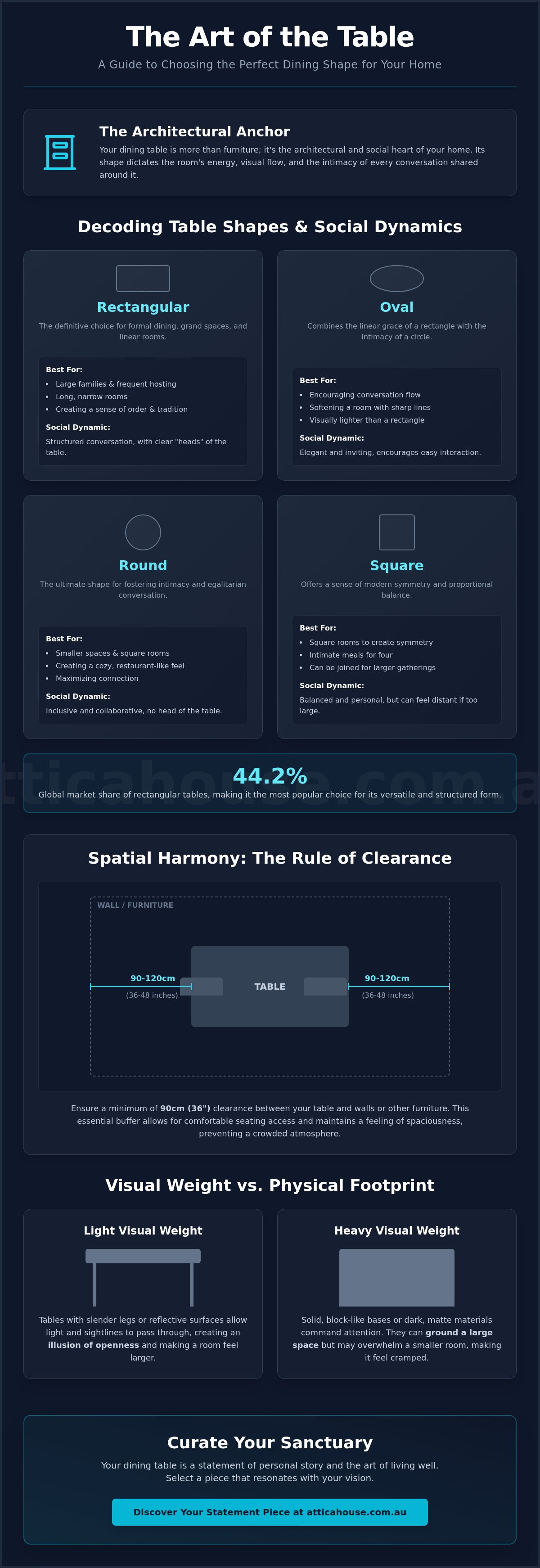
Understanding the difference between a table's physical footprint and its visual weight is essential for maintaining spatial harmony. A large rectangular table with a solid, block-like base can overwhelm a modest room, making it feel cramped and heavy. In contrast, the same dimensions supported by slender, tapered legs allow the eye to travel underneath the piece, creating an illusion of openness. Materiality plays a significant role here. A cool marble top possesses a tactile, statuesque presence that commands attention, while a warm timber surface can feel more integrated and grounded. If you're working with a confined space, selecting a table in lighter tones or one with a minimalist frame can help open up the area, preventing the furniture from dominating the architectural flow.
The Psychology of Social Geometry
The geometry of your table acts as a subtle blueprint for human connection. Linear shapes, such as rectangles and long ovals, often evoke a sense of formal tradition and grand grandeur; they are ideal for hosting structured dinner parties where the setting feels intentional and curated. Circular shapes offer a more egalitarian experience. Without a head of the table, conversation flows more inclusively, fostering a sense of calm and refuge. Your choice should ultimately reflect your personal philosophy of entertaining. Consider the entry flow of your dining area. A round table can soften the sharp corners of a square room, while a rectangular piece can reinforce the sleek, modern lines of contemporary architecture.
Rectangular and Oval Tables: Embracing Grandeur and Linear Flow
Rectangular tables are the definitive choice for those who view dining as a choreographed event. In the context of modern Australian architecture, where vast glass panes and long, clean sightlines dominate the floor plan, a rectangular table mirrors those horizontal planes. It reinforces a sense of order and permanence. When choosing the right dining table shape for an expansive open-plan area, the rectangle acts as a grand gesture, clearly demarcating the dining zone from the living lounge. This shape remains the most popular globally, accounting for 44.2% of the market share in 2025, as it provides a structured anchor for both daily life and formal celebrations.
The Rectangular Statement
A long table demands a companion that shares its architectural presence. To create a truly cohesive environment, consider pairing your selection with luxury buffets & cabinets that echo the table's length and material. This symmetry builds a gallery-like feel within the home. To anchor the ends of these elongated pieces, "host chairs" with slightly higher backs or armrests can ground the visual length, offering a sense of heritage and authority. In narrow, galley-style dining spaces, a slim rectangular table maintains a clear walkway while providing the necessary surface for elaborate spreads without overwhelming the room's physical footprint.
The Grace of the Oval
While rectangles command, ovals invite. The oval is the sophisticated compromise for those who desire the grandeur of a long table but crave a softer movement within their residence. It is particularly effective in high-traffic areas where sharp corners might impede the natural flow or pose a risk in a busy household. By removing hard angles, the eye glides across the room, making even a large piece feel less intrusive. This organic silhouette is a key trend for 2026, as designers move away from stark minimalism toward more inviting, curved forms.
The lack of corners also offers a unique social benefit regarding seating flexibility. When unexpected guests arrive, the curved perimeter allows you to comfortably add an extra chair without anyone feeling relegated to a sharp edge. This fluidity is part of why oval tables are growing faster than the market average, with a projected growth rate of 6.72% through 2031. Choosing the right dining table shape often involves balancing this need for hospitality with the constraints of your architecture. Discovering a piece that balances these elements is the first step toward a more harmonious home at atticahouse.com.au.
Round and Square Tables: Cultivating Intimacy and Spatial Balance
While elongated tables celebrate the linear flow of a home, round and square silhouettes offer a different kind of psychological comfort. They invite us to turn inward, creating a centered focus that feels grounded and secure. When you're choosing the right dining table shape for a space intended for deep, meaningful dialogue, these shapes excel. They remove the hierarchy often found at the head of a rectangular table. Instead, they promote a sense of egalitarian intimacy where every guest feels equally present and engaged. This centered geometry acts as a quiet invitation to linger long after the meal has ended.
Many of these designs feature a central pedestal base, a deliberate choice that offers significant functional advantages. By removing perimeter legs, you maximize legroom and create an ethereal, floating appearance. This aesthetic lightness is crucial when you want a large piece to feel like a sculptural element rather than a heavy obstruction. It allows the chairs to be tucked in closer, preserving the "luxury of space" even when the table is not in use. This balance of form and function is a hallmark of a thoughtfully composed interior.
The Circular Sanctuary
A circular table is a masterful tool for breaking up the repetitive geometry of a square or rectangular room. While some suggest round tables are only for compact apartments, a grand 6-seater or 8-seater circular table makes a profound statement. It becomes a true design focal point that softens the sharp corners of modern architecture. To further define this zone, pairing your table with handcrafted rugs creates a soft, tactile boundary that anchors the furniture within the larger floor plan. This combination transforms the dining area into a dedicated sanctuary of calm and refuge.
The Symmetrical Square
Square tables are a bold, contemporary choice that demands a specific room proportion. They work best in rooms that are themselves square or have a clearly defined symmetrical niche, as they reinforce the existing architectural harmony. The social intimacy of a square is unmatched. Because everyone sits at an equal distance from the center, the table facilitates a collective conversation that feels effortless. Styling a square surface requires a similar eye for balance. A central statement bowl or a singular sculptural piece can mirror the table's geometry, creating a composed look that feels both modern and timeless. Choosing the right dining table shape for a symmetrical room often leads back to the square, providing a fresh, sophisticated alternative to more traditional forms.
Spatial Harmony: Measuring for Clearance and Conversation Flow
True spatial harmony is found in the invisible boundaries that allow a room to breathe. While the aesthetic silhouette of a piece captures the eye, its relationship with the surrounding architecture determines the comfort of the lived experience. When choosing the right dining table shape, you must account for the "luxury of space" that exists between the furniture and the walls. A room that feels pinched or crowded loses its sense of refuge. To maintain a graceful flow, observe the golden rule of clearance: ensure there is a minimum of 90cm to 120cm between the table edge and the nearest wall or buffet. This buffer allows for the effortless push-back of chairs and ensures that walkways remain clear even when the table is fully occupied.
The technical nuances of your selection extend to the relationship between table height and leg placement. Standard dining tables sit between 71cm and 76cm high, but the configuration of the base can significantly alter how you select your dining chairs. A pedestal base offers unparalleled freedom for leg movement, whereas corner legs define a strict boundary for where a chair can be tucked. If you're choosing the right dining table shape for a high-traffic zone, consider the circulation paths around the piece. A table should never feel like an obstacle; it should feel like a destination that's easy to reach and even easier to linger within.
A Guide to Proportions
Visualising a new piece in your home requires more than a tape measure. Many designers recommend using painter’s tape on the floor to map out the table's footprint. This allows you to walk through the space and feel the impact of the shape on your room's natural rhythm. For a refined, non-cramped dining experience, aim for 75cm of "elbow room" per person. This exceeds the industry minimum but ensures that every guest enjoys a sense of personal space and comfort.
| Table Shape | Suggested Room Size | Comfortable Seating |
|---|---|---|
| Round (150cm) | 3.5m x 3.5m | 6 Guests |
| Rectangular (240cm) | 3.5m x 5m | 8 Guests |
| Square (150cm) | 4m x 4m | 8 Guests |
Pairing with the Surroundings
A dining table doesn't exist in isolation. It must converse with the elements that frame it. Ensure your table's geometry doesn't compete with statement wall art; instead, let the two elements balance one another. For instance, a circular table can soften the presence of a large, angular canvas. Similarly, the shape of your pendant lighting should mirror or deliberately contrast your table's lines to create a cohesive vertical narrative. Pay attention to the orientation of your floorboards or rugs. Aligning the long axis of a rectangular table with the grain of the timber floor can elongate the room, while a round table can act as a grounding pivot point in a more eclectic space.
Explore our curated collection of artisanal pieces to find the perfect anchor for your home at Attica House dining tables.
Curating Your Sanctuary: Selecting an Attica House Statement Piece
At Attica House, we believe the home is a living canvas, a sanctuary where every selection should resonate with your personal narrative. Our philosophy is rooted in the art of living well, curating global design trends while honouring the enduring beauty of timeless craftsmanship. When you've moved past the technicalities of choosing the right dining table shape, you step into the space of emotional resonance. A table isn't just a place for meals; it's the foundation for a meaningful home life. Each piece in our collection is chosen for its ability to transform a room into a refuge, blending local environmental influences with a sophisticated, global aesthetic.
Our curated selection features materials that celebrate both form and function. Whether you're drawn to the cool, statuesque presence of a marble pedestal or the grounded warmth of handcrafted timber, each piece acts as an architectural anchor. We invite you to experience these textures firsthand at our Sydney partner showroom. There, the weight of the stone and the grain of the wood offer a tactile experience that digital images cannot replicate. For those who wish to host events that match this level of luxury, Casa Catering Sydney offers professional services that bring culinary excellence to your home or yacht. This careful selection process is our promise of quality, ensuring your home remains a reflection of your commitment to excellence and internal balance.
Materials That Elevate Shape
The allure of marble remains timeless, particularly when rendered in soft round or commanding rectangular formats. Its natural veining ensures that no two pieces are identical, offering an exclusivity that defines luxury. For those seeking a more organic feel, our handcrafted timber finishes add a layer of warmth to contemporary linear shapes, softening the sharp edges of modern interiors. These pieces are more than furniture; they are essential components of luxury furniture in Australia, designed to provide a sense of spiritual well-being and longevity.
Finalising Your Vision
Once you've found the silhouette that harmonises with your space, the final steps of choosing the right dining table shape become a journey of refinement. We offer the ease of Australia-wide delivery, ensuring your statement piece arrives with the care it deserves. To complete the narrative, consider complimenting your new table with selections from our curated dining chair collection, where comfort meets high-end aspirational aesthetics. Before you commit, revisit this final checklist for a confident purchase:
- Confirm the 90cm to 120cm clearance for effortless movement around the room.
- Ensure the material’s visual weight balances your room’s existing natural light.
- Verify that the seating capacity aligns with your personal philosophy of entertaining.
- Match the table’s base style to your desired legroom and specific dining chair selection.
By following these principles, you don't just buy a table; you curate a legacy of comfort and beauty within your private sanctuary. We invite you to explore our full collection and discover the piece that speaks to your story.
Defining Your Dining Sanctuary
Selecting a dining table is a profound act of curation that shapes how you experience your home. By balancing the architectural lines of your room with the social intimacy you desire, you create more than just a place to eat. You establish a sanctuary for connection. We've explored how choosing the right dining table shape requires a careful dance between visual weight and spatial harmony. Whether you opt for the grand presence of a marble rectangle or the soft, inclusive nature of an artisanal round table, your choice dictates the energy of every gathering.
Refining your space is a journey that deserves the finest components. Our expertly curated designer collection offers pieces that serve as essential elements of a meaningful life. We invite you to Discover our curated collection of luxury dining tables and find the piece that resonates with your personal story. With a partner showroom experience in Sydney and seamless Australia-wide delivery, bringing timeless craftsmanship into your residence has never been more attainable. Trust your intuition and embrace the transformative power of thoughtful design.
Frequently Asked Questions
What is the best dining table shape for a small, narrow room?
Rectangular or oval tables are the superior choice for narrow spaces. They align with the room's longer axis, preserving a clear path for movement while providing ample surface area. An oval silhouette is particularly effective as its curved ends soften the visual impact in a tight corridor, making the room feel more fluid and less restricted by sharp angles.
How much space should be left between the dining table and the wall?
You should maintain a minimum of 36 inches, or approximately 90cm, of clearance between your table and the wall. This distance ensures guests can pull out their chairs and sit comfortably without feeling restricted. If the area serves as a primary walkway, increasing this to 48 inches is recommended to allow for effortless flow behind seated diners.
Are round dining tables better for conversation than rectangular ones?
Round tables are inherently more conducive to inclusive conversation than rectangular silhouettes. Because there is no head of the table, every guest sits at an equal distance from the center, fostering a sense of egalitarian intimacy. This geometry encourages eye contact and a shared social experience that feels both warm and centered, making it ideal for smaller gatherings.
Can I put a round rug under a rectangular dining table?
Placing a round rug under a rectangular table is typically discouraged as it disrupts the room's visual symmetry. A rug should ideally mirror the table's shape and extend 24 to 30 inches beyond the edges to accommodate chair movement. Matching these silhouettes creates a more composed and intentional aesthetic that reinforces the architectural balance of your sanctuary.
What shape of dining table is most timeless for a modern Australian home?
The rectangular table remains the most timeless choice for modern Australian residences. It complements the expansive, linear architecture and open-plan layouts frequently found in contemporary floor plans. When choosing the right dining table shape for a home with high-end aspirational aesthetics, the rectangle offers a structured anchor that bridges the gap between formal tradition and modern, lived-in luxury.
How many people can comfortably sit at a 150cm round dining table?
A 150cm round dining table can comfortably accommodate 6 to 8 guests. This size allows for the industry standard of 24 inches of width per person while maintaining enough central space for shared platters. It's an ideal dimension for those seeking a balance between a grand focal point and an intimate setting that facilitates effortless, inclusive dialogue.
Is a square dining table practical for a large family?
Square tables are remarkably practical for large families if your dining area is sufficiently wide. A large square allows everyone to sit at an equal distance, making family meals feel more connected and inclusive. It provides a bold, contemporary presence that works beautifully in symmetrical rooms where a standard rectangle might feel too elongated or traditional.
Should the shape of my dining table match the shape of my room?
While matching your table to the room's shape creates effortless harmony, it's not a strict requirement. Choosing the right dining table shape often involves a deliberate play on geometry to shift the room's energy. A round table in a square room can break up repetitive lines and introduce a sense of calm, while a rectangular table in a long room reinforces the existing architectural flow.