


How to Mix Different Furniture Styles: The Art of Refined Eclecticism
A truly soulful home is never found within the pages of a matching furniture catalog; it lives in the quiet conversation between a sleek, contemporary sofa and a storied, vintage cabinet. You likely feel the tension of wanting a space that reflects your history while fearing that one wrong move will result in a cluttered, disjointed environment. It is a common hesitation to feel unsure about how to mix different furniture styles without losing that sense of refined calm. While foundational styles like Modern and Luxury continue to dominate the market in 2026, the most evocative homes are those that embrace the surge in hybrid aesthetics to create something entirely personal.
We believe your living space should be a sanctuary that resonates with your unique story. This guide will show you how to masterfully blend contrasting design eras and tactile textures to create a luxury interior that feels curated, not chaotic. You'll discover how to use organic silhouettes, layered wood tones, and designer rugs to bridge the gap between inherited pieces and new acquisitions. By the end, you'll have the confidence to select statement pieces that transform your home into a balanced, harmonious environment where beauty and comfort coexist seamlessly.
Key Takeaways
- Learn to identify your anchor style to ground your home's narrative and provide a clear sense of purpose.
- Discover how to mix different furniture styles by applying the 80/20 rule; it's the secret to balancing a dominant aesthetic with soulful, contrasting accents.
- Uncover the power of materiality as a visual bridge, using shared textures like brass and timber to unify pieces from different centuries.
- Gain the confidence to pair organic silhouettes with geometric lines by understanding the essential role of scale and proportion.
- Follow a thoughtful implementation process to audit your space and select pieces that contribute to a harmonious, luxury sanctuary.
The Philosophy of Refined Eclecticism in Modern Interiors
Refined eclecticism is far more than a "mismatched" aesthetic. It's a deliberate, sophisticated approach to curation that values the soul of an object over the convenience of a mass-produced set. When we choose to inhabit spaces that are purely functional or strictly uniform, we often sacrifice the emotional resonance that makes a house feel like a refuge. A home should be a mirror of its inhabitants. It should reflect a history of travel, inherited legacies, and modern aspirations. Understanding how to mix different furniture styles allows you to break free from the sterility of the showroom and embrace a more meaningful way of living. It invites a sense of curiosity and discovery into the home, where every corner offers a new perspective.
This shift represents a fundamental transition in the world of high-end decor. We're no longer simply buying furniture to fill a void. Instead, we're collecting statement pieces that resonate with our personal values. This evolution involves:
- Prioritizing high-quality craftsmanship over mass-produced convenience.
- Seeking out materials that age beautifully, such as unlacquered metals and natural stone.
- Valuing the emotional connection we feel toward an object.
Each item, from a hand-finished buffet to a sculptural armchair, becomes a chapter in a larger story. By adhering to the foundational principles of interior design, such as balance and rhythm, we can ensure that this diversity feels intentional rather than accidental. It's about creating a dialogue between the old and the new.
Moving Beyond the Showroom Set
The era of the "all-in-one" furniture set has reached its natural conclusion in luxury design. These pre-packaged collections often feel hollow because they lack the friction required for true character. When every piece matches perfectly, there's no room for the eye to linger or for personal taste to evolve. Mixing styles grants your home longevity. As your life changes, your space can grow with you, integrating new finds without requiring a complete overhaul. In the Australian context, this often means blending rugged, local textures with global design sensibilities. It creates a sanctuary that feels rooted in its environment yet connected to the wider world.
The Psychology of a Curated Home
There is a profound sense of calm to be found in visual balance. While it might seem counterintuitive, contrasting styles can actually soothe the mind by providing a rich, tactile environment that rewards the senses. When you select pieces that resonate with your internal sense of well-being, the room becomes more than just a physical space; it becomes a source of spiritual energy. Mastering how to mix different furniture styles transforms a simple room into a curated sanctuary. Refined eclecticism is the precise, artful balance between the weight of heritage and the clarity of modernity.
Establishing the Foundation: The 80/20 Rule of Design
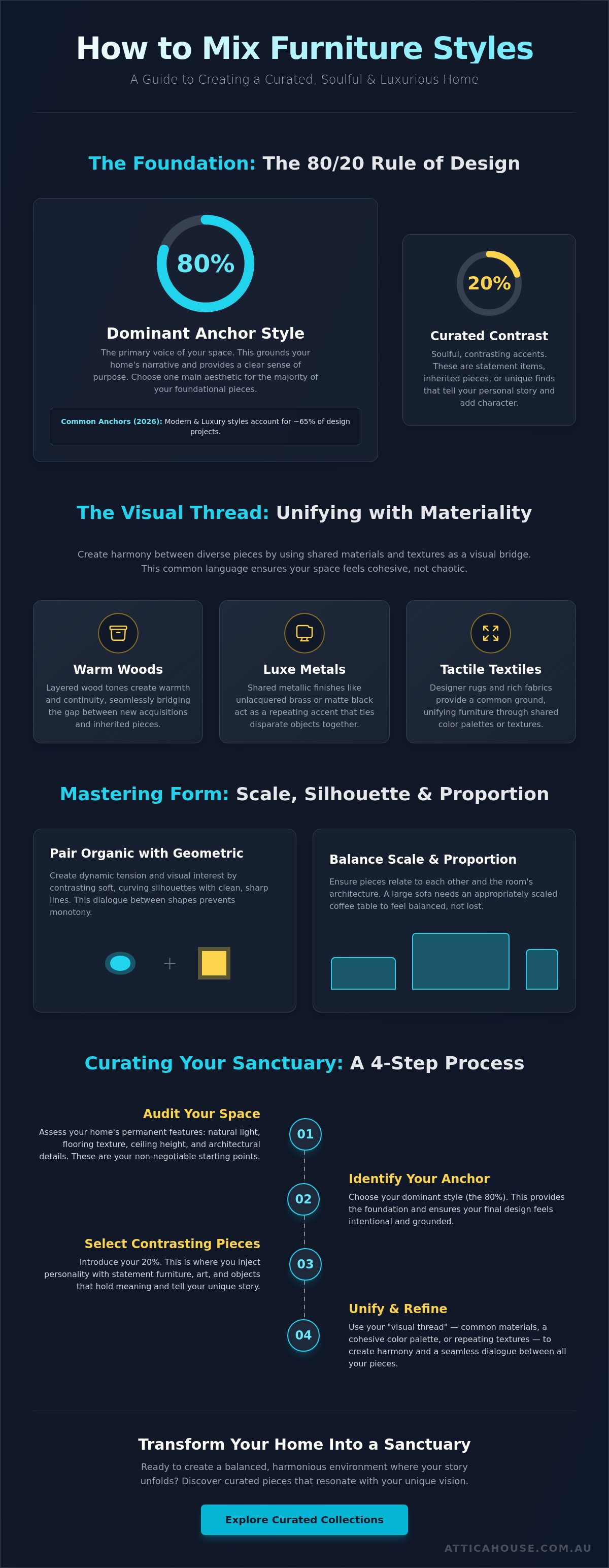
Mastery over how to mix different furniture styles begins with a clear visual hierarchy. Without a primary voice, a room can quickly become a collection of competing narratives. The 80/20 rule provides the necessary structure for a sophisticated home; it suggests that 80% of your room should follow one dominant style, while the remaining 20% acts as a curated contrast. This ratio ensures your environment feels intentional and grounded, rather than accidental. While foundational styles like Modern and Luxury account for approximately 65.42% of design projects in 2026, the most evocative interiors are those that dare to disrupt that foundation with a calculated 20% of eclectic charm.
A neutral foundation is the silent partner in this design philosophy. By keeping your largest surfaces and foundational pieces understated, you create a canvas that allows your statement items to breathe. It’s about establishing a quiet backdrop so your carefully selected accents can speak clearly without competing for attention. This balance is one of the most effective ways to master the 80/20 rule for mixing styles, ensuring that your home feels like a cohesive sanctuary.
Identifying Your Anchor Style
Assessing your home's permanent features is the first step in identifying your anchor. Consider the natural light, the texture of your flooring, and the height of your ceilings. These elements often dictate which era will feel most at home. If you choose Contemporary Minimalism as your 80%, your large-scale pieces like sofas and dining tables should reflect those clean lines and functional longevity. This consistency establishes a rhythmic flow that prevents the space from feeling chaotic. Your anchor style should resonate with your daily lifestyle, providing a stable base that can support more adventurous choices as your taste evolves.
The Power of the 20% Accent
Once your foundation is set, use the remaining 20% to introduce "disruptor" pieces. These are the items that catch the eye and spark conversation. It might be a sculptural marble coffee table or a hand-finished buffet that adds a layer of history to a contemporary room. Wall art prints are another excellent way to weave in a secondary aesthetic without overwhelming the physical floor plan. For those seeking to build a collection that feels both local and global, understanding the nuances of luxury furniture australia provides a wonderful roadmap for selection. You can explore our curated range of designer rugs and console tables to find the perfect accent for your sanctuary.
The Visual Thread: Unifying Spaces Through Materiality
While the 80/20 rule provides the structural framework for your home, materiality acts as the connective tissue that binds your collection together. To master how to mix different furniture styles, you must look beyond the surface level of color and explore the physical essence of your pieces. A "common thread" of shared materials or finishes creates a sense of continuity that allows a Mid-Century armchair to sit comfortably alongside a contemporary console table. This approach replaces the need for identical sets with a more sophisticated dialogue between textures, ensuring that even the most diverse pieces feel like they belong to the same curated world.
Materials like marble, timber, and brass serve as timeless bridges across design eras. A dining table with a solid marble top possesses a tactile gravity that grounds the space, while its cool surface can be warmed by the presence of hand-finished timber chairs. These natural elements carry an inherent luxury that transcends temporary trends. By repeating a specific finish, such as brushed brass or matte black steel, across different zones, you create a rhythmic visual path for the eye to follow. This repetition provides the necessary reassurance that every selection was made with a steady, authoritative hand.
Balancing visual weight is equally vital when curating a harmonious environment. A heavy, monolithic buffet requires the counterpoint of airy, sculptural metal frames or slender-legged stools to prevent the room from feeling stagnant. This interplay between the solid and the ethereal creates a dynamic energy, allowing each piece to maintain its individual silhouette while contributing to the overall balance of the sanctuary.
The Language of Materials
Natural stone and high-grade timber are the ultimate unifiers because they speak a language of longevity and craftsmanship. When mixing different wood tones, don't worry about finding an exact match; instead, focus on the underlying temperature of the grain. Pairing a cool-toned oak with a similarly ash-grey walnut creates depth without clashing. A shared patina of age and wear can beautifully unite a cherished vintage find with the crisp lines of a modern bedside table.
Textural Depth and Soft Furnishings
Soft furnishings provide the final layer of cohesion, acting as the canvas that holds contrasting silhouettes together. Exploring handcrafted rugs online australia is an essential step for any curator looking to define specific zones within an open-plan room. A designer rug offers a grounding foundation that physically connects a disparate sofa and armchair. The sensory contrast between smooth marble surfaces and the tactile warmth of a boucle ottoman or velvet upholstery adds a necessary dimension of comfort. This layering of textures ensures that your mastery of how to mix different furniture styles results in a home that feels as good as it looks.
Mastering Scale, Silhouette, and Proportion
Scale is the invisible arbiter of a successful interior. While materiality provides the texture, the physical dimensions of your pieces determine whether a room feels like a curated sanctuary or a cluttered storeroom. When learning how to mix different furniture styles, you'll quickly find that scale is often more vital than the era of the piece itself. A delicate, spindly chair from the mid-century era will look lost next to a monolithic, contemporary sofa. To create harmony, ensure that the visual weight of your furniture remains consistent across the room. This doesn't mean everything must be the same size; it means each piece should have enough gravity to hold its own within the collective arrangement.
Order is often found through the alignment of heights. Maintaining a consistent eye level across your primary seating and surfaces creates a sense of rhythmic calm. When the tops of your sofas, armchairs, and coffee tables sit within a similar horizontal plane, the room feels grounded. For smaller vignettes, such as styling a console table or a bedside table, the "Odd Number" rule remains a timeless principle. Grouping objects in sets of three or five creates a natural asymmetry that feels effortless and sophisticated, inviting the eye to linger without feeling overwhelmed.
The Dialogue of Silhouettes
The most compelling rooms thrive on the contrast between sharp, geometric lines and soft, organic curves. Pairing a sleek, modern sofa with a sculptural, Art Deco-inspired armchair creates a visual dialogue that feels both bold and intentional. This interplay of forms prevents the space from feeling one-dimensional. If you're working with low-profile furniture, you can use wall art to draw the eye upward and balance the height of the room. It’s also crucial to respect negative space. Allowing areas of emptiness around your statement pieces prevents visual exhaustion and lets the unique silhouette of each item truly shine.
Proportion and Spatial Harmony
Proportion ensures that the relationship between individual items feels correct. A grand, expansive dining table requires a buffet or cabinet of similar visual gravity to anchor the other side of the room. If you're mixing dining chairs from different eras, the secret to success lies in keeping the seat heights consistent; this ensures a comfortable experience for guests while allowing you to play with diverse backrests and materials. To unify the scale of a large room, consider how lighting can act as a focal point. A grand chandelier serves as a vertical anchor, drawing the eye toward the ceiling and harmonizing the proportions of the furniture below. You can explore our collection to discover chandeliers and dining tables that bring a sense of balanced luxury to your home.
Curating Your Sanctuary: A Step-by-Step Implementation
Moving from the theoretical understanding of design to the physical act of curation requires a steady hand and a patient heart. Creating a home that feels both personal and professional isn't an overnight endeavor; it's a rhythmic process of selection and refinement. To master how to mix different furniture styles, you must treat your space as a living narrative that evolves alongside your own story. This step-by-step approach ensures that your sanctuary remains balanced, inviting, and deeply resonant with your sense of self.
- Step 1: The Soulful Audit. Begin by examining your existing pieces. Identify which items bring you genuine joy or hold a cherished history. If a piece feels sterile or purely transactional, it may be time to move it on to make room for something more meaningful.
- Step 2: Define Your Material Foundation. Establish a core palette of materials that will act as your anchor. Whether you prefer the tactile warmth of oak or the cool, solid presence of marble, this foundation will guide your future selections.
- Step 3: The Anchor Investment. Every room needs a primary focal point. Invest in a high-quality piece, such as a substantial sofa or a hand-finished dining table, that defines the room's primary function and sets the tone for luxury.
- Step 4: Layering the Eclectic. This is where you explore how to mix different furniture styles with confidence. Introduce contrasting accents like a sculptural armchair, designer rugs, or fashion wall art to provide that vital 20% of personality and flair.
- Step 5: The Ruthless Edit. Step back and assess the flow of the room. If the eye feels crowded, remove one item. Every piece of furniture must have enough space to breathe so its unique silhouette can be fully appreciated.
The Art of the Final Edit
Knowing when a room is finished is a matter of intuition and balance. A space is complete not when there is nothing left to add, but when nothing can be taken away without losing the room's soul. Lighting plays a pivotal role here. A well-placed chandelier or a pair of elegant bedside lamps can highlight the beautiful intersections where different styles meet. Remember that a truly curated home is a slow process. It's better to live with an empty corner than to fill it with something that doesn't resonate with your internal sense of well-being.
Sourcing Statement Pieces
When searching for new additions, look for items that bridge the gap between global design trends and timeless craftsmanship. Seek out pieces with "soul"; those that feature handcrafted details, premium finishes, and a sense of longevity. These are the heirlooms of tomorrow. We invite you to explore the Attica House collection to find your next statement piece and continue your journey toward a more refined, personal sanctuary.
Crafting Your Personal Design Narrative
Your home is a sanctuary that should evolve with you, reflecting a life well-lived through a thoughtful collection of storied pieces. By embracing the 80/20 rule and finding the visual thread in materials like marble and timber, you've moved beyond the sterile showroom look toward a space that feels both curated and personal. Understanding how to mix different furniture styles is ultimately about trusting your intuition to blend heritage with modern clarity. It’s the final edit and the careful selection of silhouettes that transform a house into a balanced, harmonious environment.
At Attica House, we offer a curated collection of designer marble coffee tables and handcrafted timber buffets designed for timeless longevity. Each piece is expertly selected to serve as an essential component of a meaningful life. With Australia-wide delivery on our luxury furnishings, bringing these evocative elements into your private space is a seamless experience. We invite you to Discover the Attica House Collection: Statement Pieces for the Refined Home and begin the next chapter of your interior journey. You have the vision to create a home that is uniquely yours; we provide the pieces to make it a reality.
Frequently Asked Questions
Can I mix more than two different furniture styles in one room?
You can certainly mix three or more styles within a single space by maintaining a tight color palette or shared materiality. While the 80/20 rule is a helpful starting point, a more complex layering of eras can work if you anchor the room with a large scale piece like a contemporary sofa. The key is to ensure each disruptor style shares at least one common trait, such as a similar wood grain or metal finish.
How do I combine modern and traditional furniture without it looking dated?
Combining modern and traditional pieces requires a focus on silhouette and breathing room. Avoid placing too many ornate traditional pieces together; instead, pair a heritage buffet with a sleek, minimalist dining table. This juxtaposition highlights the craftsmanship of the older item while the modern piece provides a fresh, current context. Using contemporary wall art prints can also help bridge the gap between different centuries.
What is the most common mistake when mixing furniture styles?
The most frequent error is ignoring the visual weight and scale of the pieces being mixed. When people struggle with how to mix different furniture styles, they often pair a delicate, spindly antique with a heavy, overstuffed modern armchair. This creates a jarring imbalance. Ensure your furniture pieces share a similar gravity or seat height to maintain a sense of order and intentionality throughout the room.
Should all the wood in my house match if I have different styles?
You don't need to match wood finishes; in fact, mixing tones like walnut and white oak adds depth and character. Focus on the undertones of the timber rather than the exact stain. As long as you maintain a consistent temperature, such as pairing warm oaks with rich mahoganies, the room will feel cohesive. This approach allows a modern console table to sit gracefully near a vintage cabinet.
How do I use color to tie mismatched furniture together?
A restrained color palette acts as a powerful unifier for disparate furniture styles. By repeating two or three core colors across your designer rugs, upholstery, and wall art, you create a rhythmic path for the eye. This commonality allows a diverse collection of armchairs and stools to feel like a single, intentional composition. It’s about creating a quiet background that lets the unique shapes of your furniture stand out.
Is it okay to mix different metal finishes like gold and black?
Mixing metal finishes is a hallmark of sophisticated, modern luxury. You can absolutely mix metals such as brushed brass and matte black to create a layered, high end look. To keep it refined, choose one dominant metal for about 70% of the room and use the second as a thoughtful accent. For example, a grand chandelier in gold can be beautifully grounded by black steel frames on your coffee tables or console tables.
How can I incorporate an inherited antique into a minimalist home?
An inherited antique thrives in a minimalist environment when it's given enough negative space to act as a focal point. Place a storied cabinet or armchair against a neutral wall and keep the surrounding decor understated. This allows the intricate craftsmanship of the heritage piece to shine without cluttering the room. It’s a beautiful way to master how to mix different furniture styles while honoring your personal history.
Does the 80/20 rule apply to every room in the house?
The 80/20 rule is a versatile guideline that works in almost any space, from the living room to the sanctuary of the bedroom. In a bedroom, 80% might be your contemporary bed and bedside tables, while the 20% accent could be a vintage armchair or a bold piece of fashion wall art. This consistent logic helps maintain a sense of flow and calm throughout the entire home, ensuring every room feels like a refuge.