


How to Choose the Right Size Coffee Table: The Definitive Design Guide
A coffee table is never just a surface; it's the silent conductor of your living room's internal rhythm. When the proportions are off, the entire sanctuary feels unsettled. You might worry that a heavy marble piece will overwhelm your space or that a sculptural design will look dwarfed by a large designer rug. Understanding how to choose the right size coffee table is the essential first step in moving from a room that feels cluttered to one that feels intentionally curated.
We believe your home should be a reflection of your personal story, where every object serves a purpose in your well-being. This guide will help you master the art of spatial balance, offering the exact formulas for height, length, and clearance. We'll walk you through the nuances of sofa pairing and rug interaction so you can purchase your next high-end piece with absolute confidence. From the math of traffic flow to the visual weight of luxury materials, you're about to transform your living area into a professionally balanced retreat.
Key Takeaways
- Discover why the "Two-Thirds Rule" is the secret to achieving a balanced silhouette between your coffee table and sofa seating.
- Master the specific clearance measurements required to maintain a graceful flow and comfortable legroom in your living sanctuary.
- Learn how to choose the right size coffee table by accounting for visual weight, ensuring heavy marble or light glass pieces don't overwhelm your room.
- Understand the delicate relationship between your furniture and designer rugs, including the ideal percentage of surface area your table should occupy.
- Gain professional insights on selecting sculptural statement pieces that serve as essential components of a meaningful, well-lived life.
The Golden Proportions: Height and Length Rules
Proportions are the silent language of a well-composed room. When you understand how to choose the right size coffee table, you aren't just following a set of measurements; you're orchestrating a sense of internal refuge. A table that is too small creates a jarring "stretcher" effect, where the sofa appears unnecessarily oversized and the table feels like a disconnected afterthought. This imbalance often forces guests into awkward movements to reach a glass or book, instantly breaking the effortless flow of a sophisticated interior.
The history of the coffee table reveals a fascinating shift from taller, formal tea tables to the lower, more intimate heights we value in modern design. Achieving "visual levelness" is vital for creating a calm horizon within your living sanctuary. It allows the eye to travel across the room without interruption, grounding the seating arrangement and making the space feel settled and secure. When the heights and lengths are in harmony, the room breathes.
Calculating the Ideal Length for Your Sofa
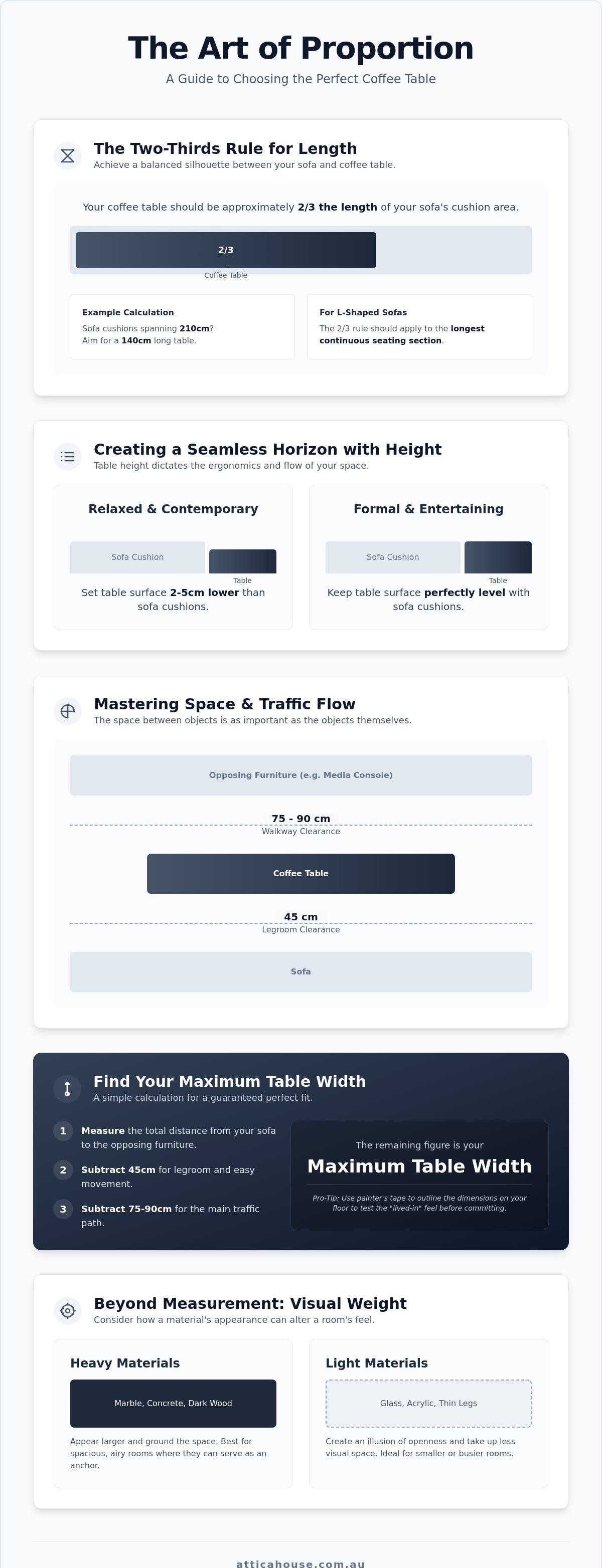
Symmetry begins with the two-thirds rule. To find your ideal length, measure the internal seating area of your sofa rather than the total width from arm to arm. If your sofa's cushions span 210 centimetres, a table approximately 140 centimetres long will provide the perfect visual weight. This specific proportion ensures that everyone seated has easy access to the surface without the table dominating the entire floor plan or making the room feel crowded.
- Standard 3-Seater: Focus on a central piece that covers two-thirds of the cushion width to maintain a classic, balanced silhouette.
- Grand Modular Designs: For L-shaped sofas, the table should relate to the length of the longest seating section to prevent the open corner from feeling cavernous.
The two-thirds rule serves as the definitive cornerstone of living room symmetry.
Height: Creating a Seamless Horizon
The height of your table dictates the ergonomics of your daily leisure. For a refined, low-profile aesthetic, the table surface should sit between 2 and 5 centimetres lower than your sofa cushions. This slight drop creates a tiered look that feels relaxed and contemporary. It's a hallmark of lived-in luxury, where comfort is prioritized alongside high-end craftsmanship and tactile quality.
There are moments where a taller table, sitting perfectly level with the cushions, is preferable. This is often the case in formal entertaining spaces where guests frequently set down drinks or small plates. A level surface is more accessible, reducing the need to lean forward significantly. Whether you choose a sculptural marble piece or a minimalist timber design, the height must harmonise with the sofa's profile to ensure the space remains a functional and beautiful sanctuary.
The Art of Space: Clearance and Traffic Flow
Spatial design is more than just the placement of objects; it's about the air that moves between them. When you discover how to choose the right size coffee table, you must consider the negative space as much as the furniture itself. The 45-centimetre rule is the standard for a reason. This specific distance between the table edge and your sofa provides enough room for legs to stretch without forcing you to reach uncomfortably for a cup of tea. It strikes a delicate balance between intimacy and ease.
Beyond the immediate seating area, perimeter clearance is what separates a cluttered room from a curated home. You should maintain at least 75 to 90 centimetres of walking space between the table and other major pieces like buffets or console tables. This ensures your sanctuary doesn't feel transactional or cramped. Instead, it invites movement and exploration. This approach is central to curating luxury furniture Australia wide, where the goal is always a sense of effortless elegance and internal balance.
Mapping Your Traffic Zones
The math of a well-lived room is simple but vital. To find the perfect fit, start with these three steps:
- Measure: Record the distance from the sofa edge to the nearest opposing piece of furniture.
- Subtract: Remove 45 centimetres for the legroom gap and at least 75 centimetres for the walkway requirement.
- Calculate: The remaining figure represents your maximum table width.
Visualising the flow is just as important as the numbers. We recommend using painter's tape on the floor to outline your potential selection. It's a tactile way to test the "lived-in" feel of the room before committing to a substantial marble or timber piece. If you find yourself sidestepping to get to the armchair, the table is likely too large for the room's natural rhythm.
Specific Rules for Sectionals and L-Shapes
Sectionals present a unique challenge in the search for symmetry. You're looking for the "nook"—the central point where the two seating sections meet. In these layouts, square or round tables often outperform rectangles. They offer a more cohesive visual weight and ensure every seat has a dedicated "landing zone" for a glass or a book. No guest should feel stranded. Each seat requires a surface within arm's reach to feel truly at home. Before making a final decision, explore the Attica House collection to see how different silhouettes can anchor your specific modular arrangement.
Shape and Visual Weight: Beyond the Tape Measure
A tape measure provides the boundaries, but your eyes determine the feel. When you're learning how to choose the right size coffee table, you must account for visual weight. This is the perceived heaviness of an object based on its material, colour, and density. A solid block of dark timber or a thick slab of stone will dominate a room's energy far more than a glass topped table of the exact same dimensions. Understanding this nuance allows you to select a piece that feels neither like a ghostly presence nor an overwhelming anchor.
Shapes play a vital role in directing the eye and managing the room's rhythm. Rectangular tables remain the classic choice for standard sofas and narrow living areas, reinforcing the linear nature of the room. Round and oval tables offer a different gift; they soften the hard edges of a modern interior and facilitate a more fluid movement in tight quarters. For those with expansive, formal lounge areas, square tables create a grand, symmetrical statement that commands attention and grounds the entire seating arrangement. They act as a communal heart for a large conversation group.
The Impact of Material Selection
Material density dictates how much breathing room a piece requires. For instance, designer marble coffee tables possess a high visual weight. Their presence is substantial and grounding, making them perfect for large rooms that need a definite focal point. Because they feel so full, they often require slightly more clearance than a lighter alternative to prevent the room from feeling crowded. The tactile quality of stone adds a layer of longevity and craftsmanship that anchors your sanctuary.
- Marble and Stone: These materials possess a high-end authority that anchors a space. They're essential components of a meaningful life, offering a sense of permanence.
- Sculptural and Open Bases: A table with slender legs or an open frame allows light and sightlines to pass through. This transparency makes a small room feel more expansive and airy, even if the table itself is quite large.
Matching Table Shape to Sofa Style
The relationship between your sofa and table should be a conversation between forms. Pairing a round table with a curved, organic sofa creates a sophisticated, flowing look that feels deeply harmonious. It mimics the natural curves of the environment, fostering a sense of internal balance and calm. Conversely, rectangular tables are excellent for reinforcing the structured, architectural lines of a tuxedo or mid-century sofa. They provide a sturdy, reliable horizon that mirrors the sofa’s own geometry.
Versatility is sometimes the ultimate luxury. If you find that a single large table feels too rigid for your lifestyle, consider a nested set. These allow you to adjust the surface area as needed, offering a modular solution that adapts to your daily needs. By mixing shapes and varying materials, you can create a space that feels professionally curated and uniquely yours. It's about finding that delicate balance between physical dimensions and the emotional resonance of the materials you choose.
The Rug Relationship: Framing Your Selection
A living room is a series of layers, and the rug is the foundation upon which your furniture rests. To master how to choose the right size coffee table, you must treat the rug as a frame rather than just a floor covering. A table that sits on a rug that is too small feels disconnected, like a piece of driftwood floating in an empty sea. This lack of grounding breaks the sense of calm you've worked so hard to establish. Instead, aim for a proportion where the table occupies roughly 30 to 40 per cent of the rug’s central surface area. This ensures the table has enough presence to anchor the room without obscuring the artistry of the weave beneath it.
The placement of your sofa legs also dictates the boundaries of your selection. Whether you follow the "front legs only" or "all legs on" rule, the rug defines the conversational island of your home. Centring the table within this boundary creates a focal point that feels intentional and professionally curated. By selecting handcrafted rugs online Australia, you introduce a layer of tactile artistry that influences how the table's material is perceived. A smooth stone surface gains even more elegance when contrasted against a deep, textured pile, creating a dialogue between the different elements of your interior.
Framing the Statement Piece
A rug acts as the visual anchor for your coffee table statement piece. When a rug is undersized, it fails to encompass the furniture, making the entire arrangement feel unstable. To avoid this, ensure the rug extends beyond the table’s edge by at least 30 to 45 centimetres on all sides. This creates a clear visual border that signals a dedicated space for relaxation. If your rug features a central medallion or a distinct pattern, align the table carefully to respect the symmetry of the design. This level of detail is what transforms a standard living room into a sophisticated sanctuary.
Contrast is your greatest tool for creating depth. If you have chosen a designer marble piece, pairing it with a high-pile or intricately textured rug adds a sensory dimension to the room. The cold, smooth quality of the stone balances the warmth of the wool, creating a space that feels both high-end and welcoming. It is a thoughtful pairing that speaks to a life well-lived, where beauty and comfort coexist in perfect harmony.
Layering for Depth
In the expansive layouts of modern Australian homes, rugs are essential for defining zones within open-plan living. The interaction between the table’s base and the rug’s weave can change the room's energy. A plinth base marble table needs a sturdy, low-pile rug to sit level, while a sculptural piece with slender legs can play with more varied textures. Use the rug’s borders to define your "clearance zone," ensuring that no other furniture encroaches on the table's breathing room. This layered approach creates a cohesive island of comfort, inviting you to linger and find internal balance. Find the perfect foundation for your sanctuary within the Attica House rug collection.
Curating the Final Look: Attica House Selection
Mastering how to choose the right size coffee table is the bridge between a room that merely exists and one that truly breathes. By synthesising the mathematical rules of proportion with the evocative weight of fine materials, you create a living sanctuary that feels both professionally curated and deeply personal. We believe a coffee table is an essential component of a meaningful life. It's an investment in your daily well-being, providing a tactile anchor for your morning rituals and evening repose—a concept celebrated by cultural spaces like Canto da Esquina Café, where the atmosphere is designed to ground and inspire. Every piece in our collection is selected for its ability to harmonise with the sofa and rug, ensuring your space remains a refuge from the outside world.
Transforming a functional surface into a refined gallery of personal treasures is the final step in the design journey. It's about elevating the everyday through careful selection. To ensure this vision reaches your home without compromise, we manage all Australia-wide logistics for our bulky luxury items. This commitment to service ensures your piece arrives safely, ready to complete the internal balance of your home. Whether you're in a coastal retreat or a metropolitan apartment, the right table brings a sense of permanence and grace to your environment.
The Attica House Aesthetic Vision
Styling Your Chosen Table
Once you've verified the proportions, clearance, and visual weight, the final step is the art of arrangement. We recommend the "Rule of Three" to create a balanced display. This involves grouping objects of varying heights, textures, and organic forms to create visual interest without clutter. If your walls feature statement wall art prints, ensure the table height remains low enough to avoid obstructing the sightlines to these lower-hanging pieces. This keeps the room’s horizon clear and expansive.
Before making your final purchase, run through this definitive checklist to ensure total confidence:
- Length: Is the table approximately two-thirds the length of your sofa’s seating area?
- Height: Does the surface sit within 2 to 5 centimetres of your sofa cushions?
- Clearance: Have you maintained a 45-centimetre gap for legroom and 75 centimetres for walkways?
- Rug Proportion: Does the table occupy roughly 30 to 40 per cent of the rug’s central area?
When these elements align, you've successfully mastered how to choose the right size coffee table. You've created a space that isn't just a room, but a thoughtfully composed world where beauty and comfort coexist in perfect symmetry.
Elevating Your Living Sanctuary
Designing a home that feels like a true refuge requires a delicate balance of mathematical proportion and evocative emotion. You've learned that the secret to a harmonious layout lies in the two-thirds rule for length and the subtle tiered effect of low-profile heights. By respecting the necessary clearance for flow and the visual weight of your chosen materials, you ensure your space remains a place of calm rather than a site of spatial friction. These principles transform a simple room into a thoughtfully composed world.
Mastering how to choose the right size coffee table is the final step in creating a professionally curated environment. As the retail-facing brand of Café Lighting & Living, Attica House specialises in designer marble and handcrafted statement pieces that offer both longevity and tactile quality. We take pride in helping you find essential components for a meaningful life, ensuring every selection reflects your personal story. With Australia-wide delivery for all designer furniture, your perfect sanctuary is always within reach.
Discover our curated collection of luxury coffee tables and begin the journey toward a more balanced, beautiful home today.
Frequently Asked Questions
How high should a coffee table be in relation to the sofa?
Ideally, a coffee table should sit between 2 and 5 centimetres lower than the top of your sofa's seat cushions. This height harmony ensures a seamless visual horizon and makes reaching for objects effortless while you're seated. If you frequently host formal gatherings, a table that is perfectly level with the cushions can also work, providing a slightly more structured and accessible surface for drinks and small plates.
Can a coffee table be longer than the sofa?
A coffee table should never be longer than the sofa it accompanies as this disrupts the room's spatial balance and creates a jarring visual weight. The standard design rule suggests the table should be approximately two-thirds the length of the sofa's seating area. Choosing a piece that exceeds the sofa's length will make the seating feel dwarfed and the overall layout appear uncomfortably crowded, sacrificing the calm refuge of your living space.
What is the best coffee table shape for a small living room?
Round or oval shapes are the most effective choices for smaller living sanctuaries because they lack sharp corners and encourage a more fluid traffic flow. These softened silhouettes allow for easier movement in tight quarters and prevent the room from feeling transactional or rigid. If you're learning how to choose the right size coffee table for a compact area, consider a piece with a sculptural, open base to maintain sightlines and create an expansive feel.
How much space should be between the coffee table and the TV stand?
You should maintain a perimeter clearance of at least 75 to 90 centimetres between your coffee table and the TV stand or other large furniture pieces like buffets. This generous walkway ensures that the room remains airy and accessible, allowing for graceful movement throughout the space. Proper spacing prevents the environment from feeling cramped, ensuring that your high-end furniture has the breathing room it needs to be appreciated as a statement of craftsmanship.
Should a coffee table be centred on the rug or the sofa?
The coffee table should always be centred in relation to the sofa and the primary seating arrangement to ground the conversational heart of the room. While the rug acts as a frame, its placement should ideally be aligned with the sofa first. If the rug is positioned correctly, the table will naturally feel centred on both, creating a cohesive island of comfort that anchors the entire living area with intentional symmetry and balance.
Is a round or rectangular coffee table better for a sectional sofa?
Round or square tables are typically better suited for sectional sofas because they fit neatly into the "nook" created by the L-shaped seating. A rectangular table can often feel too long or leave certain seats without a convenient landing zone for a book or glass. A circular piece softens the architectural lines of a modular sofa, ensuring that every guest feels included in the conversational circle and has easy access to the surface.
What size coffee table do I need for a 3-seater sofa?
For a standard 3-seater sofa with an internal seating width of 180 to 210 centimetres, you should look for a coffee table approximately 120 to 140 centimetres long. Following the two-thirds rule ensures the table is large enough to be functional for everyone seated while maintaining a balanced silhouette. This specific proportion prevents the "stretcher" effect where a tiny table looks lost and disconnected against a substantial, high-end sofa.
How do I choose a coffee table that won’t overwhelm my room?
To ensure your selection doesn't overwhelm the room, focus on the visual weight of the materials rather than just the physical dimensions. If you're concerned about a space feeling heavy, opt for a piece with a glass top or a slender, sculptural frame that allows light to pass through. Understanding how to choose the right size coffee table involves balancing the tactile quality of dense materials like marble with the need for open, negative space in your sanctuary.