


Marble vs Quartz Dining Table Pros and Cons: A Masterclass in Refined Selection
What if the very imperfections you fear in a dining table are actually the marks of a life well-lived? You've likely felt the pull of a stunning, veined surface, only to hesitate at the thought of a permanent wine stain or a subtle etch. It's a common dilemma when weighing the marble vs quartz dining table pros and cons, balancing the raw, organic beauty of the earth against the predictable resilience of modern engineering. You want a piece that feels like a permanent sanctuary, not a fragile museum exhibit.
We understand that a high-end furniture investment is about more than just utility; it's about the emotional resonance of your home. This masterclass will help you move past the confusion of technical specifications to find a material that truly mirrors your personal narrative. We'll explore the tactile allure of natural stone, the impact of the January 2026 safety regulations on engineered surfaces, and how to select a piece that serves as a timeless anchor for your living space. By the end, you'll have the clarity to choose a table that reflects your aesthetic values and stands the test of time.
Key Takeaways
- Learn to distinguish between the singular, metamorphic legacy of natural marble and the high-performance precision of engineered quartz to see which material resonates with your aesthetic vision.
- Assess the marble vs quartz dining table pros and cons to determine if you value the ritual of maintaining a "living" stone or the seamless, wipe-and-forget ease of non-porous surfaces.
- Identify your unique hosting persona to align your selection with your daily life, whether you prefer the formal grace of candlelit dinners or the vibrant energy of a busy family sanctuary.
- Gain the confidence to invest in a centerpiece that balances modern health regulations with timeless craftsmanship, ensuring your dining space remains a peaceful refuge for years to come.
The Heart of the Home: Navigating the Marble vs Quartz Dilemma
The dining table is the silent witness to our most cherished moments. It isn't just a place to set a plate; it's a vessel for connection, late-night conversations, and the slow ritual of a Sunday morning. When you begin to explore the marble vs quartz dining table pros and cons, you aren't just choosing a material. You're deciding on the tactile backdrop of your life. There is a persistent tension here. You might crave the cool, storied elegance of marble but fear the permanence of a spill. Or, you might appreciate the resilient precision of quartz while wondering if it can ever truly capture the soul of a home.
A refined sanctuary requires that beauty and function coexist without compromise. This balance is the hallmark of a thoughtfully composed environment. On one side, we have the ancient heritage of marble, a stone that has graced cathedrals and palaces for centuries. On the other, we have the modern innovation of quartz, a material designed to meet the demands of a contemporary lifestyle. Both offer a path to luxury, yet they lead to very different lived experiences.
The Symbolic Weight of Your Dining Surface
In the expansive, light-filled architecture of modern Australian homes, the dining table acts as a vital anchor. It defines the transition between the kitchen's energy and the living room's rest. Choosing a piece from a curated collection of luxury furniture Australia provides a foundation for your entire design language. It's an investment in your daily well-being. A high-quality surface sets a tone of permanence and intentionality, signaling that this is a place where time slows down. It becomes the heart of the home, grounding the space with its physical and aesthetic weight.
Defining Your Aesthetic Vision
Before diving into the technicalities, reflect on your design soul. Do you find comfort in the organic imperfections of a stone formed over millennia? Marble offers an ancient heritage, a metamorphic masterpiece where every vein is a unique fingerprint of history. Conversely, quartz represents the pinnacle of human ingenuity. This Engineered Stone Explained through its sophisticated blend of crushed minerals and resin, offers a flawless symmetry that appeals to a desire for order and unwavering resilience.
Your home should be a mirror of your internal balance. Some seek the "Quiet Luxury" of a surface that ages with them, accepting the patina of time as a beautiful narrative of shared meals. Others require the confidence of a surface that looks as pristine on year ten as it did on day one. Understanding the marble vs quartz dining table pros and cons is the first step in curating a space that feels like a true refuge. We're here to guide you through this selection, ensuring your choice resonates with your personal story and the art of living well.
Defining the Surface: The Soul of Natural Marble vs the Precision of Quartz
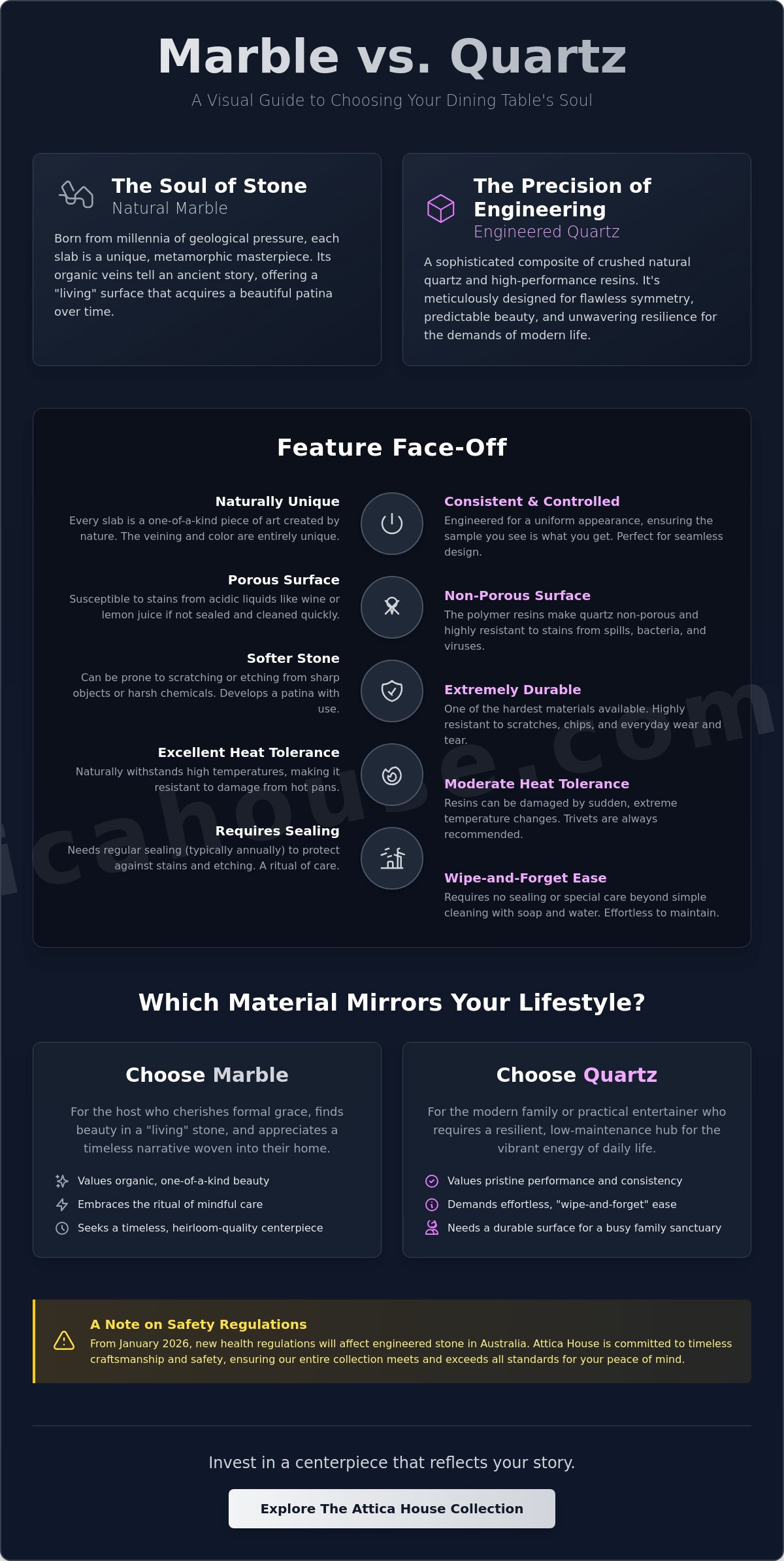
To truly appreciate the marble vs quartz dining table pros and cons, we must first look beneath the surface at the very essence of these materials. Marble is a metamorphic masterpiece. It's a stone born of deep time, forged through intense heat and pressure over millennia. This process creates a material that's as unique as a fingerprint; no two slabs ever share the exact same history or aesthetic. Quartz, conversely, is an engineered marvel. It's a sophisticated composition of crushed natural minerals and high-performance resins, meticulously designed to offer a level of precision that nature alone cannot provide.
There's a profound sensory distinction between the two. Natural stone possesses a signature "cold-to-the-touch" luxury. It draws heat away from your skin, offering a grounding, tactile sensation that feels inherently expensive and ancient. Engineered surfaces tend to maintain a more consistent, room-matching temperature. While marble tells a geological story through its unpredictable, flowing veins, quartz offers a narrative of controlled beauty. Every pattern is intentional, ensuring a flawless symmetry that many modern homeowners find deeply comforting. If you're beginning to envision how these textures might feel in your home, you might explore our curated dining collection to see these materials in situ.
The Organic Heritage of Marble
The allure of marble lies in its diverse aesthetic signatures. From the soft, grey-blue whispers of Carrara to the bold, dramatic strokes of Calacatta or the deep, obsidian depths of Nero Marquina, each variety brings a specific personality to the room. This inherent variation is why no two designer marble coffee tables or dining tables are ever identical. The choice of finish also plays a vital role. A polished finish offers a high-gloss, mirror-like brilliance that amplifies light, while a honed finish provides a velvety, matte texture that feels softer and more contemporary. Understanding the Geological Properties of Marble helps explain why this stone is so sensitive to its environment, reacting to light and touch in a way that feels almost alive.
The Engineered Excellence of Quartz
Quartz represents the pinnacle of human ingenuity in design. Its composition typically consists of approximately 90% natural quartz crystals bound together by polymer resins. This structure allows for an incredible range of "marble-look" aesthetics without the porous vulnerabilities of natural stone. It's the ideal choice for minimal or highly structured interiors where consistency is paramount. You can achieve the look of rare, exotic stone with the peace of mind that comes from a non-porous, uniform surface. It's a material that prioritizes peak performance while still nodding to the classic beauty of the natural world.
Pros and Cons: Evaluating Performance, Longevity, and Sensory Appeal
Selecting the right surface for your dining room is an exercise in balancing performance with poetry. While previous sections explored the origins of these materials, we must now look at how they behave in the vibrant, sometimes unpredictable environment of a lived-in home. The marble vs quartz dining table pros and cons often come down to a single question: do you seek a surface that remains frozen in its initial perfection, or one that evolves alongside your family? Quartz is frequently celebrated as the indestructible choice, whereas marble is a "living" stone that responds to its environment over time.
In real-world dining scenarios, the differences become tactile. A hot serving platter placed directly on the surface or a spilled glass of red wine during a spirited dinner party will affect these stones differently. Maintenance is not just a chore; it's a ritual. For some, the periodic sealing of marble is a way to care for a precious heirloom. For others, the "wipe-and-forget" ease of quartz is a necessary luxury that allows them to focus entirely on their guests rather than the table beneath the plates.
The Marble Perspective: Timeless Beauty with a Living Patina
Marble remains the gold standard for prestige. Its natural cooling properties make it a joy to touch, and its presence can significantly enhance the perceived value of your interior. However, its beauty requires a level of mindfulness. Because it is porous, it is susceptible to staining and "etching," a process where acidic substances like lemon juice or wine create dull spots on the surface.
- Pros: Unrivalled aesthetic prestige, unique natural veining, and a cool temperature ideal for pastry or warm climates.
- Cons: High porosity requires regular sealing; sensitive to acids and heavy impacts.
Many collectors view these marks not as flaws, but as a "patina." Marble honours the passing of time through its subtle evolution, becoming a textured map of your home's history and the many meals shared upon it.
The Quartz Perspective: Modern Resilience and Flawless Finish
Quartz offers a different kind of sanctuary, one defined by unwavering reliability. As a non-porous material, it resists stains from even the most stubborn pigments. It is highly scratch-resistant, standing up to the rigours of daily use and heavy cutlery without losing its lustre. There is a common misconception that quartz is a "budget" alternative; in reality, it's a premium engineered product that offers a level of consistency marble cannot match.
- Pros: Exceptional stain and scratch resistance, zero sealing required, and a uniform aesthetic that suits minimal designs.
- Cons: Sensitive to extreme heat as the polymer resins can scorch; lacks the one-of-a-kind "soul" of natural stone.
While quartz may not have the ancient heritage of marble, its precision provides a sense of calm. You don't have to worry about the aftermath of a celebration, making it the hero of the modern, multi-purpose dining room.
Curating Your Space: Choosing the Material That Reflects Your Lifestyle
Your home is a sanctuary that should reflect your personal story. When evaluating the marble vs quartz dining table pros and cons, the final decision often rests on how you inhabit your space. Are you the "Grand Entertainer" who finds joy in hosting formal, candlelit dinner parties? If so, the unrivalled prestige and ancient soul of marble will serve as the perfect dramatic backdrop. For the "Heritage Lover," only the weight and storied history of natural stone will suffice for a home intended to be a legacy for future generations. These pieces aren't just furniture; they're anchors for a life well-lived.
Conversely, the "Busy Family Sanctuary" requires a hero that can withstand the beautiful chaos of daily life. Quartz is the ideal companion for multi-purpose rooms where homework, crafts, and wine spills coexist. It also speaks to the "Minimalist Curator" who seeks the clean, architectural lines often found in modern Australian homes. In these spaces, the flawless symmetry of engineered stone provides a sense of calm and order that nature's unpredictability might occasionally disrupt. Choosing a material is an act of personal storytelling that balances your aesthetic desires with your functional needs.
Matching Material to Interior Style
Creating a cohesive environment involves more than just a table. Pairing a veined marble surface with elegant buffets & cabinets creates a classic, layered aesthetic that feels established and intentional. For those drawn to contemporary design, quartz complements sleek sofas and metal-accented furniture with effortless grace. Consider how your lighting will interact with these surfaces; a crystal chandelier will dance across a polished marble top, while ambient lamps provide a soft, diffused glow on a matte quartz finish. This interplay of light and texture is what transforms a room into a refuge.
The Practical Decision Framework
To find your stone personality, ask yourself three essential questions:
- Do I view maintenance as a burden or a rewarding ritual of care?
- Does my interior vision lean towards organic movement or structured perfection?
- Will I embrace the "patina" of a lived-in surface, or do I require a pristine finish?
While initial investment varies, consider the long-term value of your selection. Marble may appreciate as a timeless antique, whereas quartz offers a durable lifecycle with minimal maintenance costs. Always look for providers committed to ethical sourcing and quality craftsmanship to ensure your investment brings lasting peace of mind. Discover the perfect centerpiece for your lifestyle by exploring our exclusive collection of designer dining tables today.
The Attica House Perspective: Investing in Timeless Craftsmanship
Ultimately, the choice between these two exceptional materials rests on which one brings a sense of internal balance to your private world. Whether you choose the storied heritage of natural stone or the resilient innovation of engineered surfaces, the "best" material is the one that allows you to feel both pride and peace in your sanctuary. At Attica House, we believe that luxury should be personal. Our commitment is to the act of careful selection, blending global design sensibilities with a deep respect for the spaces you call home. We don't just offer furniture; we provide the essential components of a meaningful life.
Deciding on the right material after weighing the marble vs quartz dining table pros and cons is an act of intuition as much as it is an analytical process. It ensures that your investment is a lasting reflection of your self. We invite you to explore our thoughtfully composed world, where every piece is chosen for its ability to inspire a sense of calm and refuge. A dining table is more than a surface; it's the stage upon which the art of living well is performed daily. It's where your personal story unfolds, one meal at a time.
Experience the Tactile Quality
While digital galleries offer a glimpse into the beauty of our collection, nothing compares to the physical experience of high-end craftsmanship. For those who wish to feel the cool resonance of marble or the smooth precision of quartz, we invite you to visit our partner showroom in Sydney. There, you can witness the interplay of light and texture in person. Seeing the way a chandelier reflects off a polished surface or how a matte finish absorbs the morning sun can provide the final spark of confidence you need. We understand that these are substantial statement pieces, which is why we provide seamless Australia-wide delivery. This service ensures your selection arrives at your doorstep with the same care and intentionality with which it was crafted.
Completing the Vision
A dining table is the anchor, but the sanctuary is built through layers of texture and art. To truly ground your space, consider pairing your new centerpiece with our designer rugs, which offer a soft, tactile contrast to the stone’s surface. You might also look to our fashion wall art to provide a visual narrative that complements the room’s aesthetic. Refined selection is a journey that considers the marble vs quartz dining table pros and cons alongside every other element in the room. By curating every element with intention, you create a cohesive environment that supports your internal balance and daily comfort. Explore our curated Dining Table collection to find the piece that will define your home for years to come.
Crafting Your Lived-In Luxury
Finding the perfect anchor for your home requires a delicate balance of heart and logic. You've explored the marble vs quartz dining table pros and cons, from the ancient, metamorphic soul of natural stone to the high-performance precision of engineered quartz. You now understand that while marble celebrates the passing of time through its evolving patina, quartz offers a non-porous sanctuary for the modern, busy household. Both materials represent a significant investment in the art of living well and the internal balance of your environment.
At Attica House, our curated global design sensibilities ensure that every piece in our collection meets the highest standards of exclusivity and tactile quality. Whether you choose to visit our partner showroom in Sydney to experience these surfaces firsthand or prefer the ease of our seamless Australia-wide delivery for your statement piece, we're here to guide your selection. Your home is a reflection of yourself, and we invite you to create a space where beauty and comfort coexist in perfect harmony. Discover the Attica House Dining Collection and begin your journey toward a more refined sanctuary today.
Refined Enquiries: Frequently Asked Questions
Does a marble dining table stain easily with red wine or coffee?
Marble is a porous natural stone, which means it can absorb liquids like red wine or coffee if they aren't wiped away immediately. These dark pigments can penetrate the surface and leave a permanent mark that is difficult to remove. To protect the stone's organic beauty, it's best to use coasters and act quickly when spills occur. Regular sealing acts as a vital barrier, though it doesn't make the surface entirely impervious to deep stains.
Is quartz more durable than marble for a household with young children?
Quartz is generally the more resilient choice for families with young children because it is non-porous and highly scratch-resistant. It withstands the rigours of spilled juice, craft projects, and heavy cutlery without the anxiety that often accompanies natural stone. When evaluating the marble vs quartz dining table pros and cons, quartz offers a "wipe-and-forget" ease that allows you to focus on your family's moments rather than the table's protection.
How often do I need to seal a marble dining table to prevent damage?
Most professionals recommend sealing your marble dining table every six to twelve months, depending on how frequently it is used. This ritual involves applying a high-quality penetrative sealer that fills the stone's pores, providing a window of time to clean up spills before they settle. It's a simple act of care that preserves the stone's tactile quality and ensures its longevity as a centerpiece in your home.
Can I place hot pots and pans directly on a quartz dining table surface?
You shouldn't place hot pots or pans directly onto a quartz surface because the polymer resins used to bind the stone can scorch or discolour under extreme heat. While quartz is incredibly durable in other aspects, it lacks the heat resistance found in some natural stone varieties. Always use a trivet or heat pad to protect the engineered finish and maintain the table's flawless symmetry for years to come.
Why is marble usually more expensive than quartz for dining furniture?
Marble often carries a higher price point because it is a finite natural resource that must be quarried and transported as unique, heavy slabs. The cost reflects the rarity of specific veining patterns and the labour-intensive process of finishing natural stone. However, the marble vs quartz dining table pros and cons include a shifting price landscape; entry-level marbles like Carrara can sometimes be more accessible than premium, high-design engineered quartz.
Does marble go out of style, or is it a timeless investment?
Marble is an enduring symbol of luxury that has remained relevant for millennia, from ancient architecture to modern sanctuaries. It is a timeless investment because its organic movement and cool, tactile resonance never truly date. While design trends may shift between polished and honed finishes, the stone itself continues to offer a sense of prestige and heritage that transcends fleeting fashions.
Can quartz dining tables be used in outdoor dining areas in Australia?
Quartz is not suitable for outdoor dining areas in Australia because the resins are highly sensitive to UV exposure. Prolonged sunlight can cause the material to yellow, warp, or lose its structural integrity over time. For your alfresco spaces, we recommend choosing luxury outdoor furniture specifically engineered to withstand the intense Australian sun while maintaining its aesthetic appeal and durability.
What is "etching" on marble, and can it be repaired?
Etching is a chemical reaction that occurs when acidic substances, such as lemon juice or vinegar, come into contact with the calcium carbonate in marble. This creates dull, matte spots on the surface that are often mistaken for stains. Fortunately, light etching can often be repaired by a professional stone restorer who can re-polish the area to restore its original lustre and sensory appeal.