


How to Hang Wall Art: The Definitive Guide to Professional Curation
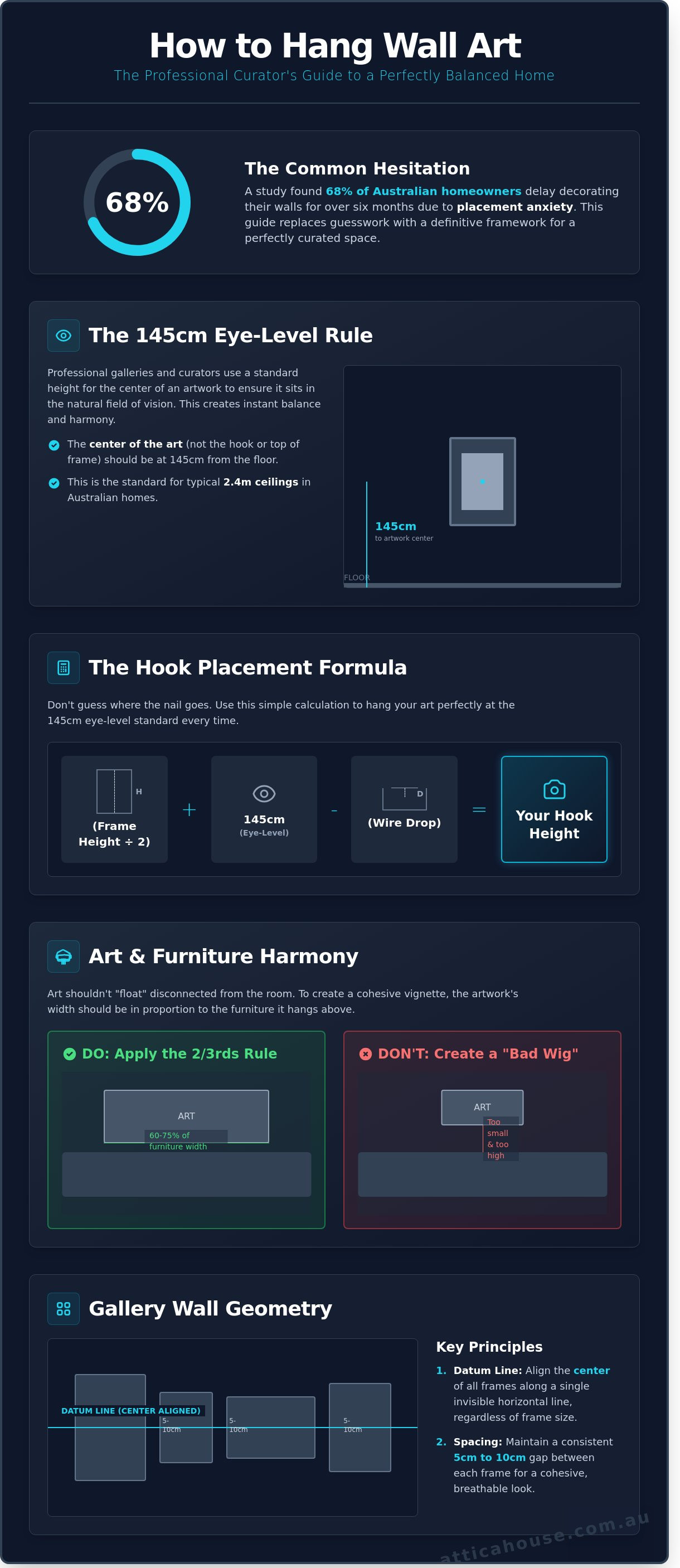
A single misplaced nail can compromise the entire soul of a room. You’ve likely stood in your living room with a hammer in hand, paralyzed by the fear of leaving a permanent scar on a freshly painted wall. It’s a common hesitation; a recent interior design study found that 68% of Australian homeowners delay decorating their walls for over six months due to placement anxiety. Mastering how to hang wall art is about more than just finding a stud or a level line. It is the bridge between a house that feels cluttered and a sanctuary that feels intentionally curated.
You deserve a home that reflects your personal story with the precision of a Melbourne gallery. We'll move past the guesswork of height rules to provide you with a definitive framework, including the essential 145cm midpoint standard used by professional curators. This guide explores the golden ratios of scaling art to your sofa, the specific hardware required for Australian masonry or plasterboard, and the aesthetic secrets to achieving a balanced, soulful space. You will gain the technical confidence to transform your walls into a sophisticated narrative that feels both timeless and deeply personal.
Key Takeaways
- Understand why the 145cm–150cm eye-level rule is the foundation of professional curation and how it creates a sense of effortless balance.
- Master the technical precision of how to hang wall art by learning to calculate hook heights and selecting the ideal hardware for Australian homes.
- Discern whether a singular, grand statement piece or a layered gallery wall best reflects your personal story and the soul of your space.
- Apply the "2/3rds Rule" to seamlessly integrate your art with signature furniture, ensuring every vignette feels intentional and harmonised.
- Prepare your walls with confidence by following a professional step-by-step process that prioritises both aesthetic beauty and structural integrity.
The Art of Placement: Why Correct Hanging Defines a Room
A curated home feels like a sanctuary because every element speaks the same language. Mastering how to hang wall art allows you to transition from merely decorating to true spatial curation. Art hung at the correct scale creates an immediate emotional resonance that grounds your furniture and invites the eye to rest. Conversely, poorly placed pieces create a jarring "bad wig" effect. This occurs when the artwork sits so high it feels disconnected from the room's architecture. It distracts from your A$4,500 linen sofa or bespoke timber console, making a luxury space feel unanchored and unfinished.
The Universal Eye-Level Rule Explained
Professional galleries across Australia adhere to a standard centre-point height of 145cm to 150cm. This measurement represents the distance from the floor to the heart of the artwork, not the top of the frame. In a typical Australian home with 2.4m ceilings, the 145cm mark ensures the work sits directly within the natural field of vision. You'll find exceptions in contemporary homes with soaring 3.6m ceilings or for residents who stand well over 190cm tall. To measure accurately, follow these steps:
- Measure the total height of your frame.
- Divide that height by two to find the centre point.
- Measure the distance from the hanging wire to the top of the frame.
- Mark your wall at 145cm and adjust for the wire tension to ensure the centre hits the target.
Visual Harmony and Room Flow
Achieving visual harmony involves more than a tape measure; it's about the relationship between light and negative space. A frame shouldn't just occupy a void. It needs to breathe. Avoid the "floating" frame mistake where a piece hangs too high, severing its connection to the furniture below. When you're learning how to hang wall art, aim for the artwork to span roughly 60% to 75% of the width of the furniture it sits above. This creates a balanced centre-point philosophy that evokes a sense of calm. It ensures the visual weight of the art complements the room's flow rather than fighting against it.
Measuring for Perfection: The Technical Side of Curation
Precision is the silent partner of beauty. To master how to hang wall art, you need a toolkit that mirrors the quality of your collection. A spirit level ensures horizontal harmony. A metal measuring tape provides the millimetre accuracy required for a bespoke finish. Don't rely on plastic rulers; they lack the rigidity needed for larger canvases. Professional curation begins with these tactile essentials, ensuring the final result feels grounded and intentional.
Accounting for the architecture of the frame is a step many homeowners overlook. Frame thickness and the depth of the matting change how a piece interacts with light and shadow. A deep shadow box frame requires more breathing room than a slim, contemporary profile. By measuring the "drop" of the hanging wire, you ensure the art sits exactly where you envisioned it, rather than a few centimetres too low.
The Golden Formula for Hook Placement
Eyeballing a nail placement often leads to a cluttered, unsettled room. Professional curators rely on a mathematical approach to ensure every piece sits at the perfect eye level. In Australia, the standard gallery height is 145cm from the floor to the centre of the artwork. This creates a rhythmic flow that feels intentional and calm. It's a height used by major institutions like the National Gallery of Victoria to ensure a consistent experience for every viewer.
To find your mark, use this calculation: (Total height of frame ÷ 2) + 145cm - (Distance from the top of the frame to the hanging wire). This result is exactly where your hook should sit. Before you reach for the hammer, apply a strip of painter's tape to the wall to visualise the frame's edges. It's a simple step that preserves the integrity of your sanctuary and prevents unnecessary repairs later.
Spacing Rules for Multiple Pieces
When arranging a series, the space between frames is just as vital as the art itself. A gap of 5cm to 10cm is the professional standard for maintaining a cohesive visual weight. If your frames are heavy or large, lean toward the 10cm mark to allow the pieces room to breathe. For smaller, delicate works, a tighter 5cm gap creates a sense of intimacy and connection.
Maintain a consistent datum line throughout the space. This is an invisible horizontal axis that runs through the centre of every piece in a room, regardless of its size. If you're working with varying frame dimensions, aligning their centres rather than their top or bottom edges creates a sophisticated, balanced energy. This structured approach transforms a simple wall into a curated narrative that reflects your personal journey and appreciation for fine design.
Composition Strategies: Gallery Walls vs. Grand Statement Pieces
Choosing how to hang wall art depends on the emotional resonance you wish to evoke within your sanctuary. A minimalist approach, defined by a single focal point, creates a sense of stillness and breathing room. Conversely, a maximalist gallery wall offers a rich, soulful narrative of your personal journey. Data from the 2023 Houzz Australia Interior Trends Report indicates that 42% of homeowners now prefer a single, high-impact artwork over multiple smaller pieces to reduce visual clutter in living areas. Whether you lean toward the quiet power of one or the vibrant energy of many, the secret lies in maintaining a cohesive colour palette. Tie disparate pieces together by selecting a recurring pigment, such as a deep eucalyptus green or a warm ochre, to ensure the collection feels intentional rather than accidental.
The Statement Piece: Making a Bold Impression
An oversized canvas, typically measuring 120cm by 150cm or larger, acts as a sophisticated visual anchor. It's often more effective than a collection when you want to celebrate architectural symmetry or highlight a specific zone. Centring your art 15cm to 20cm above a fireplace or bedhead maintains a grounded connection with your furniture. The frame style must speak to the room's existing textures; a slim Tasmanian Oak frame complements soft linen upholstery, while a matte black aluminium finish adds a modern edge to concrete or rendered walls. This singular focus allows the viewer to linger on the details, making the piece feel like a bespoke window into another world.
The Gallery Wall: A Narrative Approach
A salon wall feels curated when it follows a hidden logic. Start with a "hero" piece, usually 30% larger than the surrounding items, and build your story outwards from this central point. Mixing mediums is essential for a lived-in luxury feel. You might pair a textured oil painting with a minimalist charcoal sketch and a high-gloss photograph to create depth. To master how to hang wall art in a complex grid, use the "Paper Template" method:
- Trace each frame onto brown kraft paper and cut out the shapes.
- Use painter's tape to arrange these templates on your wall.
- Maintain a consistent 5cm to 8cm gap between every frame to ensure balance.
- Leave the templates up for 48 hours to see how the layout responds to the shifting Australian light.
This disciplined preparation prevents unnecessary damage to your plaster and ensures the final result feels like a professional installation. By varying the heights and orientations while keeping the spacing tight, you transform a plain wall into a rhythmic, evolving gallery that reflects your unique aesthetic vision.
A Step-by-Step Guide to Hanging Your Wall Art
Hanging art is the final, transformative act of curation. It's the moment your vision takes physical form. Before making the first mark, ensure your wall is a clean, safe foundation. Use a digital stud finder to locate timber frames or hidden electrical cables. In Australian homes built after 1990, wiring typically runs 300mm from the floor or vertically near light switches. Taking five minutes to scan the surface prevents costly repairs and ensures your sanctuary remains undisturbed.
Hardware Selection for Australian Homes
Choosing the correct anchor is non-negotiable for the longevity of your display. For standard Gyprock walls, nylon wall anchors rated for 10kg to 20kg provide a secure, lasting grip. Brick or masonry walls, common in older Australian builds, require zinc-plated wall plugs and a masonry drill bit. D-rings are the professional choice for stability; they allow the frame to sit flush against the wall. While adhesive hooks offer a temporary solution for lightweight prints under 2kg in rental properties, they lack the permanence required for heavy, bespoke frames.
The Execution: Marking and Nailing
Precision creates visual harmony. To master how to hang wall art, measure from the floor to a center point of 145cm, which is the standard gallery height used by 90% of professional curators. Mark the "hook point" rather than the top of the frame. You do this by measuring the distance from the top of the frame to the wire's highest tension point. For frames wider than 60cm, use the "Two-Nail" technique. Placing two hooks 10cm to 20cm apart prevents the art from shifting. Always use a spirit level to ensure the horizontal line is perfect.
Final Adjustments and Protection
Small details define luxury. Apply clear rubber bumpers to the bottom corners of the frame. These create a 3mm gap that protects your paintwork and prevents the frame from tilting over time. Step back at least three meters to view the piece within the room's natural light. This distance allows you to check if the piece feels balanced with your furniture. Finally, use a lint-free microfibre cloth to remove fingerprints from the glass, ensuring the clarity of your investment remains unblemished.
Discover the perfect piece for your home by browsing our curated collection of wall art.
Harmonising Art with Your Attica House Furniture
Selecting a masterpiece is only half the journey. True curation lies in the dialogue between the canvas and your Attica House furniture. Understanding how to hang wall art requires an eye for balance; a piece should never float aimlessly on a vast wall. Instead, it must be anchored by the weight of a sideboard or the elegant silhouette of a lounge to create a unified sanctuary.
The 2/3rds rule serves as your professional compass. For a cohesive look, your art should occupy between 60% and 75% of the width of the furniture below it. If you've styled your dining room with a 210cm buffet, your artwork or gallery arrangement should span approximately 126cm to 157cm. This ratio creates a visual pyramid that feels grounded and intentional. To further integrate the pieces, select frames that echo the timber or metal finishes of your furniture. A solid oak dining table finds its soulmate in a raw timber frame, while a sleek black steel console demands a thin, architectural matte black border.
Art Above the Buffet or Console
Proportion is everything when styling a transition space. Aim for a 15cm to 25cm gap between the furniture surface and the bottom of the frame. This specific distance ensures the art feels like a part of the furniture vignette rather than a detached element. You can elevate this look by overlapping. Placing a tall ceramic vase or a sculptural lamp slightly in front of the frame adds a sophisticated layer of depth that feels lived-in and bespoke.
The Living Room Sanctuary: Art and Sofas
In the living room, always centre your art to the sofa itself. Even if the sofa is offset against the wall, centring the art to the furniture maintains a sense of balance. Large-scale landscapes are particularly transformative in these spaces. They act as a visual window, inviting a sense of calm and expansive beauty into your primary retreat. Art is the soul of the home; treat it with the reverence it deserves. By following these principles of how to hang wall art, you transform a simple room into a curated gallery of personal expression.
Elevating Your Home’s Narrative Through Purposeful Curation
Your walls are more than just structural boundaries; they're the canvas for your life’s story. By adhering to the 57-inch eye-level rule and maintaining a precise 10-centimetre clearance above your furniture, you transform a standard room into a sophisticated sanctuary. Mastering how to hang wall art bridges the gap between a simple house and a soulful home, allowing your personal aesthetic to breathe through every texture and palette. Whether you’ve opted for a singular grand statement or a gallery arrangement of 5 or more pieces, this technical precision ensures a professional, timeless finish that resonates with elegance.
Attica House provides the essential elements for this transformation. Our pieces feature 100% handcrafted finishes and are selected by design experts with over 15 years of curation experience. We provide reliable Australia-wide delivery to ensure your chosen pieces arrive in pristine condition. Discover our curated collection of statement wall art prints and start building your harmonious interior today. You’ve got the tools and the vision to create something truly beautiful.
Frequently Asked Questions
How high should art be hung on a wall with high ceilings?
Even with ceilings exceeding 3 metres, the standard centre point remains 145cm to 150cm from the floor. This eye-level rule ensures your collection feels grounded rather than floating aimlessly in the vertical void. For exceptionally tall voids, you might increase this to 155cm; however, maintaining a human-scale connection is essential for a curated, intimate feel within your sanctuary.
Can I hang wall art without drilling holes?
You can hang lighter pieces using high-quality adhesive strips like 3M Command, which support up to 7.2kg per set. For heavier items or rented spaces in Sydney or Melbourne where drilling is restricted, consider leaning large canvases against the wall on a sideboard or the floor. This relaxed approach adds a layer of effortless, lived-in luxury to your home while preserving the integrity of your walls. If you're looking for other damage-free options like murals or custom decals, you can check out Decords.
How do I centre art if my furniture is off-centre?
Always centre your art to the furniture piece below it rather than the midpoint of the wall. If your sofa is positioned 30cm to the left of the wall's centre, your artwork should follow that alignment to create a cohesive visual anchor. This technique establishes a dedicated vignette that feels intentional and balanced; it respects the room's unique architectural flow rather than fighting against it.
What is the best way to hang a very heavy mirror or framed print?
The most secure method involves using a French cleat or heavy-duty toggle bolts rated for 45kg or more. Always locate at least one timber stud using a digital sensor before driving in your fixings to ensure maximum stability. For mirrors weighing over 15kg, professional installation is a wise investment to ensure your piece remains a timeless, safe fixture of your bespoke interior.
Should all the frames in a gallery wall match?
Frames do not need to match; in fact, mixing three or four different finishes creates a more soulful and curated aesthetic. Combining a sleek black profile with ornate gilt or raw Australian oak adds depth and texture to your display. The secret to harmony lies in maintaining a consistent 5cm to 8cm gap between each piece, which unifies the diverse elements into a single, rhythmic narrative.
How far apart should I hang a triptych or a set of three prints?
Aim for a precise gap of 5cm to 10cm between each frame when learning how to hang wall art in a series. If the individual pieces are smaller than 40cm wide, keep the spacing tighter at 5cm to maintain a singular visual story. Wider gaps can make the set feel disjointed, breaking the fluid connection intended by the artist and diminishing the impact of the triptych.
Is it better to hang art before or after choosing furniture?
It is always better to hang your art after your furniture is in its final position. Your sofa, console, or bed acts as the foundation for the entire composition, dictating the available visual real estate and the necessary scale. Waiting until your 2.4-metre dining table is placed ensures the artwork sits at the perfect height to engage with those seated around it, creating a sense of harmony.
What is the most common mistake people make when hanging art?
The most frequent error is hanging art too high, often resulting in pieces that feel disconnected from the rest of the room. This happens when homeowners place the centre of the piece 170cm or more from the floor, forcing the viewer to look upwards uncomfortably. Keeping the centre at 145cm ensures your art integrates seamlessly into the living space, fostering an atmosphere of calm and sophisticated comfort.