


The Definitive Guide to Hand-Knotted Rugs: Artistry, Investment, and Curation
What if the most enduring investment in your home isn't the stone benchtops or the custom joinery, but a textile that took a family of artisans over 1,400 hours to weave? You've likely felt the pull toward pieces that carry a sense of history, yet the technical world of hand-knotted rugs can feel intentionally opaque. It's common to feel a flicker of hesitation when faced with terms like warp, weft, or a KPSI of 150. You want a home that feels curated and soulful, not a space filled with mass-produced imitations that lose their lustre within two years.
We agree that true luxury should be felt, not just seen. This guide strips away the complexity to help you confidently identify high-quality pieces that act as a true anchor for your sanctuary. You'll learn how to evaluate the long-term value of these heirloom investments, where a A$6,000 piece can appreciate over eighty years, and how to seamlessly integrate their rich textures into a modern Australian aesthetic. We're providing the roadmap to a more intentional, beautifully composed home.
Key Takeaways
- Discover the emotional resonance of "slow design" and how a single, hand-crafted piece can transform your home into a soulful sanctuary.
- Master the expert techniques for verifying authenticity, including the critical underside and fringe inspections that distinguish genuine hand-knotted rugs from mass-produced imitations.
- Learn how to artfully anchor open-plan Australian living spaces by selecting textures and palettes that harmonise with our unique natural light.
- Explore the enduring investment value of premium natural fibres, understanding how meticulous craftsmanship creates a timeless heirloom for the modern home.
The Soul of the Home: Understanding the Allure of Hand-Knotted Rugs
A home is more than a collection of furniture; it is a sanctuary where our personal stories unfold. At the heart of this sanctuary often lies a piece that transcends mere decoration. Hand-knotted rugs represent a pinnacle of textile artistry, where every single thread is tied individually by a master weaver. This isn't a product of a factory line. It's a labor of patience, often taking months or even years to complete a single piece. This commitment to "slow design" creates an emotional resonance that mass-produced items simply cannot replicate.
The beauty of these rugs lies in their organic imperfection. While machine-made pieces offer a sterile uniformity, a hand-knotted piece features subtle variations in color and texture. These nuances, known as abrash, reflect the natural dyes and the weaver's unique touch. To understand the depth of this craft, one only needs to look at the history of carpet making, a tradition that has survived for millennia. These rugs are living heritage. They are tactile records of culture and time, designed to be walked upon by generations of your family.
Hand-Knotted vs. Hand-Tufted: The Crucial Distinction
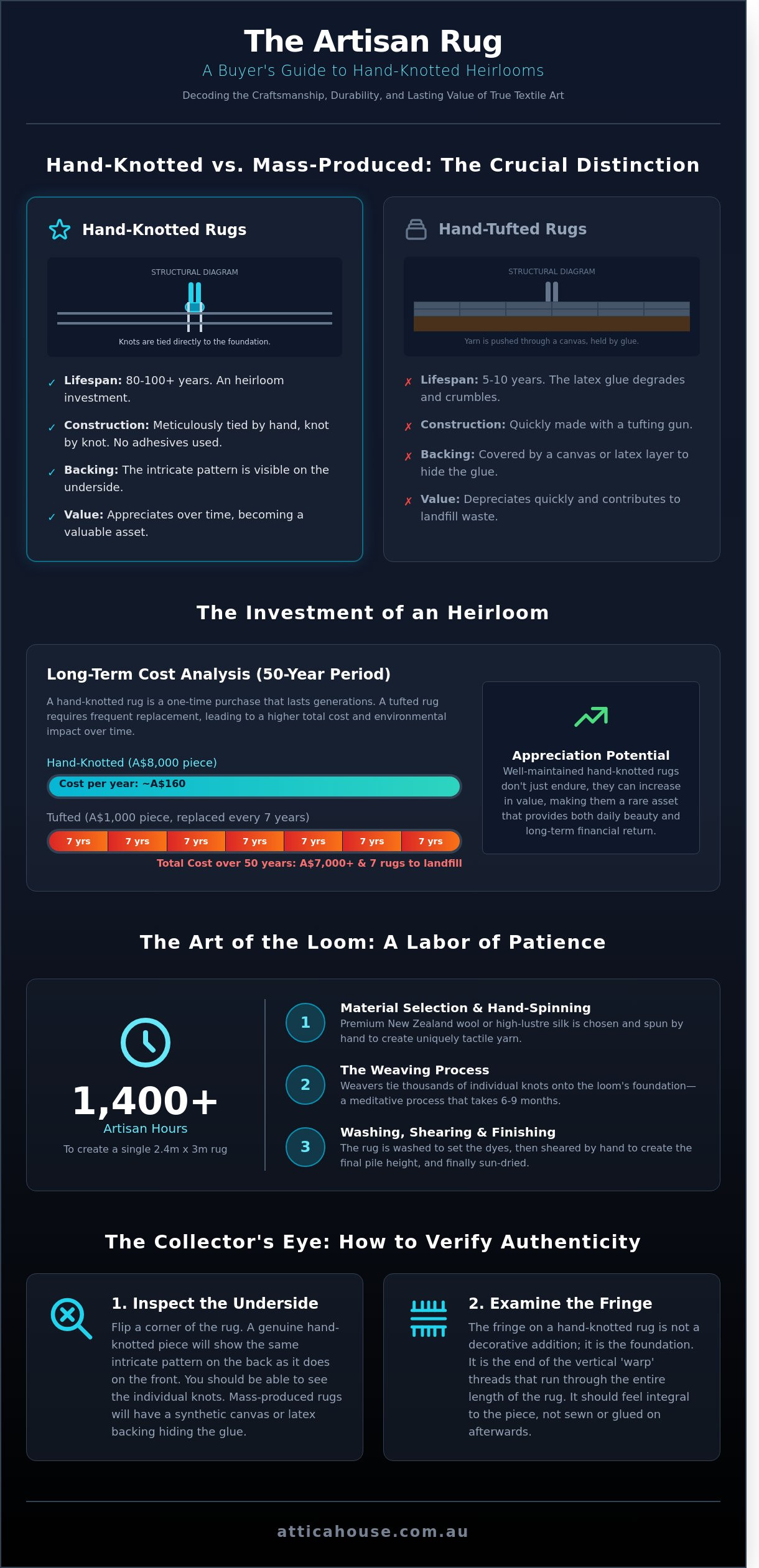
The difference between these two methods is structural and profound. A hand-tufted rug is made by pushing yarn through a pre-woven canvas using a tufting gun, then securing it with a latex backing. It's a faster process, but it limits the rug's life to roughly 5 to 10 years as the glue eventually degrades. In contrast, hand-knotted rugs are physically tied to the warp threads. There's no glue, no backing, and nothing to crumble. This structural integrity allows them to last 100 years or more, often becoming more beautiful as they age.
The Investment Value of an Heirloom Piece
Choosing a hand-knotted rug is a conscious shift toward sustainable luxury. While an initial outlay might reach A$8,000 for a high-quality piece, the "cost-per-year" over a 50-year lifespan is only A$160. A cheaper A$1,000 tufted rug that requires replacement every 7 years will eventually cost more and contribute to the millions of tonnes of furniture waste generated globally each year. Well-maintained knotted rugs don't just endure; they often appreciate. A 19th-century Persian rug in good condition can fetch tens of thousands of dollars at Australian auction houses, making it a rare asset that provides both daily comfort and long-term financial value.
- Durability: Capable of withstanding high foot traffic for decades without losing structural integrity.
- Authenticity: No two pieces are identical, ensuring your home remains a unique reflection of your style.
- Sustainability: Natural fibers like wool and silk are biodegradable and renewable, unlike the synthetic backings in tufted alternatives.
The Art of the Loom: How Hand-Knotted Rugs are Created
The journey of hand-knotted rugs begins long before the first thread meets the loom. It starts with the rigorous selection of premium New Zealand wool or high-lustre silk, materials chosen for their resilience and their ability to hold deep, soulful pigments. Artisans often spend weeks preparing these fibres, spinning them by hand to create a texture that is uniquely tactile. For a sense of the historical scale these materials can achieve, one only needs to look at The Ardabil Carpet, which features roughly 5,184 knots per square decimetre, a testament to the enduring strength of silk and wool when handled with such precision.
Once the materials are ready, the stage is set on a massive vertical loom. The warp threads, which run vertically, are pulled to a precise tension. This tension is critical; if it is too loose, the rug will lose its shape over time; if it is too tight, the fibres may snap. The weaver then begins the rhythmic process of tying individual knots around these warp threads. It is a slow, meditative labour. A standard 2.4m by 3m rug can require over 1,000 hours of focused work, often spanning six to nine months of craftsmanship. This explains why high-quality pieces in Australia are viewed as legacy investments, with prices often starting from A$3,500 to reflect the artisan's dedication.
Finishing is just as vital as the weaving itself. After the rug is removed from the loom, it undergoes a series of traditional treatments to wake up the fibres. It is washed in clear water to remove excess dye and then sheared by hand with specialized blades. This shearing determines the final pile height, a task that requires a steady hand to ensure a level surface. Finally, the rug is laid out under the sun to dry. This natural UV exposure sets the colours and gives the wool a soft, lived-in glow that synthetic processes cannot replicate. You can explore our curated collection to see how these traditional finishes translate into a modern sanctuary.
The Anatomy of a Knot: Persian vs. Turkish Techniques
The character of a rug is often defined by the knot used. The Senneh, or Persian knot, is asymmetrical. It allows the weaver to pack knots more closely together, creating the fluid, curvilinear patterns found in intricate floral designs. In contrast, the Ghiordes, or Turkish knot, is symmetrical. This technique wraps the yarn around two warp threads, creating a heavy-duty structure that is incredibly durable. While the Senneh knot offers a refined, velvet-like hand-feel, the Ghiordes knot provides a sturdy, tactile presence underfoot that excels in high-traffic Australian living rooms.
Natural Dyes and the Beauty of Abrash
Authentic luxury is found in the shift back to organic pigments. Master dyers use madder root for deep reds, indigo for moody blues, and walnut shells for earthy browns. Because these natural batches vary slightly, a phenomenon known as "Abrash" occurs. This refers to the subtle, horizontal colour fluctuations seen across the rug's surface. These aren't defects; they're the signature of a hand-dyed process. In a world of mass-produced uniformity, these shifts in tone provide a soulful depth, ensuring that no two pieces are ever identical. It takes roughly 10 to 15 years for these natural dyes to develop their full, soft patina, a grace that only improves with age.
The Collector’s Eye: How to Evaluate Quality and Authenticity
Discerning the true value of a textile requires more than a passing glance; it demands an intimacy with the craft. When you flip over a piece, the story reveals itself. Authentic hand-knotted rugs display a mirror image of the top pattern on their underside. Each individual knot should be visible, slightly irregular, and distinct. If you see a thick canvas backing or a uniform, plastic-like mesh, you're likely looking at a tufted or machine-made alternative that lacks the soul of a true heirloom. A clear, vibrant pattern on the back confirms that the yarn is tied through the foundation, ensuring the design remains a permanent part of the structure.
The fringe offers another definitive clue. In a genuine piece, the fringe isn't a decorative trim sewn onto the edges after production. It's the actual extension of the warp threads, the very foundation of the rug. If you notice a seam where the fringe meets the pile, the integrity of the construction is compromised. Beyond the visual, trust your sense of touch. A high-quality rug feels supple and heavy. It should drape gracefully over your hand like a heavy fabric rather than resisting with the stiffness of industrial adhesives. This suppleness is a hallmark of luxury, allowing the rug to settle into your space with a natural, lived-in elegance.
Material selection defines the sensory experience of your sanctuary. New Zealand wool remains a gold standard in Australian homes for its high lanolin content, which provides a natural stain resistance and a soft, resilient handle. For those seeking a luminous glow, pure silk offers a refined shimmer that captures the light of a Sydney afternoon beautifully. Bamboo silk provides a similar aesthetic at a more accessible price point, though it lacks the generational durability of its organic counterpart. Choosing the right material ensures your palette remains vibrant for decades while providing the tactile comfort your home deserves.
Understanding Knot Density (KPSI)
Knot density, measured in Knots Per Square Inch (KPSI), serves as a metric for detail and labour. A standard decorative piece might feature 60 to 100 KPSI, while a fine investment piece can exceed 400 KPSI. High density isn't always the goal; a rustic tribal rug with a lower KPSI can be just as soulful as a dense urban weave. To calculate this yourself, use a ruler to count the knots along one inch of the warp and one inch of the weft, then multiply the two numbers. This simple check confirms if the A$5,000 price tag aligns with the actual hours of craftsmanship involved in the creation.
Spotting Machine-Made Imitations
Machine-made rugs often fall into the "perfect" trap. Their symmetry is too clinical, lacking the charming "abrash" or subtle colour variations found in hand-dyed yarns. Look closely at the edges, known as the overcasting. Authentic hand-knotted rugs feature edges wrapped by hand with a needle and thread, creating a slightly uneven, organic finish. You might also spot "white knots," which are small bits of the cotton foundation peeking through the pile. These aren't defects; they're the fingerprints of the weaver, proving the piece was built knot by knot on a traditional loom rather than processed by a 2024 industrial power loom.
Modern Curation: Styling Hand-Knotted Rugs in Australian Interiors
A home's floor serves as its fifth wall, providing the foundation for every other design choice. In the expansive, sun-drenched architecture typical of contemporary Australian dwellings, hand-knotted rugs act as the essential anchor. They define the boundaries of a living space within open-plan layouts, creating islands of intimacy without the need for physical partitions. When you place a bespoke hand-knotted piece in a large room, you're not just adding decor; you're establishing a soulful destination that invites conversation and rest.
The Australian sun is famously uncompromising, yet it's the best tool for revealing the artistry of a hand-knotted pile. These rugs possess a natural "nap," meaning the fibers lean in a specific direction during the weaving process. As the light shifts from the sharp clarity of midday to the golden hues of a Perth or Brisbane sunset, the rug's colors transform. A deep indigo might soften into a misty blue, while a terracotta shade can suddenly glow with warmth. This kinetic quality brings a sense of movement to a room that static, machine-made alternatives cannot replicate.
Texture builds the depth required for a sophisticated, lived-in feel. To achieve this, consider layering techniques. Placing a smaller, intricately patterned knot over a larger, neutral flat-weave jute rug adds immediate visual interest. Size is equally vital to the final composition. A common styling error is selecting a rug that's too small for the furniture it supports. For a genuine sense of grand sanctuary, aim for an oversized piece. In a standard 5x6 meter living area, a 3x4 meter rug creates a far more cohesive environment than a 2x3 meter option, ensuring all furniture legs sit comfortably on the wool to ground the entire arrangement.
Complementing Modern Australian Architecture
Modern Australian homes often celebrate raw materials like polished concrete, burnished steel, or reclaimed Tasmanian Oak. A tribal hand-knotted rug provides the perfect organic counterpoint to these hard, minimalist surfaces. If your space leans toward a high-ceilinged industrial aesthetic, a neutral, high-texture knot softens the acoustics while adding much-needed warmth. While you're refining your space, styling a buffet table with curated ceramics or sculptural lighting can further bridge the gap between your rug choice and your timber furniture.
Choosing the Right Rug for Each Room
Each room demands a different functional profile to maintain both beauty and longevity. For the dining room, a low-pile wool knot is the most practical choice. It allows chairs to glide effortlessly and handles the occasional spill with the natural resilience of lanolin-rich fibers. In the living room, prioritize plush textures and statement patterns that act as a central focal point for the home. The bedroom, however, is your ultimate retreat. Choosing a silk-blend rug for this space ensures a soft, luxurious sensation underfoot at 6:00 AM, reinforcing a daily ritual of comfort and calm.
Discover how a curated foundation can transform your living space into a personal sanctuary by exploring our latest collection. View the Attica House rug collection today.
The Attica House Promise: Curating Timeless Craftsmanship
At Attica House, we believe your floor is the foundation of your home's narrative. Our philosophy centres on a harmonious blend of ancient global heritage and the specific, golden light of the Australian landscape. We don't just sell decor; we curate pieces that invite a sense of calm and sanctuary into your daily life. Every rug in our selection is hand-picked for its soulful character. We look for pieces that carry the weight of history and the breath of the artisan, ensuring your home feels grounded and intentional.
Transparency remains a cornerstone of our practice. We maintain direct relationships with weaving communities that have practiced these techniques for centuries. By supporting these artisans, we help preserve a craft that is increasingly rare in a world of mass production. This commitment ensures that every one of our hand-knotted rugs is ethically sourced and reflects a genuine human touch. We've seen how a single, well-chosen piece can transform a room from a functional space into a personal sanctuary, echoing the unique journey of the person who lives there. It's about finding that rare balance where luxury feels both attainable and deeply personal.
Your home should be a reflection of your personal story, not a showroom for temporary fads. We approach the selection process as a partnership, helping you find textures and palettes that resonate with your lifestyle. Whether you're styling a coastal retreat in Byron Bay or a contemporary terrace in Paddington, our goal is to provide a piece that feels like it has always belonged there. We prioritize the emotional resonance of a space, focusing on how a texture feels underfoot on a quiet morning or how a pattern holds the room together during a lively dinner.
Why Our Hand-Knotted Collection is Different
Our focus remains strictly on "Modern Classics." These are designs that ignore the noise of fleeting trends to offer something enduring. The Attica House aesthetic is sophisticated, evocative, and intentionally warm, designed to complement the open-plan living and natural materials favoured in Australian architecture. When you invest in our hand-knotted rugs, you're choosing a textile designed to age gracefully over fifty years or more. We provide direct access to expert guidance for your specific interior project, helping you navigate the nuances of wool grades and knot densities to suit your specific foot-traffic requirements.
Your Next Steps to a Soulful Home
Finding the perfect piece shouldn't feel like a transaction; it should feel like a discovery. You can explore our full range through our digital gallery or experience the textures in person by visiting our partner showroom in Melbourne. We understand that choosing a legacy piece requires confidence. To assist your decision, our team offers high-resolution additional photos or personalized video consultations to show how a rug reacts to different lighting conditions. This ensures the piece you receive is exactly what your space requires. We're here to help you compose a home that feels as good as it looks.
Ready to transform your interior? Explore the Attica House Hand-Knotted Rug Collection today and find the foundation for your home's next chapter.
Invite Timeless Artistry Into Your Home
A hand-knotted rug isn't just a floor covering; it's a heritage investment designed to endure for over 80 years. These pieces anchor a room's palette while providing a soulful foundation that transforms any space into a sanctuary of calm. By focusing on authentic materials and traditional weaving techniques, you're choosing a textile that reflects a commitment to quality and a deeply personal design story.
Our collection at Attica House represents a meticulous selection process led by the Elegant Curator, focusing on pieces that blend global artistry with the unique light of the Australian landscape. We provide Australia-wide delivery for all luxury items, ensuring your piece arrives with the care it deserves. If you'd like to experience the intricate texture of our hand-knotted rugs first-hand, our partner showroom in Sydney offers a tactile, immersive experience. Every piece we offer is an invitation to embrace the art of living well.
Discover the Curated Hand-Knotted Rug Collection at Attica House
Frequently Asked Questions
How long does it take to make a hand-knotted rug?
A standard 2.4m x 3m hand-knotted rug typically requires 6 to 10 months of meticulous labour to complete. Each artisan ties roughly 10,000 knots per day; a high-density piece can contain over 1 million knots in total. This slow, rhythmic process ensures every thread is secured with intention. It's this dedication to the craft that creates a piece capable of lasting for 50 years or more.
Are hand-knotted rugs difficult to clean and maintain?
Hand-knotted rugs aren't difficult to maintain and are often more resilient than machine-made options. Weekly vacuuming with a flat head attachment removes 90% of surface dust without pulling at the delicate fibres. For spills, blotting with a clean cloth usually suffices because the natural lanolin in high-quality wool acts as a protective barrier. Professional cleaning is recommended only once every 3 to 5 years to preserve the rug's structural integrity.
Why are hand-knotted rugs more expensive than hand-tufted ones?
The price difference reflects the 1,500 hours of manual labour required for a hand-knotted rug compared to the 20 hours needed for a tufted version. While a hand-tufted rug uses glue and a canvas backing that degrades within 7 years, hand-knotted rugs rely on structural knots that stay secure for generations. In the Australian market, you'll find quality pieces starting around A$3,500, reflecting their status as a lifetime investment rather than a disposable item.
Can hand-knotted rugs handle high-traffic areas like hallways?
Hand-knotted rugs are the superior choice for high-traffic zones like hallways because of their dense, individual knot construction. Each knot is tied to the foundation, meaning the pile won't pull out even under the weight of 50 footsteps a day. Unlike tufted rugs that lose their shape, these pieces maintain their pile height and vibrancy for decades. They're built to withstand the beautiful chaos of a lived-in Australian home.
Do hand-knotted rugs shed over time?
You'll notice minor shedding for the first 3 to 6 months as loose fibres from the shearing process rise to the surface. This isn't a defect but a natural characteristic of premium wool. Regular vacuuming on a low setting during this initial period manages the transition perfectly. After this short window, the shedding decreases by 95%, leaving you with a stable, soft surface that feels like a sanctuary underfoot for years to come.
How can I tell if a rug is truly hand-knotted and not a machine imitation?
You can identify a genuine hand-knotted rug by flipping it over to see if the pattern is mirrored on the underside. You'll see slight irregularities in the knot sizes, which are the fingerprints of the artisan. Crucially, the fringe is an extension of the rug's internal warp threads rather than being sewn on afterwards. Machine-made imitations often have a uniform, plastic-like backing or a fringe that's clearly attached with a visible seam.
Will a hand-knotted rug increase in value over the years?
High-quality hand-knotted rugs frequently appreciate in value by 2% to 5% annually if they're well-maintained. As traditional weaving communities dwindle, these pieces become rare collectibles rather than just floor coverings. A rug purchased for A$5,000 today can often fetch a higher price at specialised auctions 20 years from now. They're soulful heirlooms that tell a story, gaining character and worth as they age gracefully within your curated space.
What is the best material for a hand-knotted rug in an Australian climate?
100% New Zealand wool is the gold standard for the Australian climate because it's naturally breathable and regulates temperature. It stays cool during 40-degree Sydney summers and provides warmth during Melbourne's crisp winters. Wool's organic structure also resists the UV damage common in sun-drenched Australian living rooms. If you're seeking a hint of lustre, a blend with 20% bamboo silk adds a sophisticated sheen without sacrificing the rug's legendary durability.